Introduction
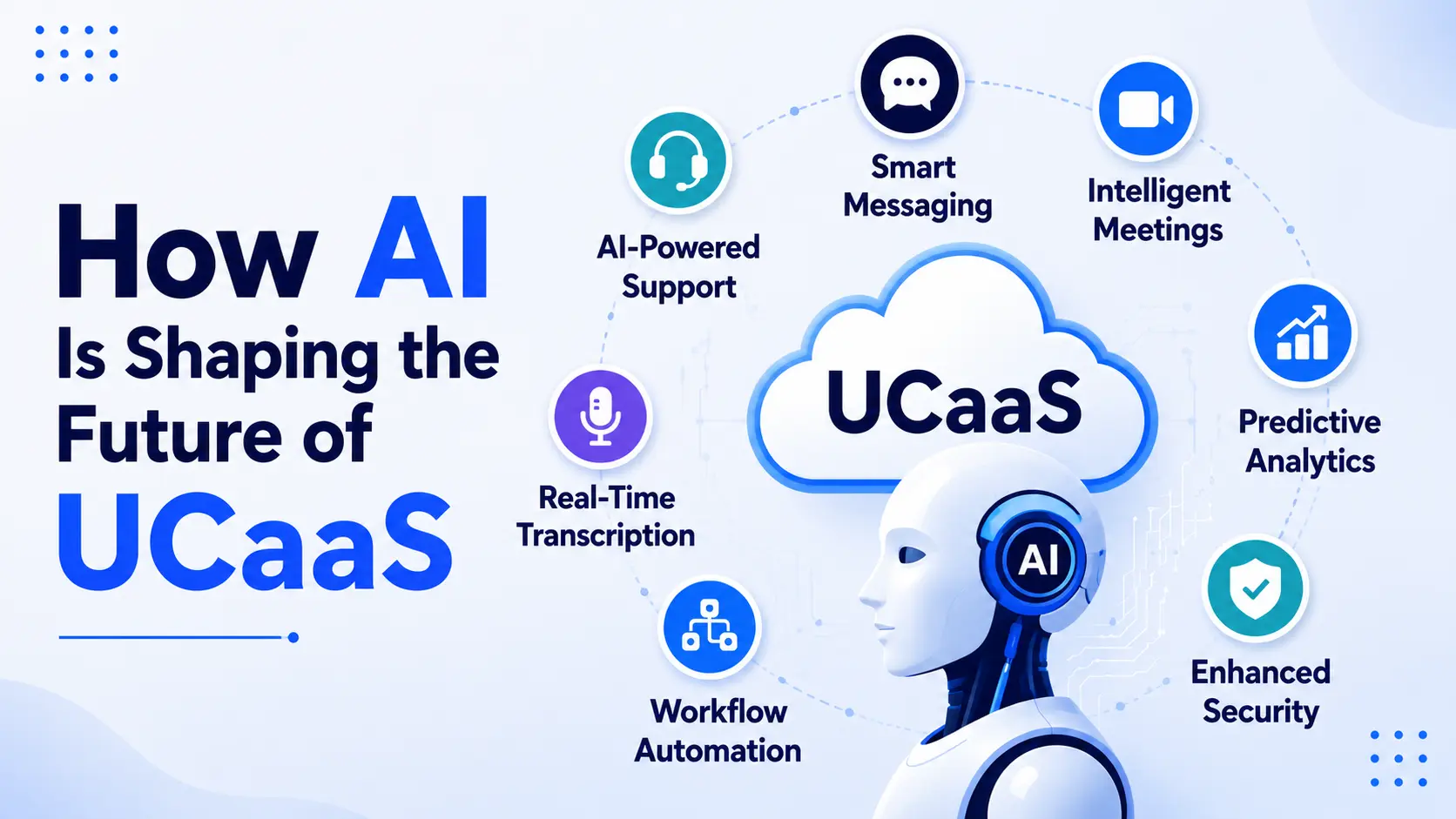
UCaaS already replaced the old phone system with one cloud platform for calls, video, and messaging. Now AI is layering on top of that platform, quietly turning it from a place where conversations happen into a system that also understands, summarizes, and acts on them.
This guide looks at exactly how AI in UCaaS is changing day-to-day business communication, from meeting summaries to smarter call routing. You will finish with a clear picture of where the future of UCaaS is heading and what to look for in a platform built for it.
Key Takeaways
- AI in UCaaS adds transcription, meeting summaries, and sentiment analysis on top of calls, video, and messaging.
- Intent-based call routing lets a system direct callers to the right person automatically, without a rigid menu.
- Virtual agents and automation are handling routine scheduling and FAQ requests without human involvement.
- Businesses choosing a UCaaS provider should check how deeply AI is built into the platform, not bolted on as an extra.
What Does AI in UCaaS Actually Mean?
AI in UCaaS means artificial intelligence features built directly into a business's unified communications platform, working alongside voice calls, video meetings, and team messaging rather than as a separate tool.
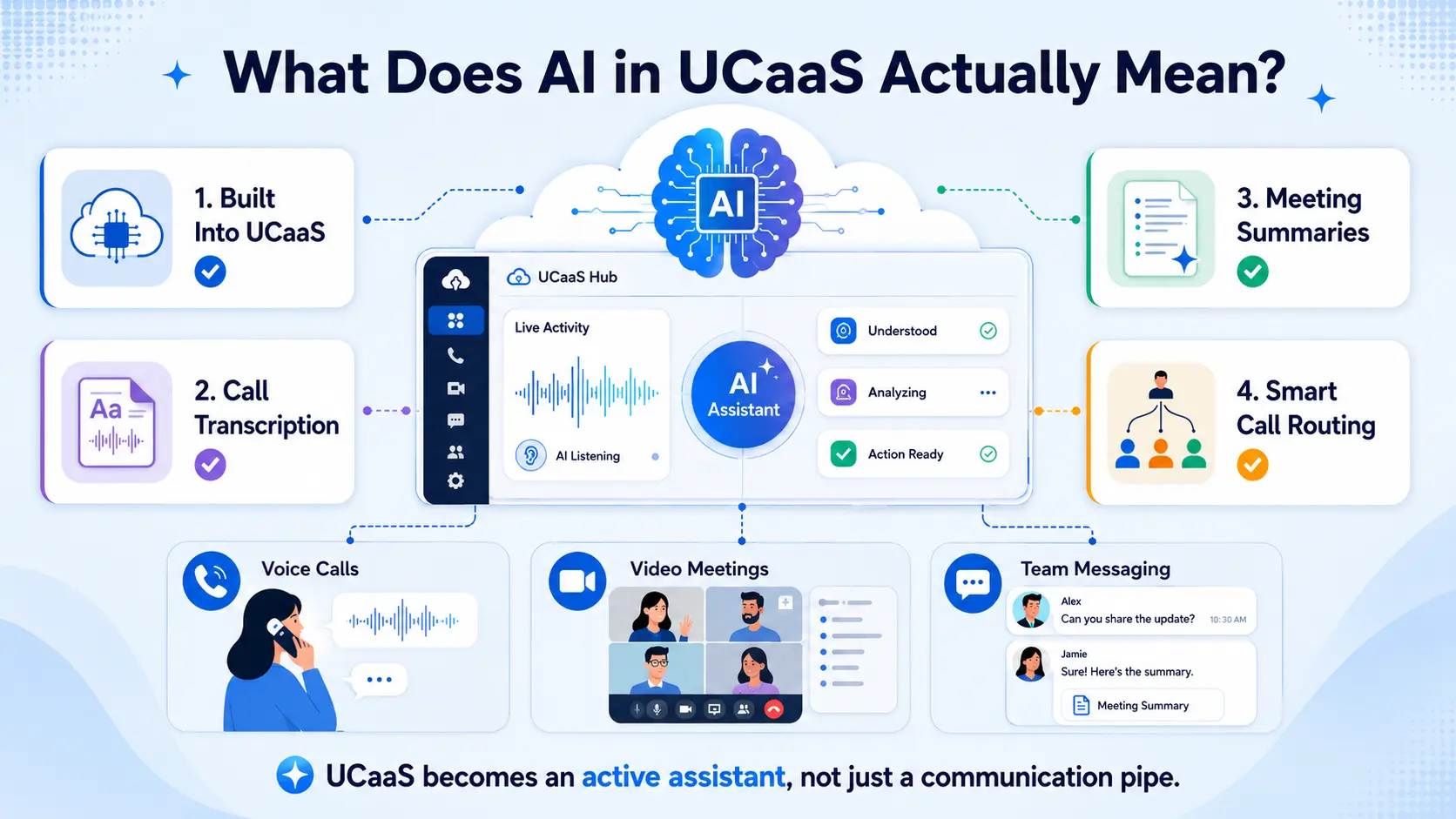
Instead of just carrying a conversation, an AI-enabled UCaaS platform can also listen to it, understand what was said, and take useful action afterward.
That might mean transcribing a call automatically, summarizing a meeting into key points, or routing an inbound call to the right department based on what the caller actually says rather than which button they press.
The shift is significant because it moves UCaaS from a passive communication pipe to an active assistant sitting inside every call and meeting a business has.
Key Ways AI Is Transforming UCaaS
A handful of AI capabilities are showing up across most modern UCaaS platforms, each changing a different part of daily communication.
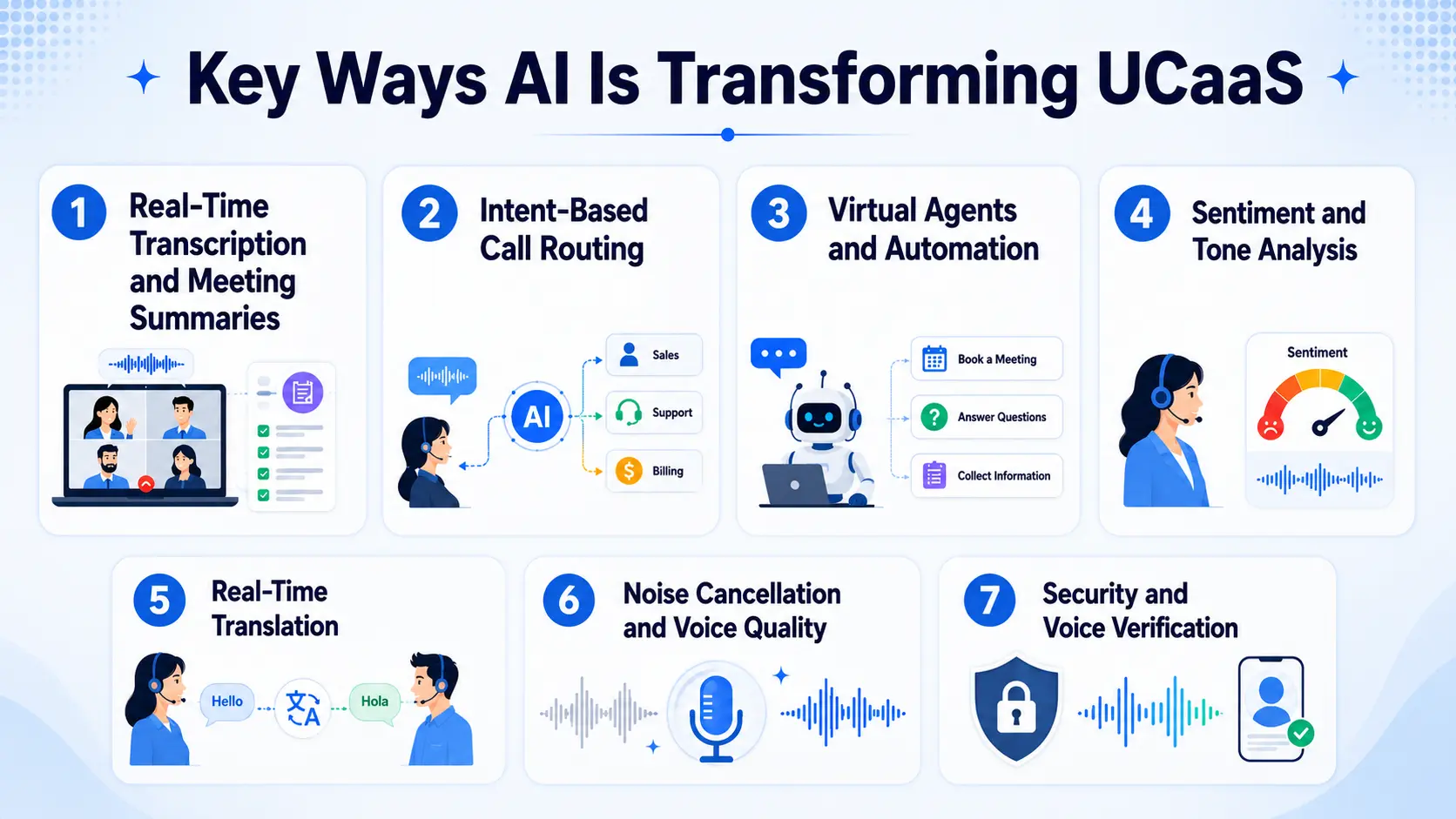
Real-Time Transcription and Meeting Summaries
AI now listens to calls and meetings as they happen, converting speech to searchable text in real time. Once a meeting ends, the same system can generate a summary covering key points, decisions made, and action items assigned, so nobody has to take notes manually or replay a recording to remember what was agreed.
Intent-Based Call Routing
Traditional call routing relies on a caller pressing a number on a fixed menu. AI-based routing instead analyzes what a caller says and directs them straight to the right person or department, cutting out the frustrating menu navigation entirely and reducing how often a call gets transferred multiple times before reaching the right person.
Virtual Agents and Automation
AI-powered virtual agents now handle routine requests inside a UCaaS platform, such as booking a meeting, answering a common question, or collecting details before a human joins the conversation. This frees employees to spend time on conversations that actually need a person's judgment.
Sentiment and Tone Analysis
Some platforms now analyze tone and sentiment during a live call, flagging when a customer sounds frustrated so a manager or agent can step in before a situation escalates. This turns a subjective read on how a call is going into something a team can actually measure and act on.
Real-Time Translation
AI translation built into a UCaaS platform lets team members and customers who speak different languages communicate directly, with speech converted and translated close to real time rather than requiring a separate interpreter or translation tool.
Noise Cancellation and Voice Quality
AI-driven audio processing now strips out background noise, echo, and cross-talk from calls in real time, so a conversation from a busy home office or an open-plan floor sounds as clear as one from a quiet room.
This matters more as hybrid and remote work make inconsistent call environments the norm rather than the exception, and it removes one of the more common complaints teams have about cloud calling quality.
Security and Voice Verification
AI is also strengthening the security side of UCaaS.
Voice biometrics and anomaly detection can confirm a caller's identity without a separate password step and flag unusual call patterns that might indicate fraud or account compromise.
For businesses handling sensitive customer conversations, this adds a layer of protection that traditional phone systems never had.
Why This Matters for Businesses
These AI capabilities are not just convenient extras; they change what a business can realistically expect from its communication system. Productivity improves because employees spend less time on note-taking, manual call routing, and repetitive administrative tasks that AI now handles automatically.
Customer experience improves too, since intent-based routing and sentiment detection mean callers reach the right person faster and get help before a bad experience compounds, which is a big part of what genuine multichannel engagement depends on. Costs come down as virtual agents absorb routine requests that would otherwise need a human to handle every single one.
Decision-making gets sharper as well, since transcripts, summaries, and sentiment data give managers visibility into conversations that used to disappear the moment a call ended. Taken together, these gains compound over a quarter rather than a single call, which is why teams that adopt AI-enabled UCaaS early tend to keep widening the gap on response times and customer satisfaction scores.
A Practical Example
Picture a small service business that used to miss after-hours calls entirely and relied on a receptionist to manually jot down notes from every meeting.
With AI built into its UCaaS platform, an inbound call after hours is understood, routed to a virtual agent that books an appointment directly into the calendar, and a follow-up summary lands in the team's inbox automatically. A client meeting later that day is transcribed and summarized without anyone taking notes, with action items assigned to the right person before the call even ends.
None of this required new hardware or a bigger team, only a platform where AI was already built in.
Where AI in UCaaS Is Headed Next
The direction is clear even if the exact features keep evolving: AI is moving from a helpful add-on to a core part of how a UCaaS platform operates.
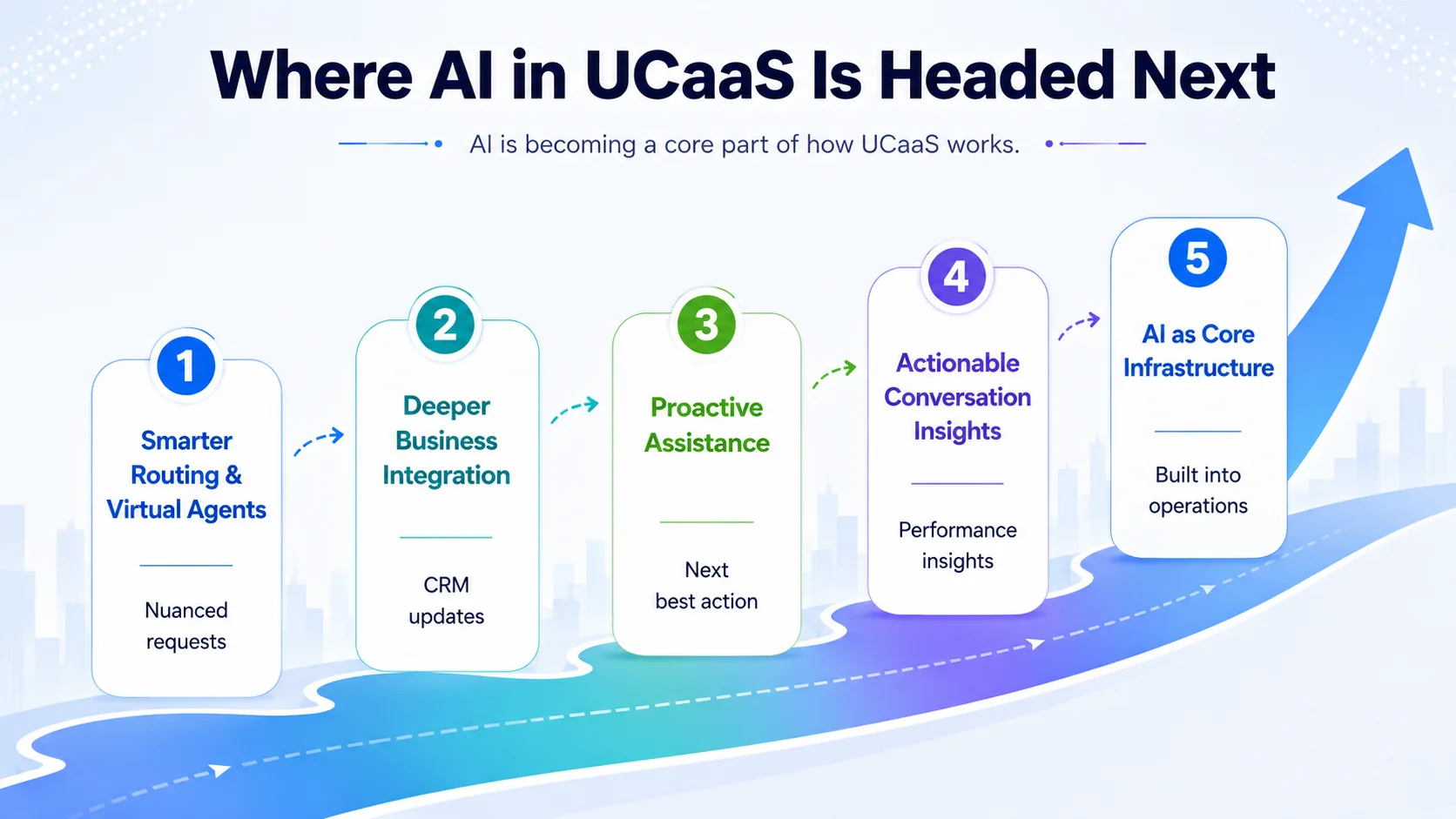
Expect routing and virtual agents to keep getting better at handling nuanced requests, not just simple, scripted ones.
Expect deeper integration between communication data and other business systems, so a summarized call automatically updates a CRM record without anyone copying notes over manually. Expect proactive assistance to grow too, with systems that flag a missed follow-up or suggest the next best action based on a past conversation, rather than waiting to be asked.
The businesses that benefit most will be the ones that treat these features as core infrastructure rather than experiments to try later.
What to Look for in an AI-Ready UCaaS Provider
Not every provider that mentions AI has built it deeply into the platform, so it is worth checking a few things before choosing one. Look for transcription and summarization that work automatically across calls and meetings, not as a separate paid add-on bolted onto the core plan.
Check whether call routing genuinely understands caller intent, rather than just offering a slightly nicer version of a fixed menu. Ask how virtual agents integrate with your calendar, CRM, and other tools, since a disconnected assistant creates as much extra work as it saves.
Finally, confirm how the provider handles data privacy for transcripts and recordings, since AI features only add value if they are handled securely. A short pilot on a real queue, rather than a scripted demo, is usually the fastest way to tell which of these a provider has actually built versus bolted on.
Getting Started with TKOS
TKOS is building AI-powered features directly into its cloud calling and UCaaS platform, so businesses get smarter call handling without juggling a separate add-on tool. Getting started takes just a few steps.
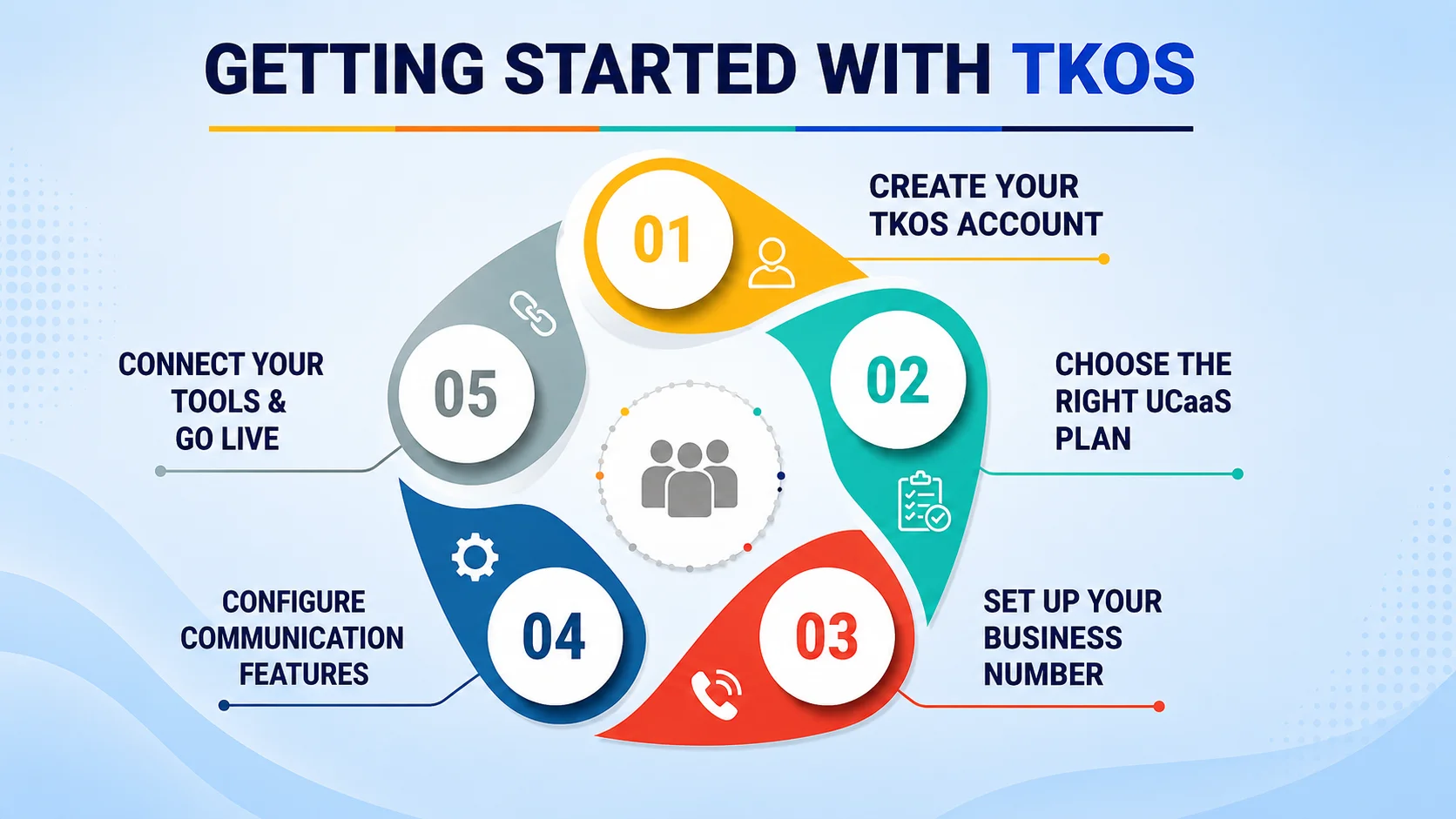
- Create your TKOS account: visit tkos.co.za and start a free trial using your work email.
- Choose the right plan by checking which essential UCaaS features your team size, calling needs, messaging, and meetings actually require.
- Set up your business number: choose a new virtual number or connect your existing business number.
- Configure communication features: call routing, voicemail, team messaging, video meetings, transcription, and AI summaries.
- Connect your tools and go live: link your CRM or calendar, add team members, and start managing calls, messages, and meetings from one platform.
See also: WhatsApp UCaaS integration.
The 323 area code also carries cultural weight that few US area codes can match. Hollywood productions, music releases, and brand campaigns regularly reference LA area codes as shorthand for authenticity and relevance. Having a 323 number on your marketing materials, website, and business cards signals fluency with the LA market that out-of-state numbers simply cannot replicate.
For businesses that already use a 310 number and want to expand capacity, adding 424 lines on the same VoIP account is seamless. Both numbers ring through the same call routing rules, share the same voicemail and recording infrastructure, and appear in the same analytics dashboard. Clients calling either number reach the same team — the only difference is the DID printed on the marketing material that prompted the call.
Conclusion
AI in UCaaS is turning a system built to carry conversations into one that also understands and acts on them, from transcribing meetings to routing calls based on intent rather than a fixed menu. That shift is already improving productivity, customer experience, and decision-making for businesses that have adopted it.
The future of UCaaS will keep pushing these capabilities deeper into daily communication rather than treating them as optional extras. Businesses that choose a platform built around AI from the ground up, rather than one with a feature bolted on as an afterthought, will be the ones that benefit first.