Introduction
Customers no longer pick one channel and stick with it. They call, then text, then message on WhatsApp, then email a follow-up, and they expect a business to remember all of it regardless of which one they used last.
Multichannel engagement and UCaaS adoption are rising together for exactly this reason: businesses cannot deliver a consistent experience across channels that were never designed to talk to each other.
This guide covers what multichannel engagement actually means once it runs through a UCaaS platform, what is driving adoption right now, and what still holds some businesses back from making the switch. You will also get the measurable payoff, real adoption data, and a realistic five-step path to rolling it out.
Framing this as multichannel engagement and UCaaS adoption together also matters, since one rarely succeeds without the other. By the end, you will know whether this is a shift worth prioritizing for your own team this year.
What Multichannel Engagement Means in a UCaaS Context
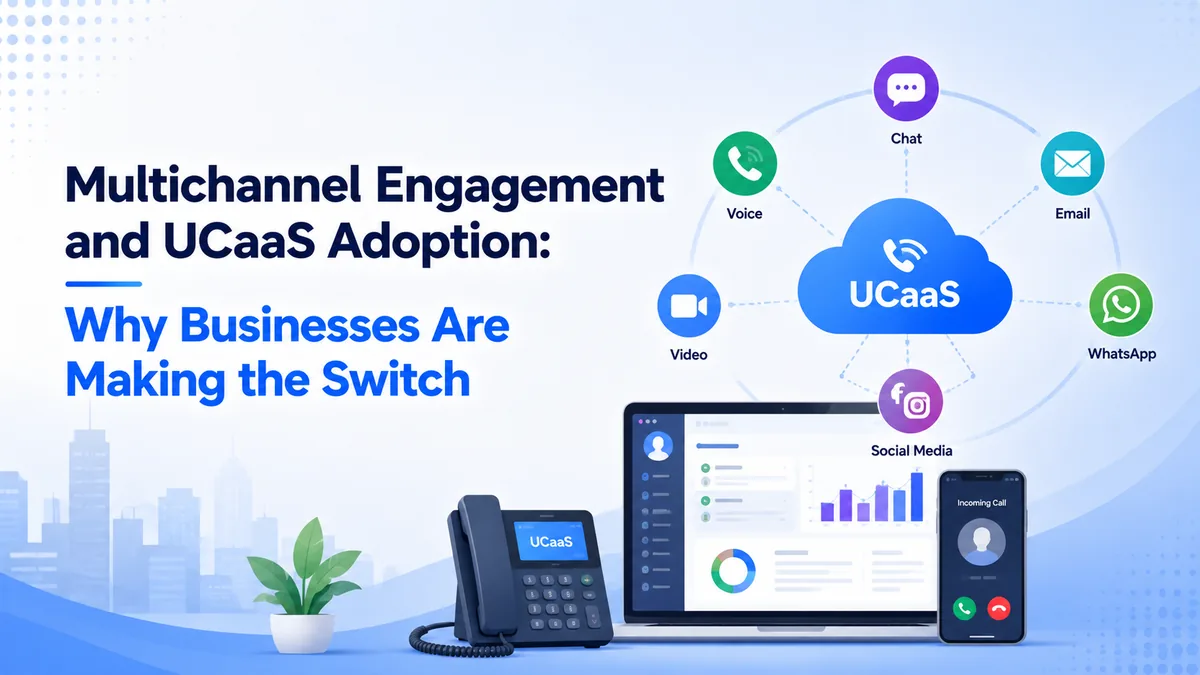
Multichannel customer engagement means a business reaches and responds to customers across voice, SMS, live chat, WhatsApp, email, and social messaging, with a shared record of every conversation regardless of which channel it started on.
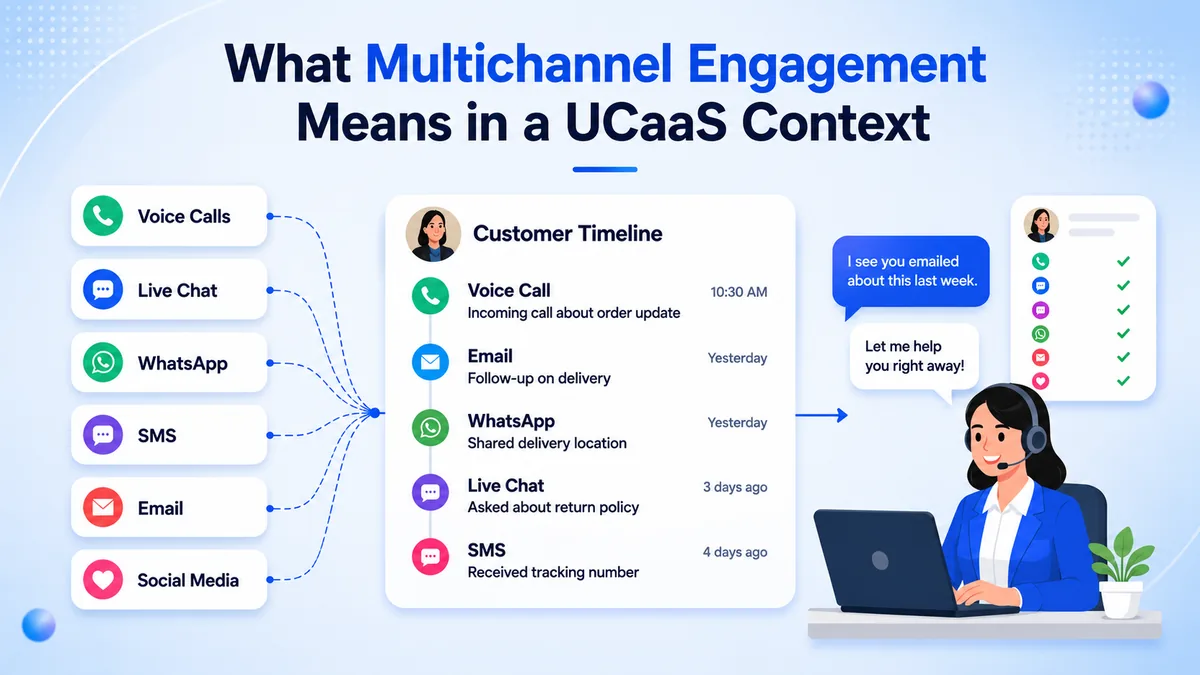
Multichannel engagement and UCaaS adoption go together because a UCaaS platform is what actually makes that shared record possible, rather than leaving each channel logged in a separate system nobody else can see.
TKOS handles this by threading calls, chat, and messaging into a single customer timeline, so an agent picking up a support call can see that the same customer emailed twice last week without having to ask. Without a multichannel engagement platform behind it, that history usually lives in three or four disconnected tools, and the customer ends up repeating themselves every time they switch channels.
The distinction matters because multichannel and omnichannel are often used loosely, even inside the same team. True multichannel customer engagement means every channel is available and connected, not just available. A business that answers on five channels but cannot see a customer's history across any of them has not really solved the problem UCaaS adoption is meant to fix.
Picture a customer who books a callback through a website form, gets a confirmation SMS, then messages a follow-up question on WhatsApp before the call even happens.
On a connected UCaaS platform, the agent taking that call sees all three touchpoints in one timeline before picking up. On a disconnected setup, the agent starts cold, the customer repeats the whole story, and the interaction feels like three separate relationships with the same company rather than one.
What's Driving Adoption Right Now
The biggest driver behind multichannel engagement and UCaaS adoption is simple: customers switch channels mid-conversation constantly, and businesses that cannot follow along lose the thread.
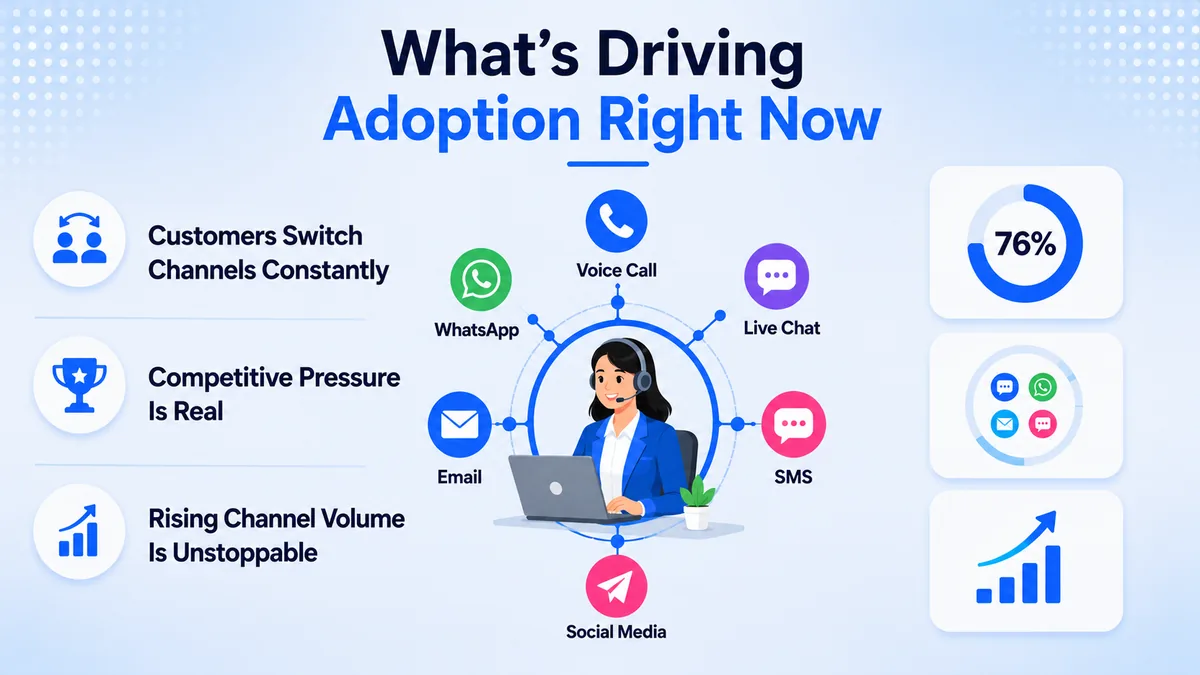
A customer might call about a delayed order, then send a photo of a damaged item over WhatsApp an hour later, expecting the same context to carry over automatically.
Competitive pressure adds to that: once a handful of businesses in an industry offer connected, multichannel support, customers start expecting it everywhere, and businesses still running channels separately look noticeably slower by comparison. 76% of customers now expect consistent interactions across every touchpoint, which leaves little room for a business to treat channels as separate silos.
Rising channel volume plays a role too. Around a third of consumers across most age groups now prefer social and messaging apps for reaching a business, alongside more traditional phone and email contact.
Trying to staff and monitor that many separate inboxes without a unified system quickly becomes unsustainable as channel count grows, which is exactly why UCaaS adoption trends have moved from an enterprise-only conversation to something growing businesses of every size are now weighing seriously.
What's Holding Businesses Back
Cost is rarely the real obstacle in multichannel engagement and UCaaS adoption, despite what many assume going in. The more common barrier is integration complexity: legacy phone systems, older CRM tools, and channel-specific apps that were never built to share data with each other.
Migrating all of that at once feels risky, so many businesses delay indefinitely instead of starting with the highest-impact channel.
A second barrier is uncertainty about where to start. Forty-three percent of organizational leaders say building connected, omnichannel experiences is one of the hardest parts of improving customer experience.
That difficulty often comes from trying to unify everything at once rather than migrating channel by channel, which is exactly the kind of decision that stalls without a clear first step to point to.
Team readiness is a quieter but real barrier as well. Agents used to working one channel at a time need training on unified workflows, and skipping that step is a common reason early UCaaS adoption efforts stall before showing results.
None of these barriers are permanent, and the businesses that eventually complete multichannel engagement and UCaaS adoption almost always describe the same fix: starting small. A single-channel pilot exposes the real integration issues and training gaps early, before the whole customer base is depending on the new system to work correctly.
It also gives leadership something concrete to evaluate before signing off on the full rollout. A pilot that runs cleanly on the highest-volume channel for a few weeks answers the integration and training questions with real data instead of assumptions, which makes the case for expanding to the next channel a much easier conversation internally.
The Measurable Payoff
The return on multichannel engagement and UCaaS adoption is not theoretical. Businesses with strong omnichannel engagement retain 89% of customers, compared to just 33% for businesses stuck on a single channel.
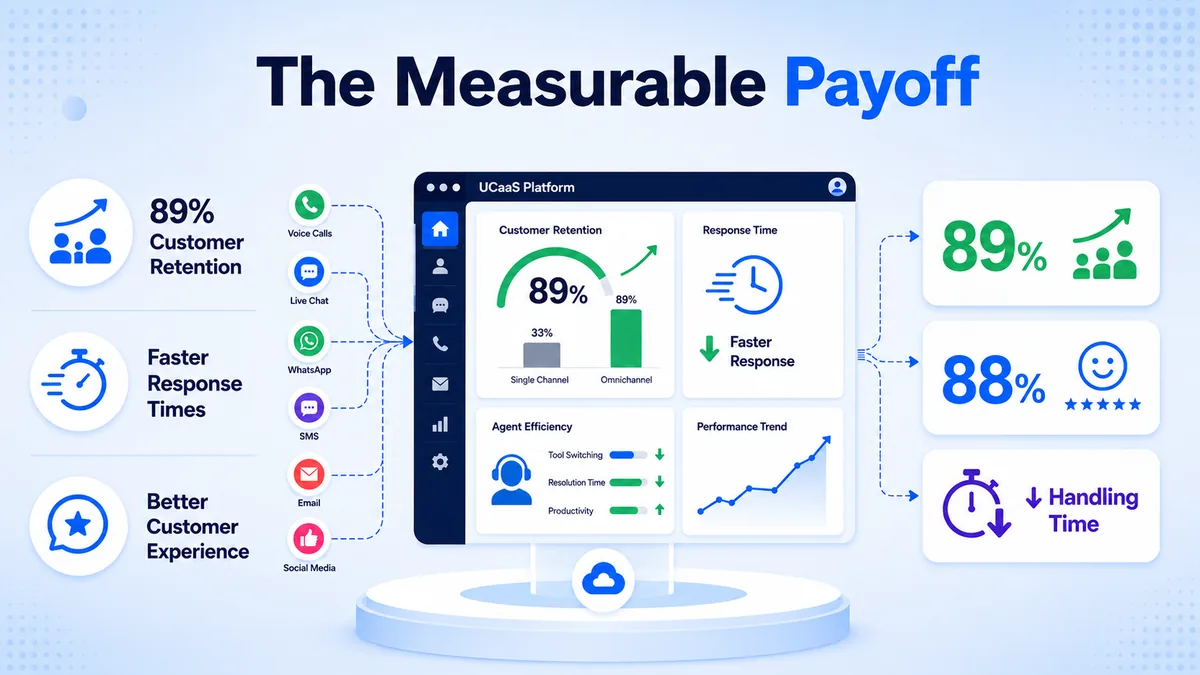
That gap alone is large enough to justify the migration effort. Consistent cross-channel experience also drives measurably higher order frequency and lifetime value compared to single-channel engagement.
Response time improves too, since agents are no longer hunting across separate tools to reconstruct a customer's history before replying — 88% of customers say the experience a company provides matters as much as the product or service itself, which makes a fast, connected response one of the more direct levers a business actually controls.
Agent efficiency is the quieter half of the payoff. When multichannel customer engagement runs through one platform instead of five separate inboxes, agents spend less time toggling between tools and more time actually resolving the conversation in front of them, which shortens handling time across every channel at once.
Over a full quarter, that time saved compounds into either lower staffing costs for the same volume or higher volume handled by the same team, depending on which a business needs more.
Adoption by the Numbers
UCaaS adoption trends point in one clear direction. Roughly 75% of companies are projected to have adopted a unified communications platform by 2030, up from roughly half implementing broader cloud-based IT services today. That growth curve reflects businesses treating multichannel customer engagement as a baseline expectation rather than a competitive advantage reserved for larger companies.
91% of consumers already behave as omnichannel users, moving between channels freely regardless of what any individual business has set up to support it. Businesses that have not caught up on multichannel engagement and UCaaS adoption are, in effect, already behind where their customers already are, and the gap tends to widen each year rather than close on its own.
That timeline is also shortening. Adoption forecasts that once looked aggressive have repeatedly moved earlier as more mid-sized businesses treat a connected platform as table stakes rather than a future upgrade, which means the competitive advantage of adopting early keeps shrinking the longer a business waits.
Getting Started in 5 Steps
Rolling out multichannel engagement and UCaaS adoption works best as a phased migration rather than switching every channel simultaneously, since a single cutover across every channel at once is exactly the kind of all-at-once migration that stalls the projects described above. Here is a realistic path:
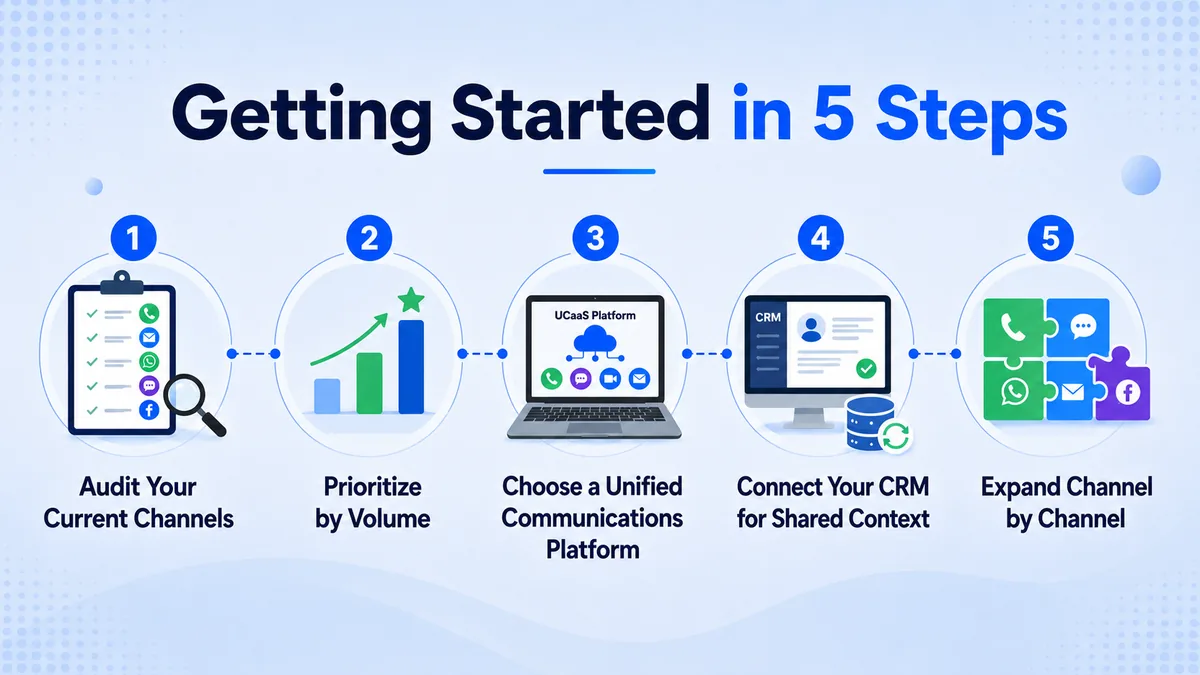
- 1. Audit your current channels. List every channel customers currently use to reach you, and note where conversation history is siloed or missing entirely.
- 2. Prioritize by volume. Identify the one or two channels carrying the most customer conversations, and migrate those first rather than starting with the least-used channel.
- 3. Choose a unified communications platform. Compare options, including TKOS, and check which essential UCaaS features actually support the channels you need.
- 4. Connect your CRM for shared context. Sync customer records so history carries over automatically the moment a conversation moves from one channel to another.
- 5. Expand channel by channel. Add the next channel only once the first is running smoothly, training agents on the unified workflow as each one comes online.
Conclusion
Multichannel engagement and UCaaS adoption are accelerating because customers already behave like omnichannel users, whether or not the businesses they contact have caught up. The retention gap alone, 89% versus 33% between connected and single-channel businesses, makes a strong case on its own.
Start with the five-step path above, migrate your highest-volume channel first, and give your team real training on the unified workflow before adding the next one. Once multichannel engagement is genuinely connected rather than scattered across separate tools, the case for finishing the rollout becomes obvious fast.