Introduction
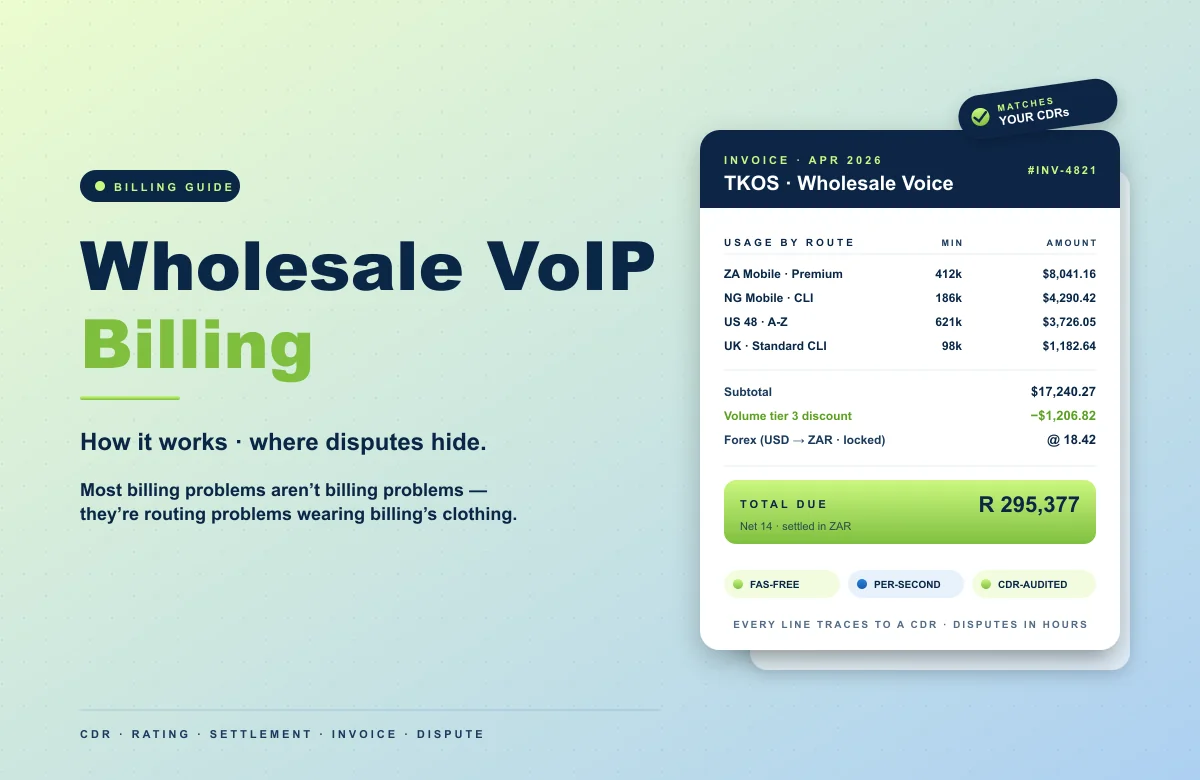
Most wholesale VoIP billing problems aren't billing problems. They're routing problems wearing billing's clothing. A bill that came in 30% higher than forecast usually doesn't reflect a calculation error — it reflects FAS exposure on a route, stripped CLI lowering completion rates, or a transit aggregator quietly adding minutes you didn't expect to pay for. The invoice is the visible output. The economics underneath decide whether the number is real.
This guide breaks down how the billing process actually works — the four billing models providers use, how CDRs are generated and reconciled, the disputes that catch buyers off guard, and what to look for in a billing partner whose numbers match your CDRs every cycle. It's written for MSPs, contact centres, CPaaS platforms, and resellers paying real money against real call volume.
What is wholesale VoIP billing?
Wholesale VoIP billing is the process of generating, reconciling, and invoicing per-minute charges for voice-call termination delivered through a wholesale FCC-registered carrier. It covers CDR (Call Detail Record) creation on every call leg, rating those CDRs against destination-specific rate tables, applying volume tiers and discounts, settling with upstream and downstream partners, and producing the buyer's invoice — usually monthly or weekly.
How the Billing System Actually Works
Billing is really just wholesale voice termination accuracy expressed as an invoice — see Wholesale VoIP for the broader platform this sits inside.
Behind every billing line item is a chain of records. A real billing system runs five operational stages:
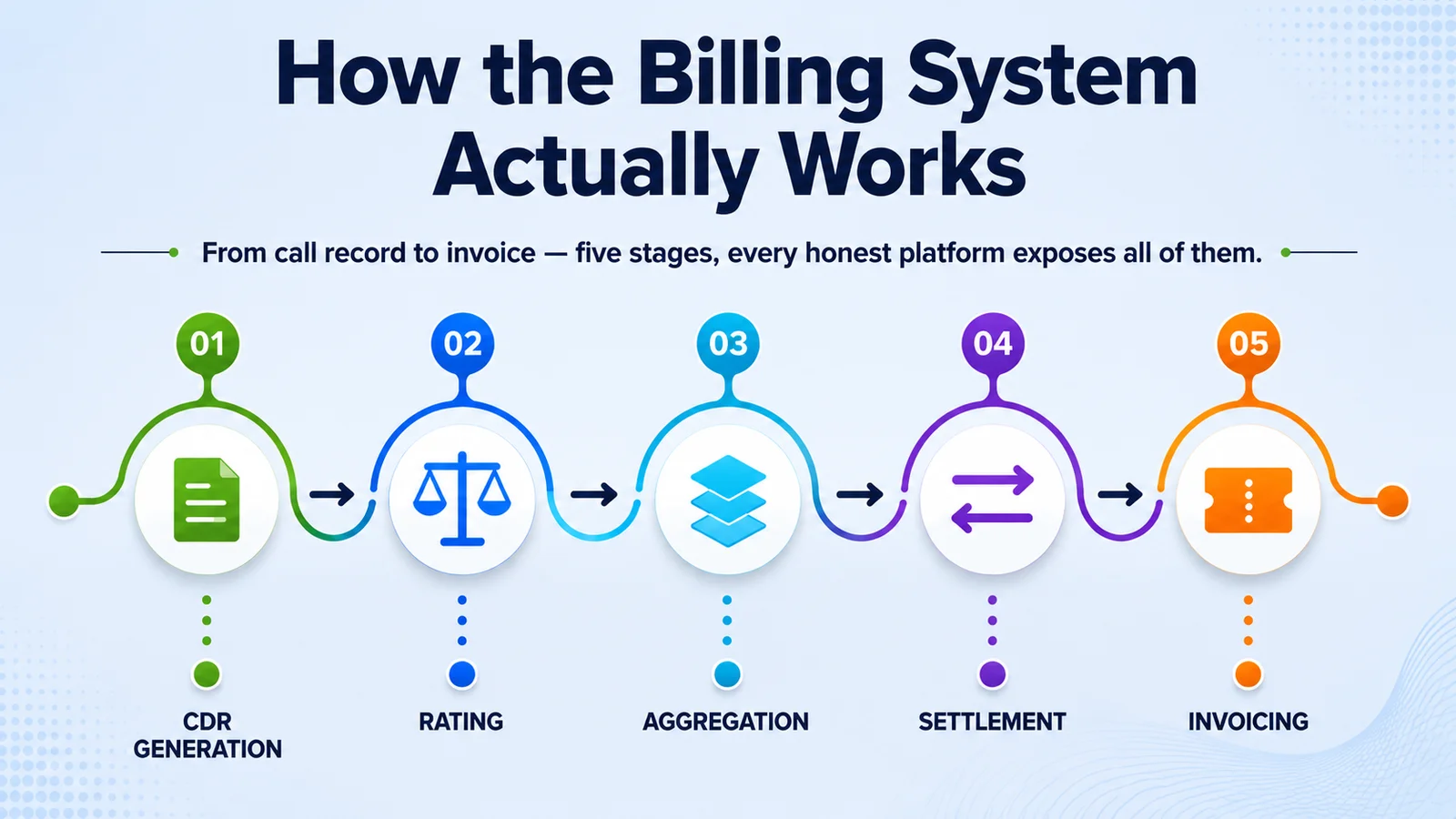
- CDR generation. The carrier's softswitch records every call leg in real time — call start, call answer, call end, source IP, destination, route used, duration, and disconnect cause.
- Rating. Each CDR is matched against the destination rate table. Mobile vs fixed-line, CLI vs Non-CLI, and route type all affect the per-minute price applied.
- Aggregation. Rated CDRs aggregate into per-customer, per-route, per-destination buckets, ready for invoicing.
- Settlement. The carrier reconciles its outbound CDRs against upstream partner invoices and inbound CDRs against downstream customer payments. Discrepancies become disputes.
- Invoicing and dispute handling. Invoices issue on the agreed cycle. Disputes flow through a documented process with response-time SLAs.
Every honest billing platform exposes those five stages. Polished resellers compress them into a black-box invoice that the buyer either accepts or argues with.
The Four Billing Models
Most carriers use one of four billing models. The right model depends on your traffic profile, and each one prices differently when compared against published wholesale VoIP rates.
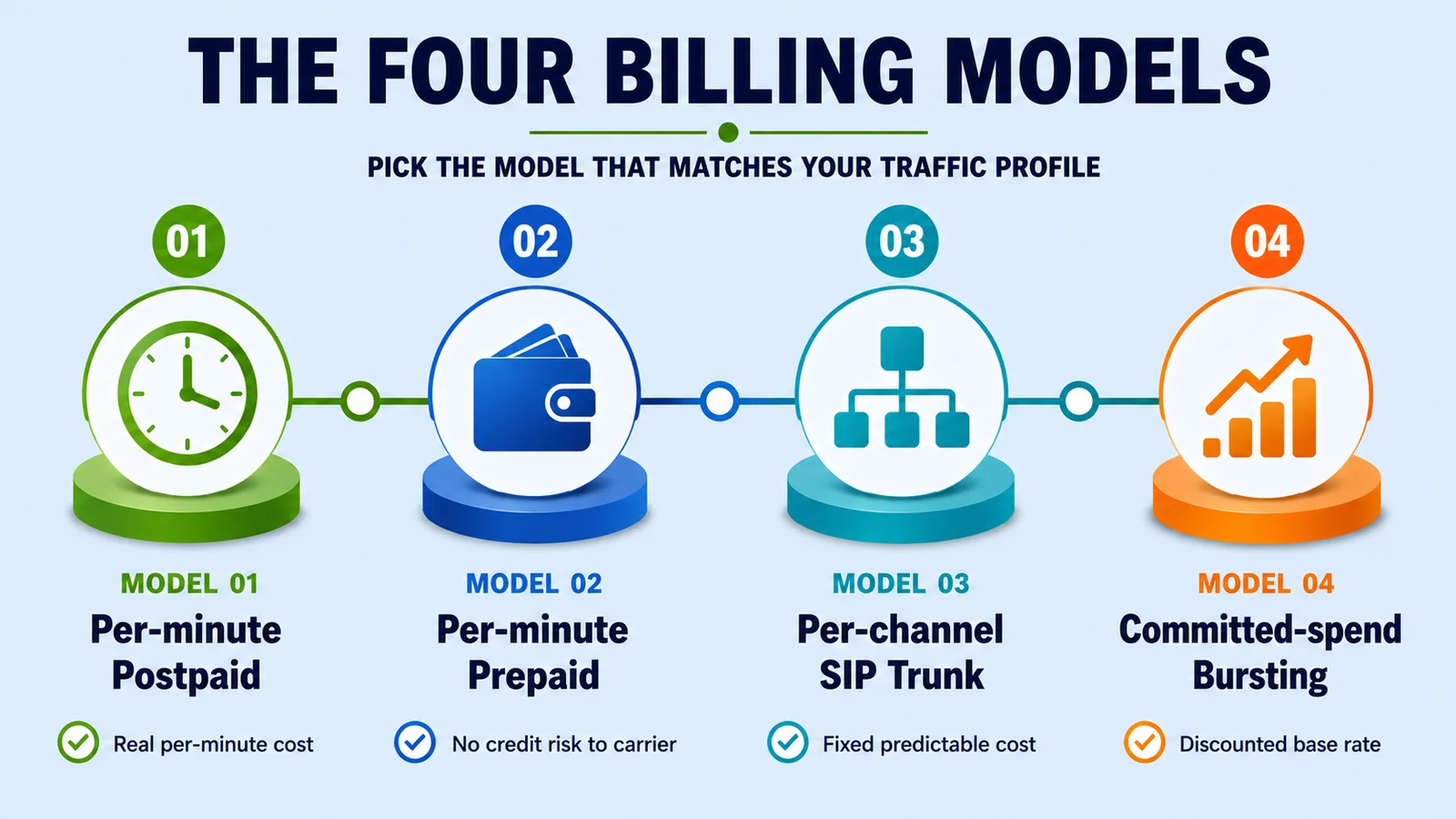
- Per-minute, postpaid — charged per actual minute terminated, billed monthly. Best for predictable monthly volume.
- Per-minute, prepaid — buyer tops up a balance; minutes drain it in real time. Best for variable traffic or new customers.
- Per-channel (SIP trunk) — flat fee per concurrent call channel, usage included. Best for contact centres with steady volume.
- Committed-spend with bursting — fixed monthly spend covers a base; bursts billed separately. Best for platforms with baseline plus spikes.
CDR Accuracy: The Foundation of Accurate Billing
CDRs are the raw fuel for billing. Inaccurate CDRs mean inaccurate invoices, and the disputes that follow can erase a quarter of margin. The FCC requires carriers to retain CDRs for 18 months — a minimum floor, not a best practice. Three CDR fields matter most:
- Call duration. Measured from answer to disconnect. Per-second billing increments produce more accurate cost per call than per-minute rounding.
- Disconnect cause. Codes that distinguish normal hangups from network errors, busy signals, no-answer, or fraud-indicator events. Disputes start when this field is missing or generic.
- Route used. Direct interconnect or transit hops? CLI or Non-CLI? Without this metadata, you can't audit whether the price applied matched the route delivered.
A billing platform that doesn't expose these fields in real time forces you to trust the invoice. A real one lets you reconcile against your own CDRs every cycle.
How FAS Inflates Your Billing
False Answer Supervision (FAS) is the single biggest hidden cost in billing. A FAS-exposed route triggers billing the moment a call signal crosses a threshold, even if the called party never picked up. You pay for connect tones, voicemail prompts, and ringing time as if they were live conversations.
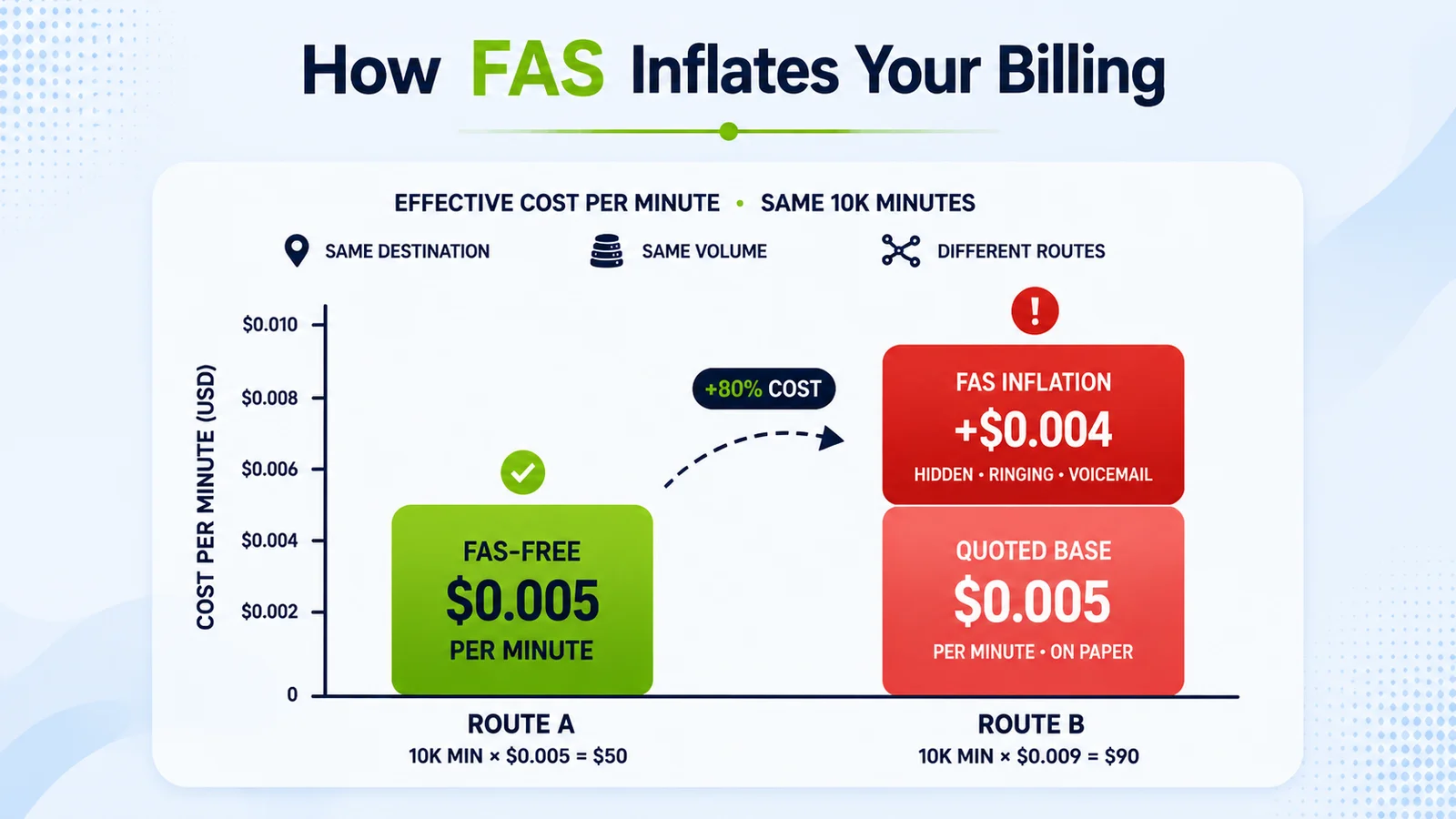
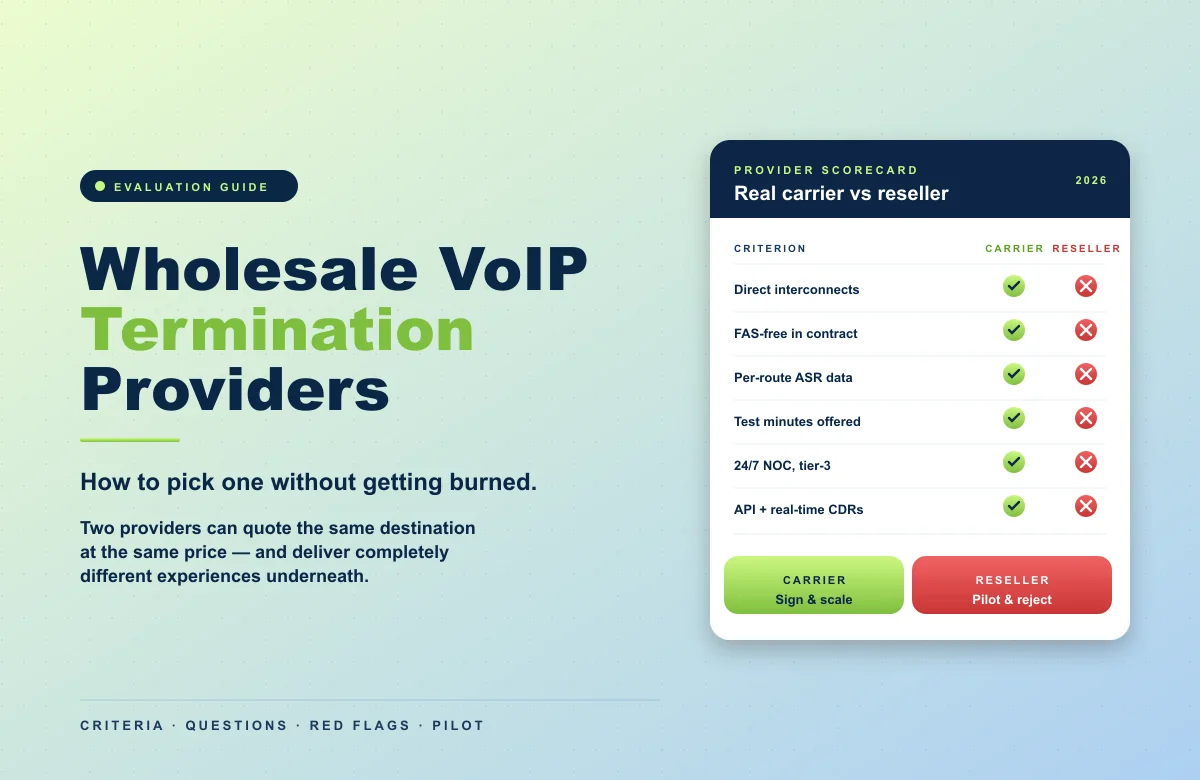
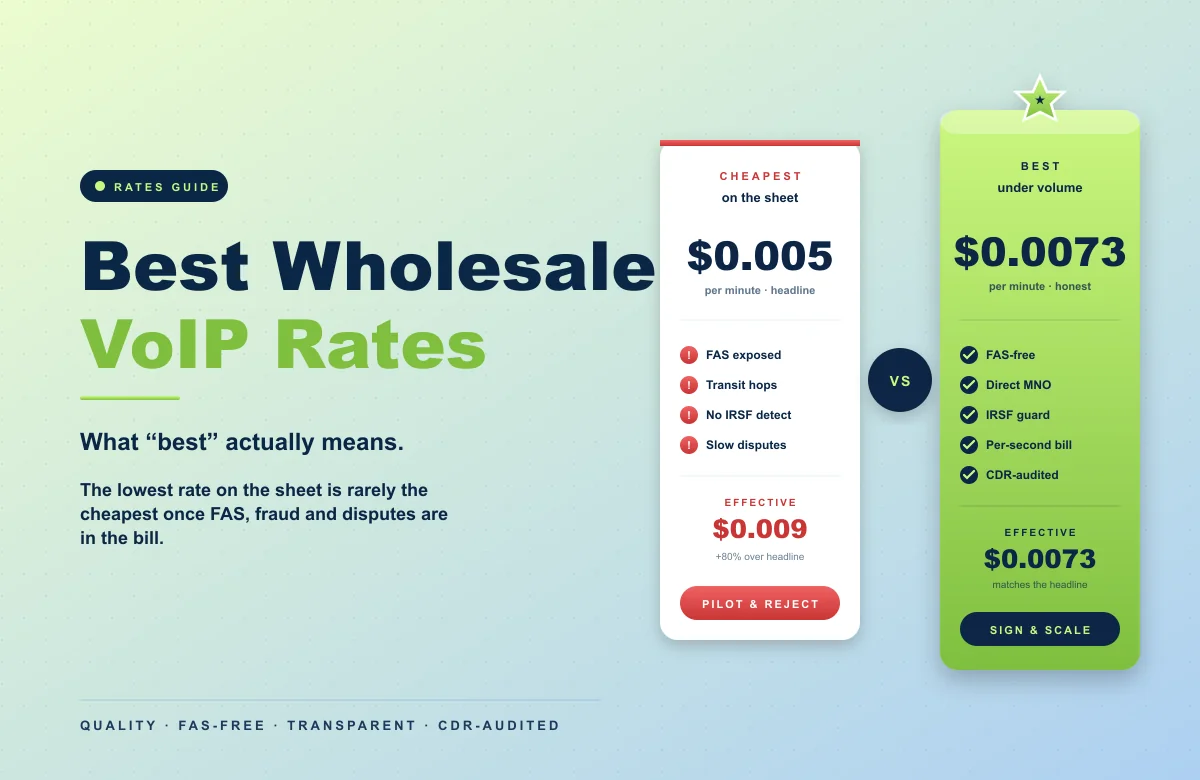
A route that looks like $0.005 per minute can effectively cost $0.009 once FAS inflation is factored in. ACD numbers in your CDRs don't match the recipient's actual answer behaviour. Customers complain about quality on calls that look fine in your billing system. Trust evaporates inside one quarter. The right billing partner publishes routes as FAS-free as a contractual exclusion, not a sales line — the same standard buyers should expect when comparing wholesale voice termination rates across providers.
Common Billing Disputes
Most billing disputes fall into one of five buckets, and the fraud-driven categories track closely with the patterns documented in GSMA fraud and security reporting:
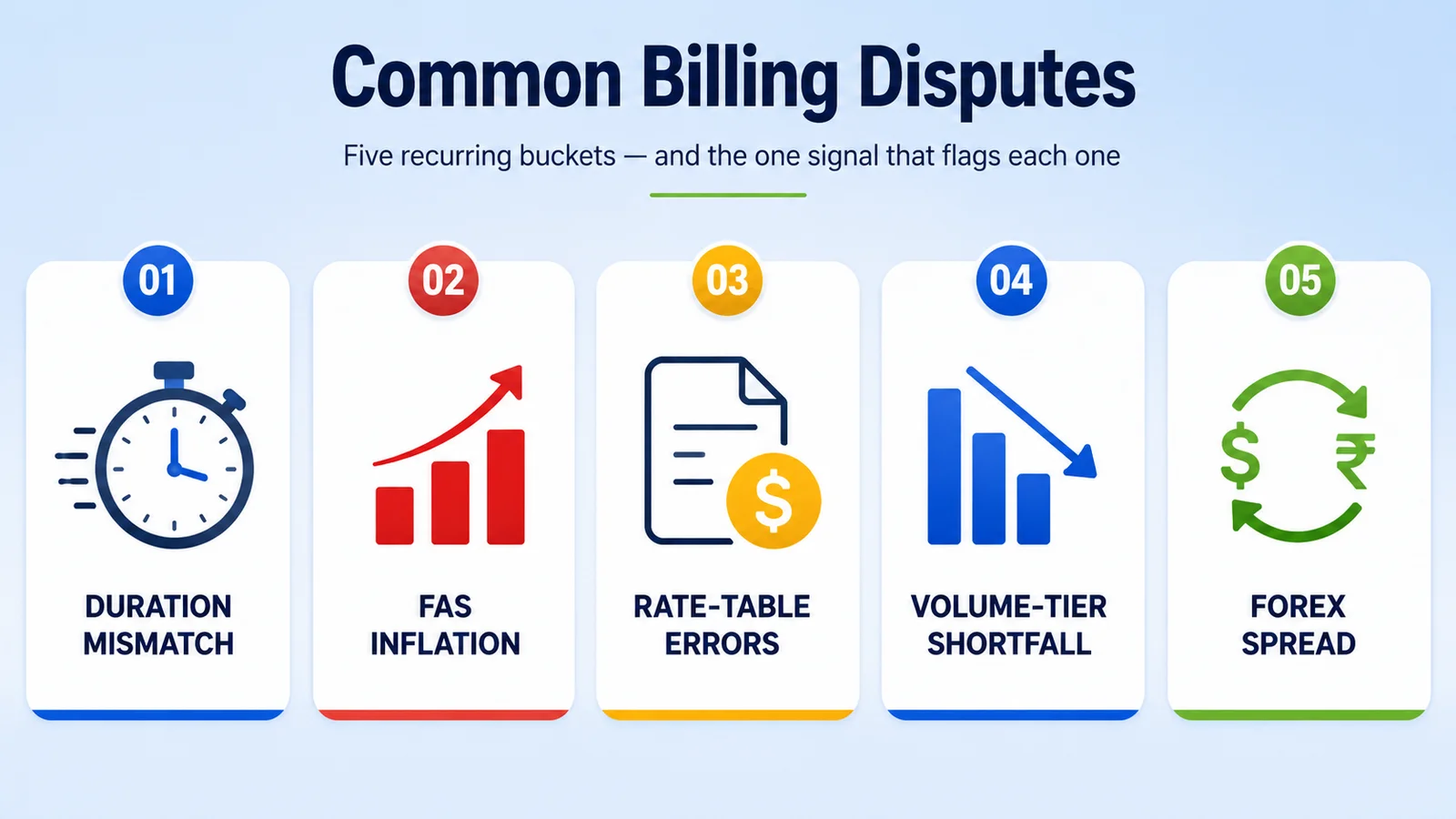
- Duration mismatch. Customer CDRs show shorter calls than the carrier invoiced. Usually a billing-increment issue (60-second vs 6-second vs 1-second).
- FAS inflation. Calls billed where the called party never answered. Often surfaces as a sudden ACD drop on a specific route.
- Rate-table errors. Carrier applied an outdated or wrong rate to a destination. Common during quarterly rate refreshes.
- Volume-tier shortfall. Customer expected tier 2 pricing but didn't hit the committed volume threshold. Often a contractual ambiguity.
- Forex spread. USD-priced traffic billed at a worse exchange rate than the customer assumed. Common for African operators paying in ZAR or NGN.
A serious billing partner publishes a documented dispute process with response-time SLAs and resolution windows in days, not weeks. Industry data on the wholesale voice market shows continued growth across emerging regions.
Wholesale Billing Realities in Africa
African voice traffic introduces billing complexity that most global providers don't price in. Three patterns recur:
Regulated MTRs. South African mobile, Nigerian mobile, and Kenyan termination rates have hard floors. A carrier billing below those floors is either burning cash or routing somewhere they shouldn't.
Forex volatility. USD-denominated rates billed against ZAR or NGN bring spread surprises if the carrier doesn't lock the rate at invoice time.
Dispute friction. African MNOs reconcile on different cadences than European or US carriers, which extends settlement cycles and makes billing transparency harder.
TKOS operates from a Johannesburg HQ with carrier relationships built across the continent over a decade. The billing platform reflects that — multi-currency invoicing, transparent forex spread, and dispute resolution timelines that account for African settlement cadences.
How to Evaluate a Wholesale VoIP Billing Partner
A real wholesale VoIP billing platform offers more than a monthly invoice. Insist on:
- Real-time CDR access through API or portal, not after end-of-month batch.
- Per-second billing increments rather than 60-second rounding.
- FAS-free routes in contract, not just in conversation.
- Documented dispute process with response-time SLAs.
- Transparent forex spread for cross-currency billing.
- Volume-tier visibility and quarterly tier reviews.
- Multi-currency invoicing for buyers paying in ZAR, NGN, EUR, or GBP.
Anything missing is a flag. VoIP billing is where carrier relationships either deepen or break.
How TKOS Handles VoIP Billing
TKOS isn't the cheapest. We don't try to be. Our billing platform reflects what carrier-grade economics actually look like:
- Real-time CDRs through API and self-service portal.
- Per-second billing increments on every route.
- FAS-free routes as a contractual exclusion.
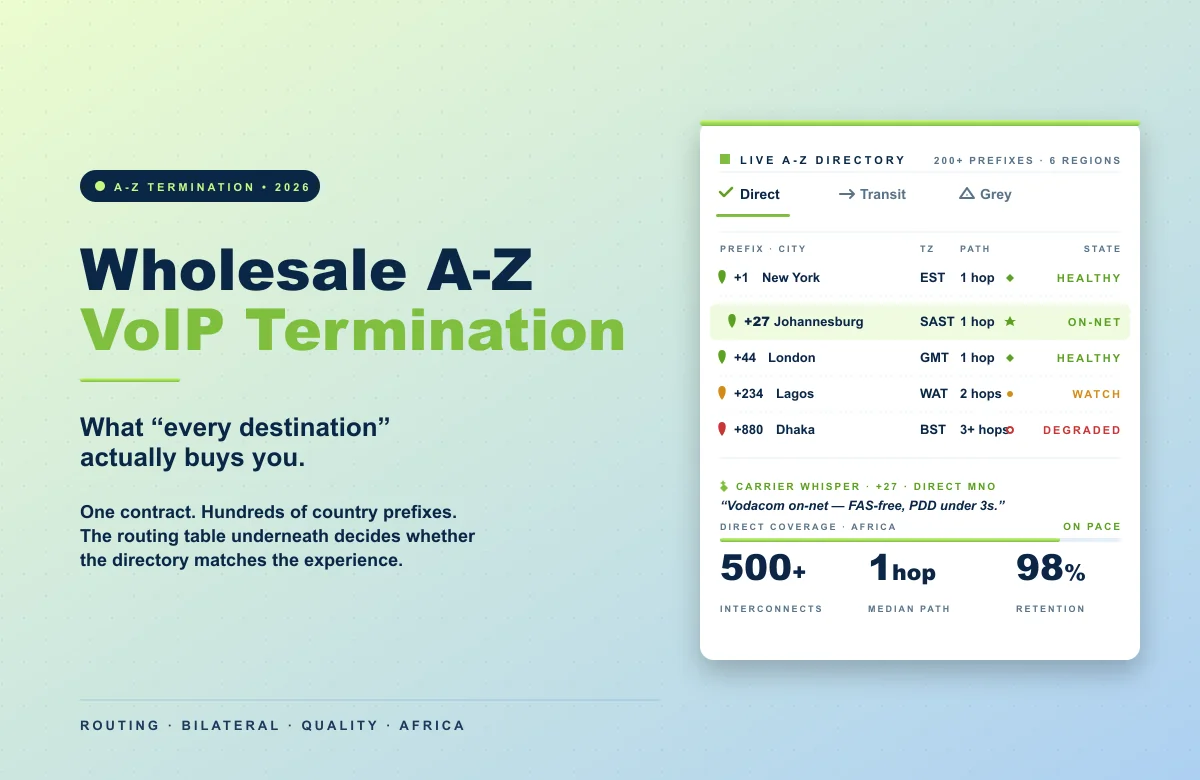
- 500+ direct carrier interconnects with full route metadata in every CDR.
- Multi-currency invoicing with transparent forex spread.
- Documented dispute process with tier-3 engineer escalation.
- 99.9% uptime SLA backed by real-time QoS monitoring at the 24/7/365 NOC.
98% partner retention across 500+ active partners reflects what wholesale VoIP billing looks like when the invoice matches the CDRs every cycle.
See also: wholesale VoIP rates.
Conclusion
Wholesale VoIP billing only feels predictable when the routing underneath is predictable. Direct interconnects, FAS-free routes, real-time CDRs, and a documented dispute process turn an unpredictable invoice into a reconciliation exercise that takes hours, not days. Buyers who treat the billing function as a wholesale voice termination quality issue in disguise — not a finance issue — pick partners whose numbers hold up under volume.
Getting Started
Don't pick a wholesale VoIP billing partner on monthly cost alone. Ask for the CDR access, the FAS policy, the dispute process, and the forex handling in writing. Run test traffic and reconcile the resulting invoice against your own CDRs before committing.
Top international termination destinations