Introduction
Half the confusion in business voice buying comes from one source: "VoIP" gets used to describe both a $20-a-seat softphone app and a multi-million-minute carrier termination contract. The two products share a transport layer (IP-based voice) and almost nothing else. Retail VoIP is a finished product sold to end users. Wholesale VoIP is infrastructure sold to other businesses — MSPs, resellers, contact centres, CPaaS platforms — who deliver their own branded voice services on top of it.
Getting that distinction right is the difference between paying retail margins forever and building a voice product with healthy economics. This guide breaks down what wholesale VoIP actually is, how it works at the network layer, who buys it, what real pricing looks like, and how to evaluate a provider.
What is wholesale VoIP?
Wholesale VoIP is the business-to-business sale of voice infrastructure — termination, origination, DID numbers, SIP trunking capacity, and routing — to other carriers, MSPs, resellers, and platform builders. Wholesale customers buy in bulk, run their own voice products on top, and sell to end users under their own brand.
The relationship is closer to buying electricity from a generator than buying a phone plan from a store. You take the input. You deliver the output.
How does wholesale VoIP work?
Three layers make wholesale VoIP function:
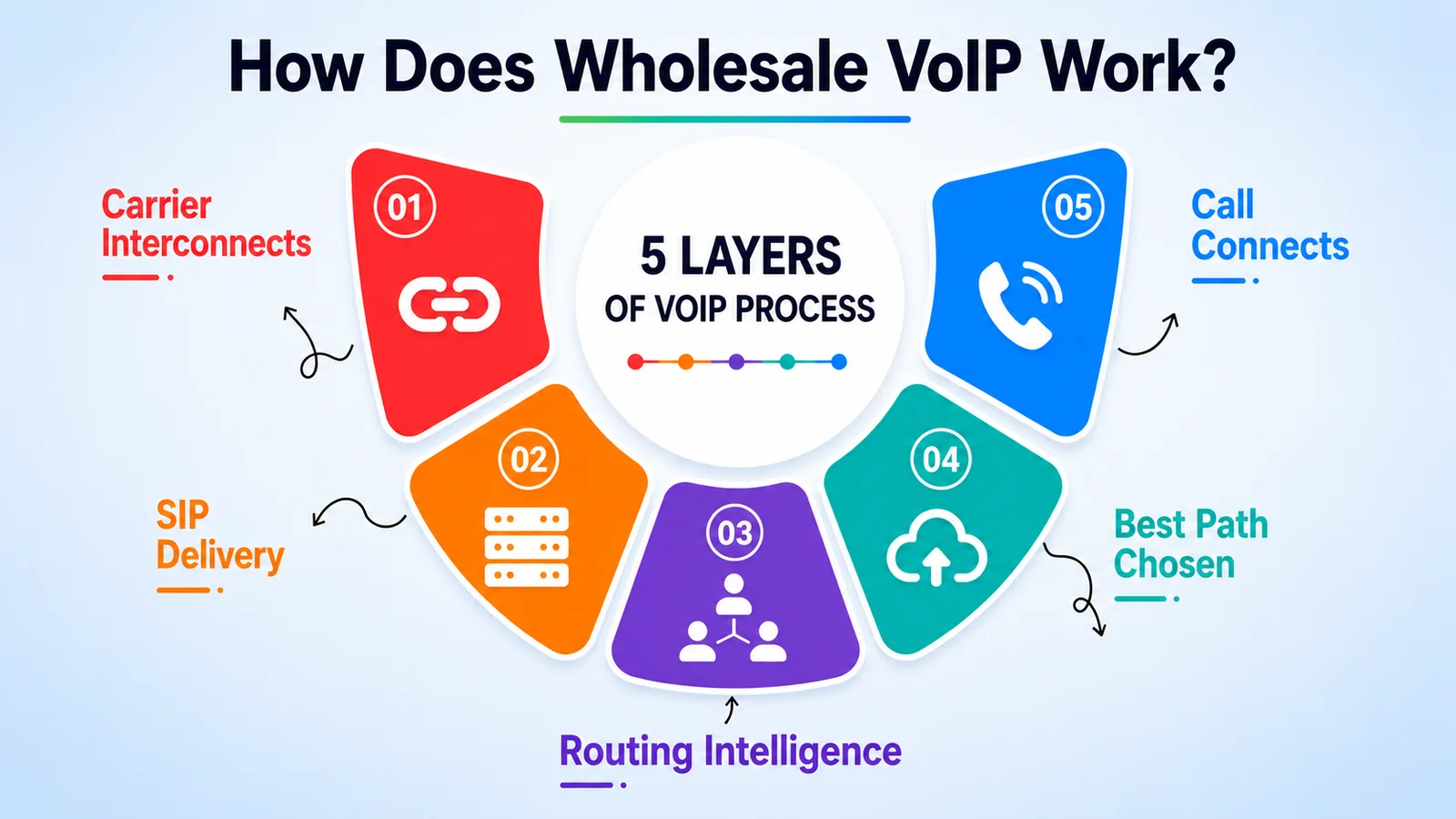
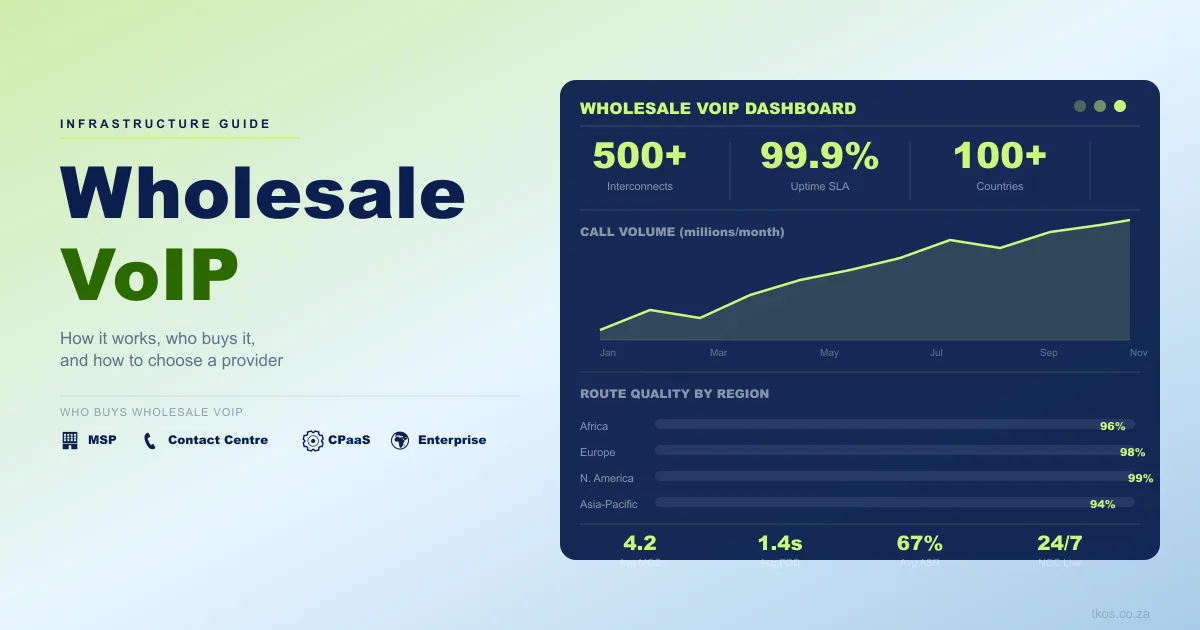
- Carrier interconnects. A wholesale VoIP provider operates direct relationships with national and regional carriers across the countries it serves. The more direct interconnects, the fewer transit hops a call takes, and the higher the audio quality stays. Providers with 500+ direct carrier interconnects deliver meaningfully different call quality.
- SIP delivery. Wholesale traffic moves over the Session Initiation Protocol. Customers connect via SIP trunking to the provider's softswitch, which handles signalling and routes calls onto the right interconnect path. The customer's own platform sits on top of the SIP layer.
- Routing intelligence. Modern wholesale VoIP providers use real-time routing decisions based on completion rate, audio MOS scores, and price signals — not just cheapest-route logic.
What is the difference between wholesale VoIP and retail VoIP?
The distinction has five dimensions:
| Dimension | Wholesale VoIP | Retail VoIP |
|---|---|---|
| Buyer | MSP, reseller, carrier, platform | End business user |
| Pricing | Per-minute, per-DID, volume-tiered | Per-seat, per-month |
| Delivery | SIP trunk, API, raw routing | Finished softphone or app |
| Contract | Custom, includes resale rights | Standard, no resale |
| Support | Tier-3 NOC, 24/7/365 | Helpdesk, ticket queue |
Either model works for the right buyer. The mistake is mixing them — running a customer-facing voice product on a retail VoIP backend, or buying wholesale capacity when you only have 10 internal users and no resale plans.
Who buys wholesale VoIP?
Several buyer profiles drive most wholesale VoIP demand:
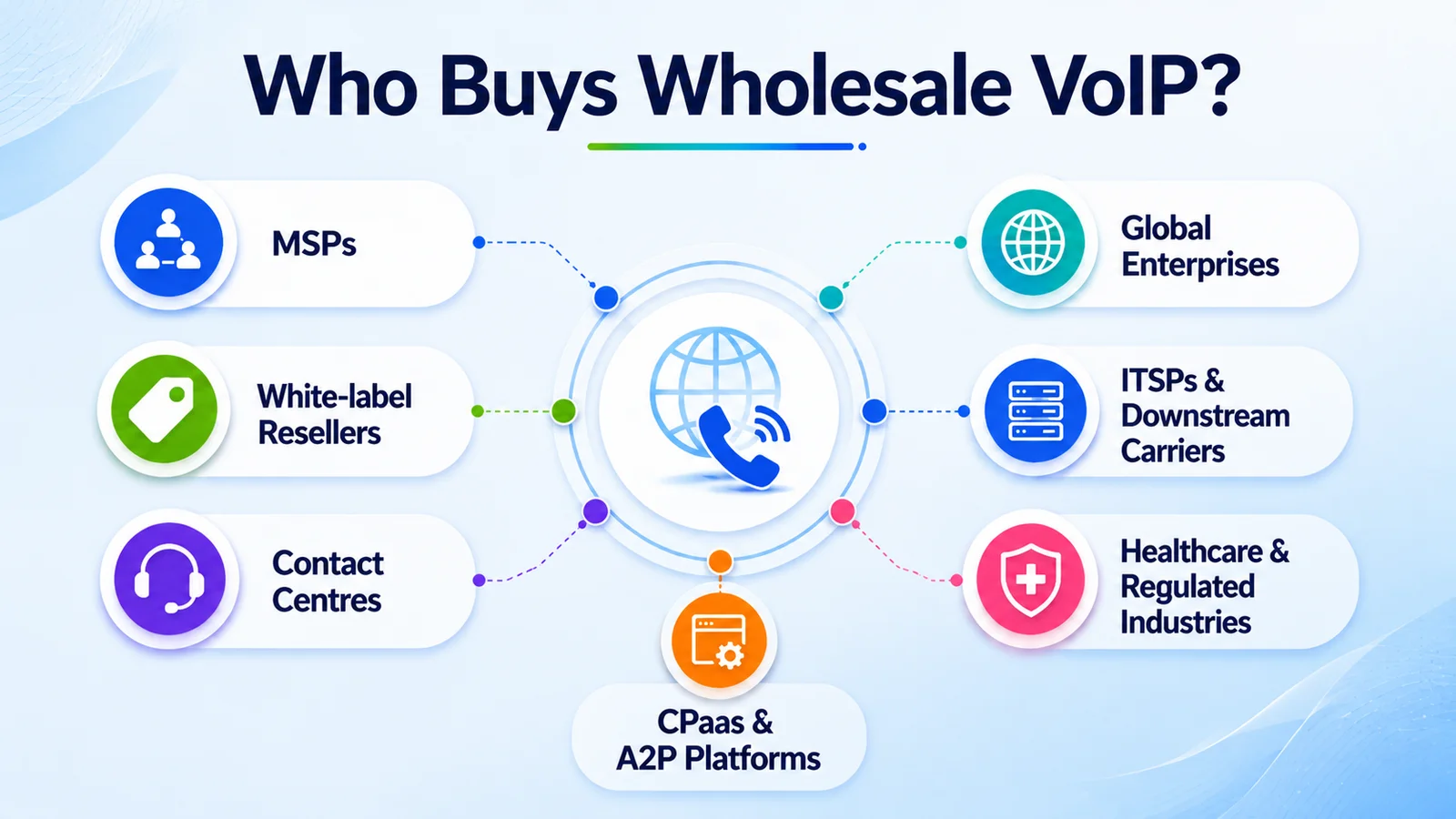
- MSPs. Managed service providers white-labelling UCaaS, hosted PBX, and SIP trunking for their own end customers.
- White-label resellers. Building a branded voice product on someone else's infrastructure.
- Contact centres. High-volume inbound and outbound calling at carrier-grade quality, with DID rotation and fraud protection.
- CPaaS and A2P platforms. Programmable voice for verification, notifications, and voice-OTP workflows.
- Global enterprises. Unifying multi-country voice on a single backbone instead of cobbling together local providers.
- ITSPs and downstream carriers. Sub-allocating wholesale capacity to smaller providers.
- Healthcare and regulated industries. Buyers needing HIPAA-compliant communication with carrier-grade reliability.
Below 50 end users or 100,000 minutes per month, retail VoIP usually wins on convenience. Above those thresholds, wholesale economics start to dominate.
What does wholesale VoIP pricing look like?
Wholesale VoIP pricing is unbundled, which throws first-time buyers. Four components apply:
- Per-minute termination rates. Charged by destination country and sometimes by carrier within a country. Domestic US rates are fractions of a cent; certain international destinations are higher.
- Per-DID monthly recurring charge. Flat per-line fee for each DID, lower than retail.
- SIP trunk channel capacity. Concurrent-call capacity, sometimes billed flat-rate, sometimes per channel.
- Optional add-ons. Fraud protection, regulatory reporting, premium routing tiers, dedicated NOC support.
Volume tiers matter. Pricing improves at 100,000 minutes, 1 million minutes, and 10 million minutes per month, with custom contracts beyond that. A provider that refuses to disclose this structure during evaluation is a red flag.
What to look for in a wholesale VoIP provider
Eight criteria separate credible wholesale voice providers from resellers two layers removed from the underlying carrier:
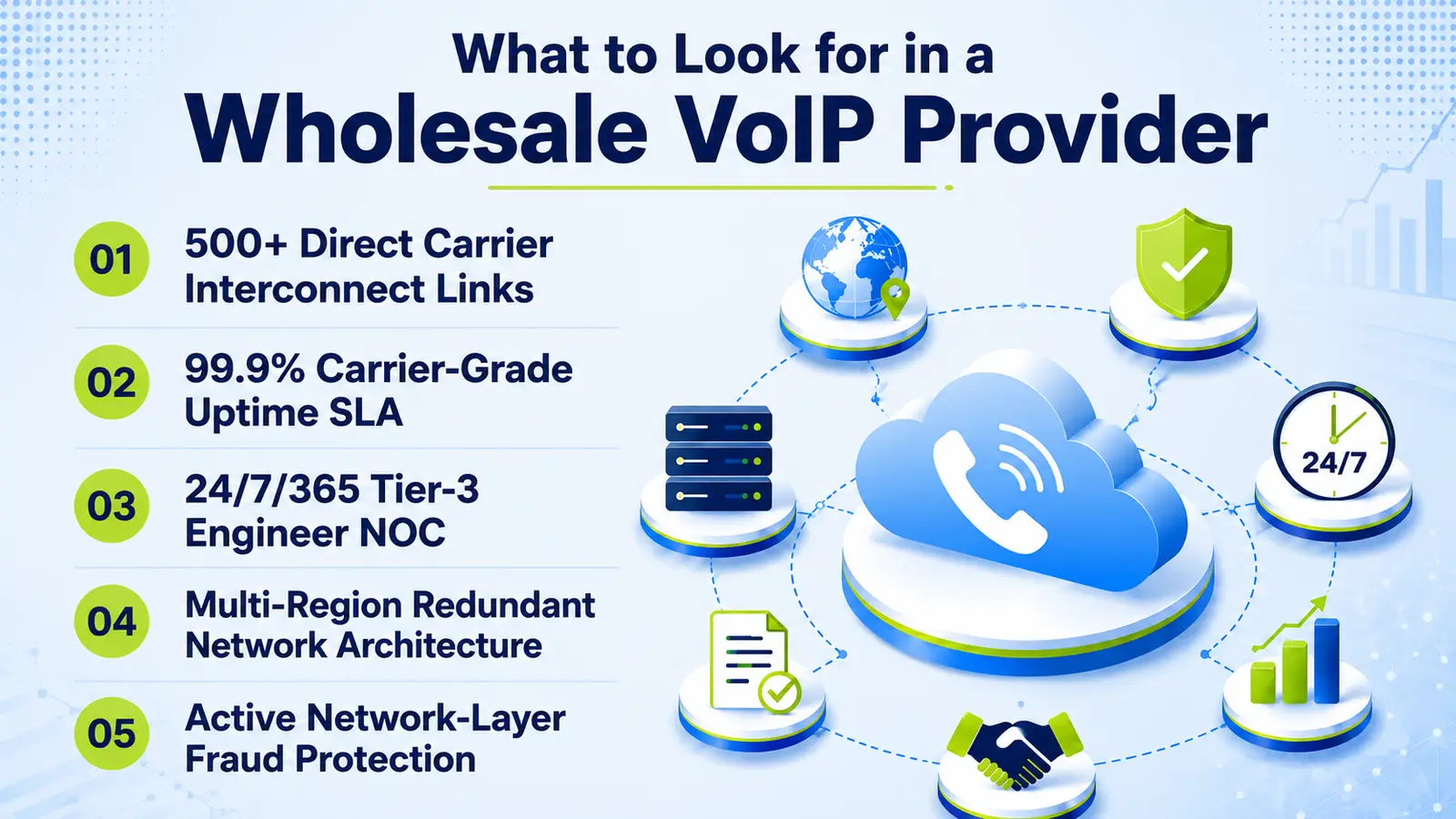
- Direct interconnect count and geography. 500+ direct interconnects and clear country-by-country breakdowns.
- Uptime SLA. 99.9% is the modern carrier-grade floor. Anything claiming 99.999% without audit evidence is marketing.
- NOC model. A 24/7/365 NOC staffed by tier-3 engineers, not a ticket queue.
- Network architecture. Geographically redundant PoPs across multiple regions, automatic failover.
- Fraud protection. Active controls — IRSF detection, geo-fencing, velocity limits, scam-list scrubbing.
- Compliance. HIPAA for healthcare resellers, plus per-country regulatory adherence. The FCC Guide covers US-specific caller authentication and STIR/SHAKEN requirements.
- DID coverage. 100+ countries with sub-hour activation as the modern bar.
- Resale flexibility. Contracts explicitly permitting white-label resale, with reasonable term, churn, and notice clauses.
Common use cases for wholesale VoIP
Different patterns drive different procurement priorities:
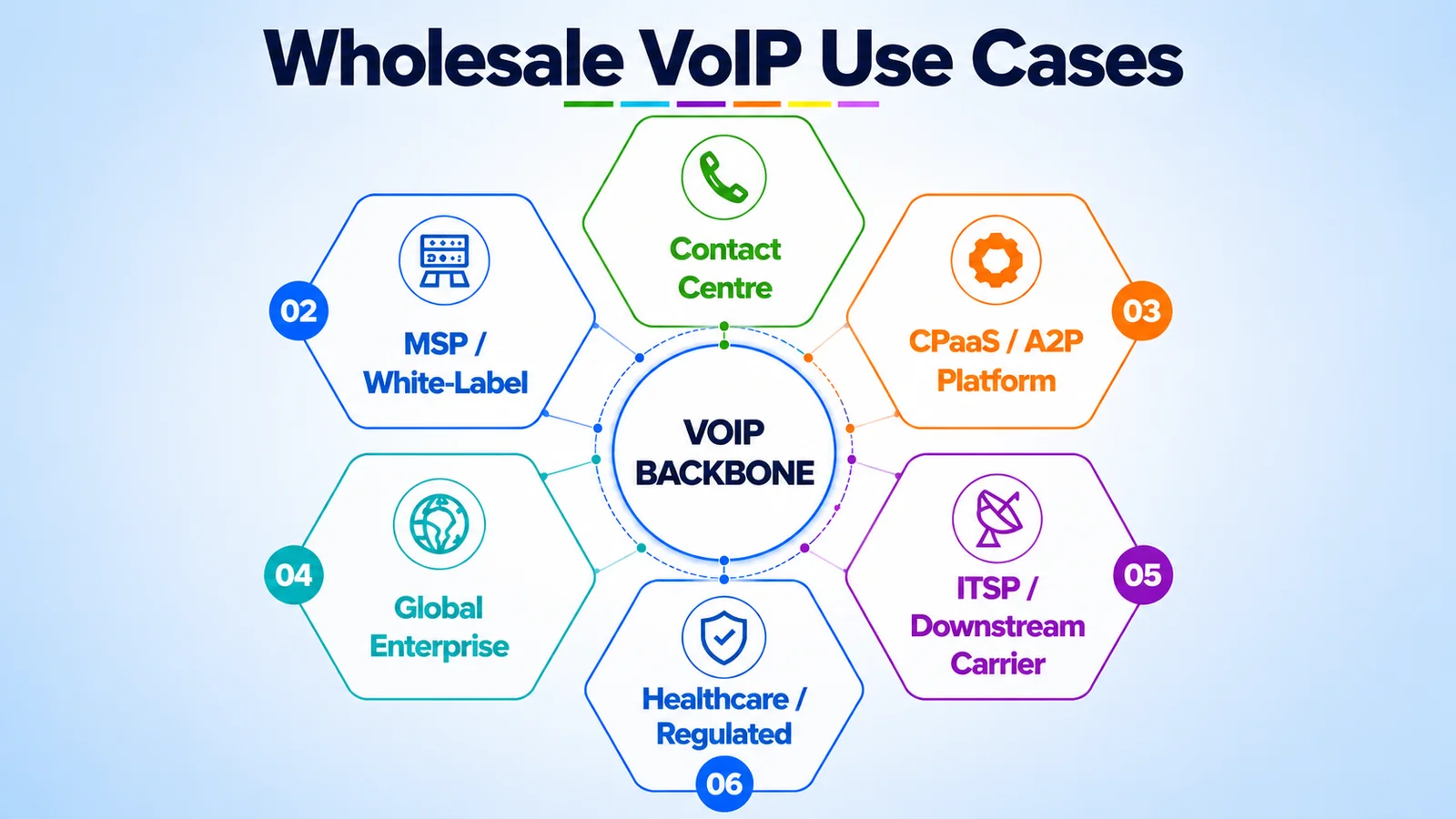
- MSP launching UCaaS. Need white-label SIP trunking, DIDs in customer regions, hosted PBX enablement, and tier-3 engineering on call.
- Contact centre cutting call clarity tickets. A 60%+ drop in audio-quality complaints typically comes from moving termination to a provider with direct interconnects.
- E-commerce expanding internationally. Local-presence DIDs in target countries lift answer rates on regional support and sales.
- Global enterprise unifying voice. A single wholesale backbone replacing 8 to 15 local providers with one set of contracts, one routing layer, one NOC.
Conclusion
Wholesale VoIP is infrastructure, not a finished product. For MSPs, resellers, contact centres, CPaaS platforms, and global enterprises, choosing the right wholesale partner shapes call quality, unit economics, fraud exposure, and product capability for years. The differentiators that matter — direct interconnect count, NOC depth, fraud protection, compliance, DID coverage, and contract flexibility — are operational realities, not marketing claims. Evaluating against those eight criteria turns a high-stakes procurement into a repeatable buying motion.