Introduction
Your wholesale VoIP carrier is the foundation under every minute you sell, every call your platform routes, and every customer that picks up the phone. Get the carrier wrong and you're explaining call-quality complaints to enterprise buyers, fighting fraud you didn't cause, and watching margins evaporate against competitors with cleaner routes.
This guide breaks down what a wholesale VoIP carrier actually does, how the network underneath operates, the difference between carriers and the resellers that pretend to be carriers, and what to look for in a partner. It's written for MSPs, CPaaS builders, contact centres, and resellers who want to make the right call on their voice partner.
How a Wholesale VoIP Carrier Actually Works
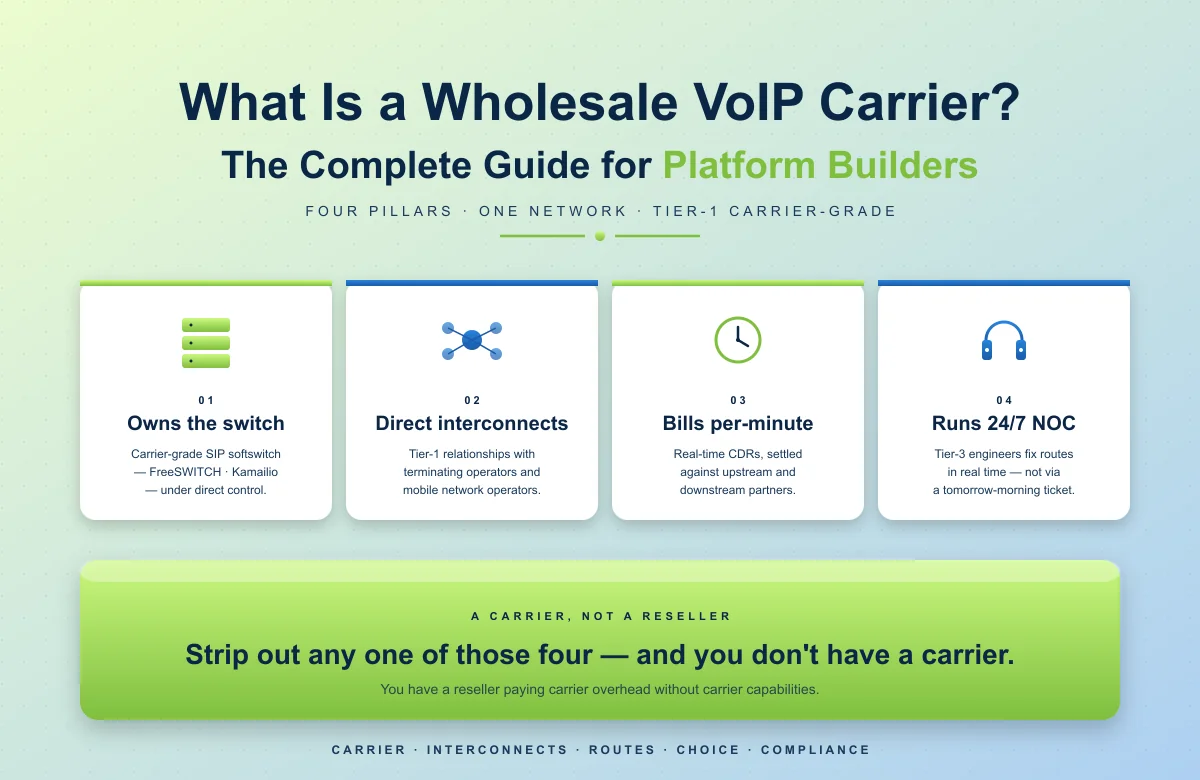
Behind every termination quote is a network architecture. A real wholesale VoIP carrier runs five operational pillars.
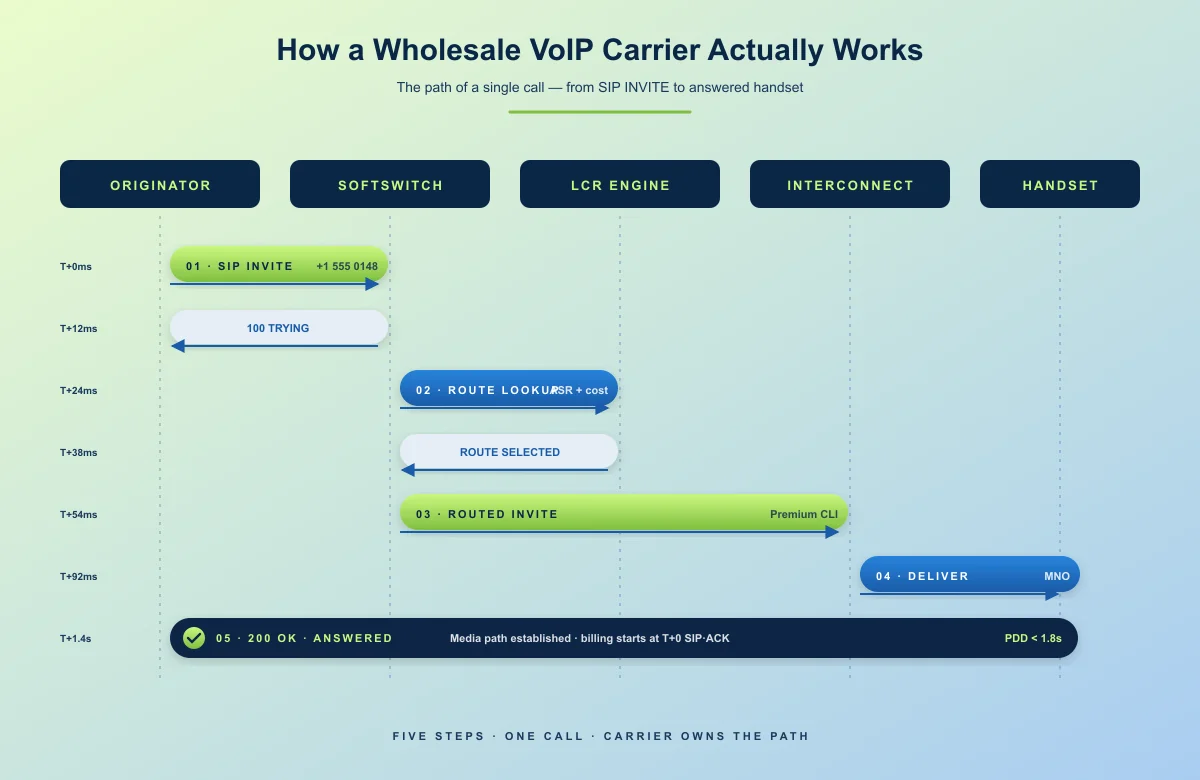
- Carrier interconnect network. Direct relationships with terminating operators, mobile network operators, and other wholesale carriers. The depth of this network determines what destinations the carrier can reach cleanly.
- SIP switching infrastructure. Carrier-grade softswitches (FreeSWITCH, OpenSIPS, Kamailio, Asterisk) handle real-time routing, signalling, and media. Geographic redundancy with sub-second failover is the baseline.
- Routing intelligence. Least Cost Routing engines pick paths in real time, balanced against quality-aware routing that factors in ASR, PDD, and MOS thresholds.
- Settlement, billing, and CDRs. Per-minute billing on every leg of every call, with real-time CDR generation and reconciliation against upstream and downstream partners.
- Operations and NOC. A 24/7 Network Operations Center monitors route health, traffic anomalies, fraud signals, and customer escalations. The NOC is where the business actually lives.
Strip out any one of those pillars and you don't have a carrier. You have a reseller wearing a carrier's name.
Wholesale VoIP Carrier vs Reseller
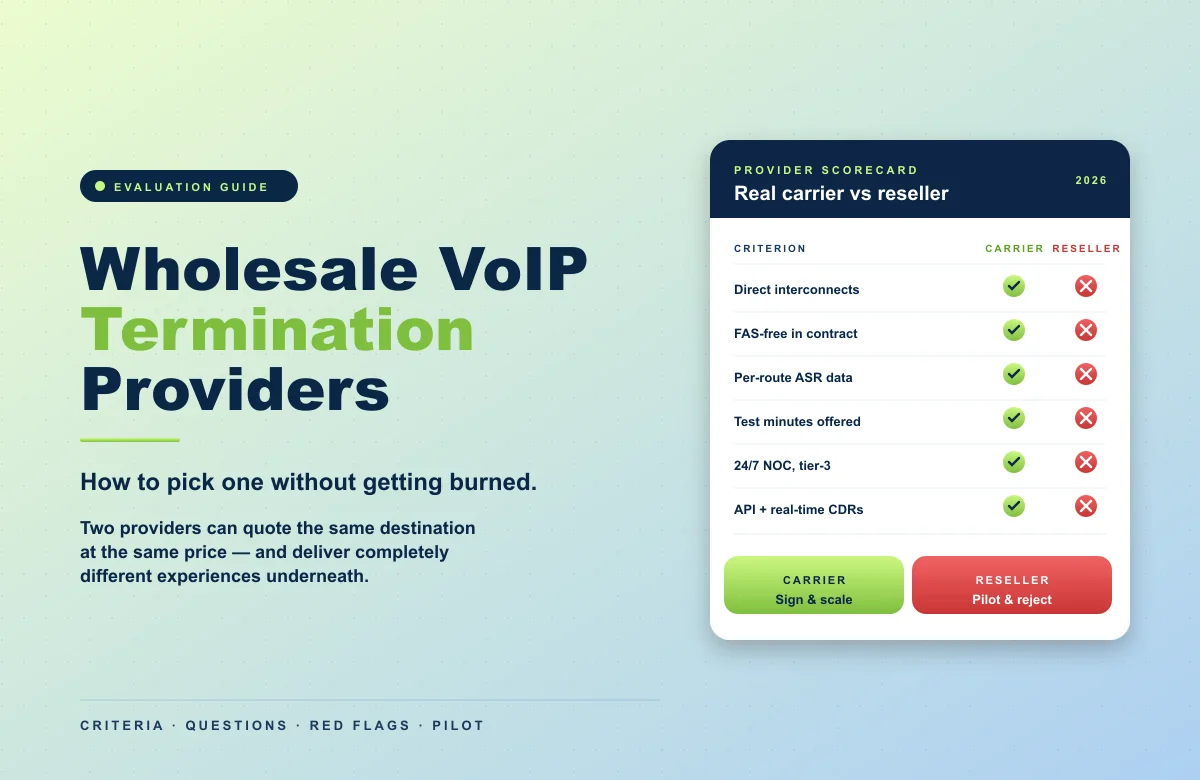
A reseller buys wholesale minutes from one carrier, marks them up, and resells. A carrier owns the routes the reseller is reselling.
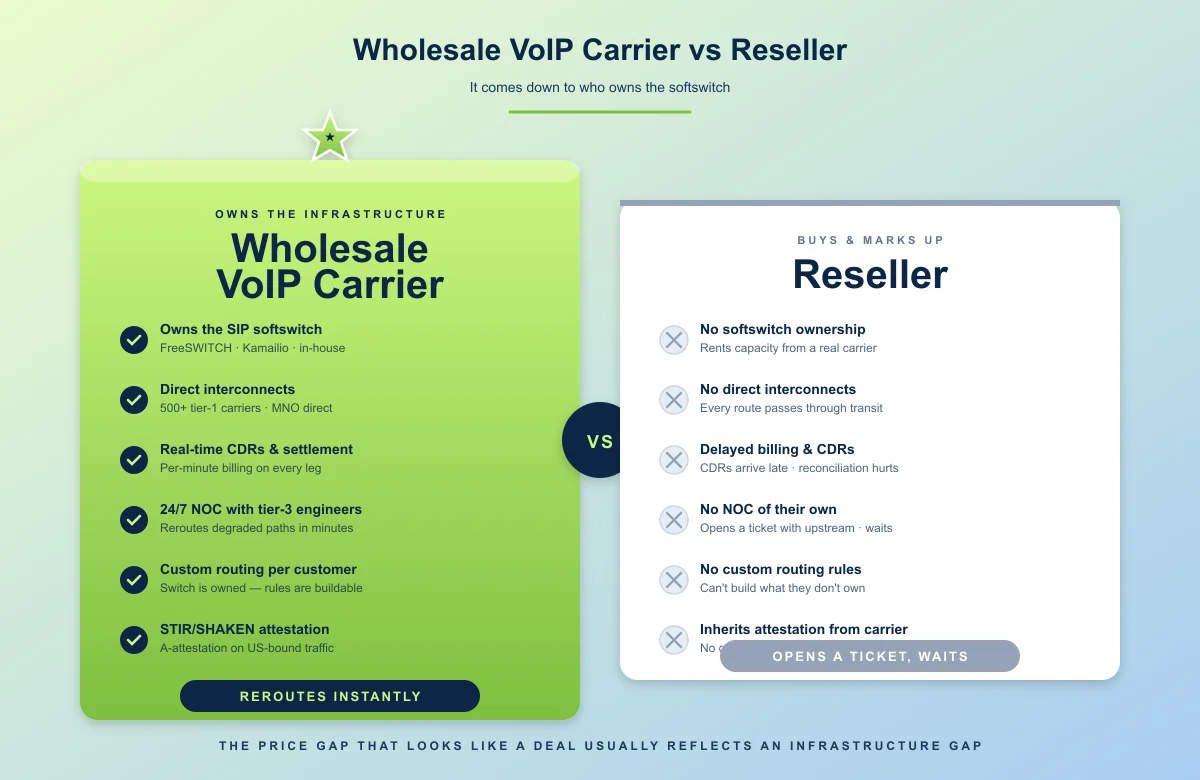
Resellers don't own switching, don't hold direct interconnects, and don't run a NOC. When something breaks, they open a ticket with their upstream carrier and wait.
A wholesale VoIP carrier owns the infrastructure. When a route degrades, the carrier reroutes in real time. When fraud spikes, the carrier's NOC investigates. When a customer needs a custom routing rule, the carrier can build it because the carrier owns the switch. The price gap that looks like a deal usually reflects an infrastructure gap that shows up later.
Wholesale VoIP Carrier vs Retail VoIP Provider
The two get conflated, but they're different businesses with different economics. A wholesale VoIP carrier sells in bulk to other businesses — almost always B2B, almost always per-minute or per-channel. The buyer is an MSP, a CPaaS platform, a contact centre, or another carrier. The pricing model is volume-driven and the relationship is contractual.
A retail VoIP provider sells directly to end users — small businesses, enterprises, individual seats. Pricing is per-user-per-month, the channel is marketing-driven, and the support model assumes non-technical buyers. Many companies do both, but they're separate motions. When you're shopping for wholesale capacity, the retail-style sales pitch ("unlimited calling for $25 a seat") is a flag that the seller doesn't understand the buyer's economics.
The Routes a Wholesale VoIP Carrier Sells
Every wholesale carrier's rate sheet is built around route types and destination tiers. Routes are priced by quality, not just country — the deeper economics show up across published wholesale VoIP rates.
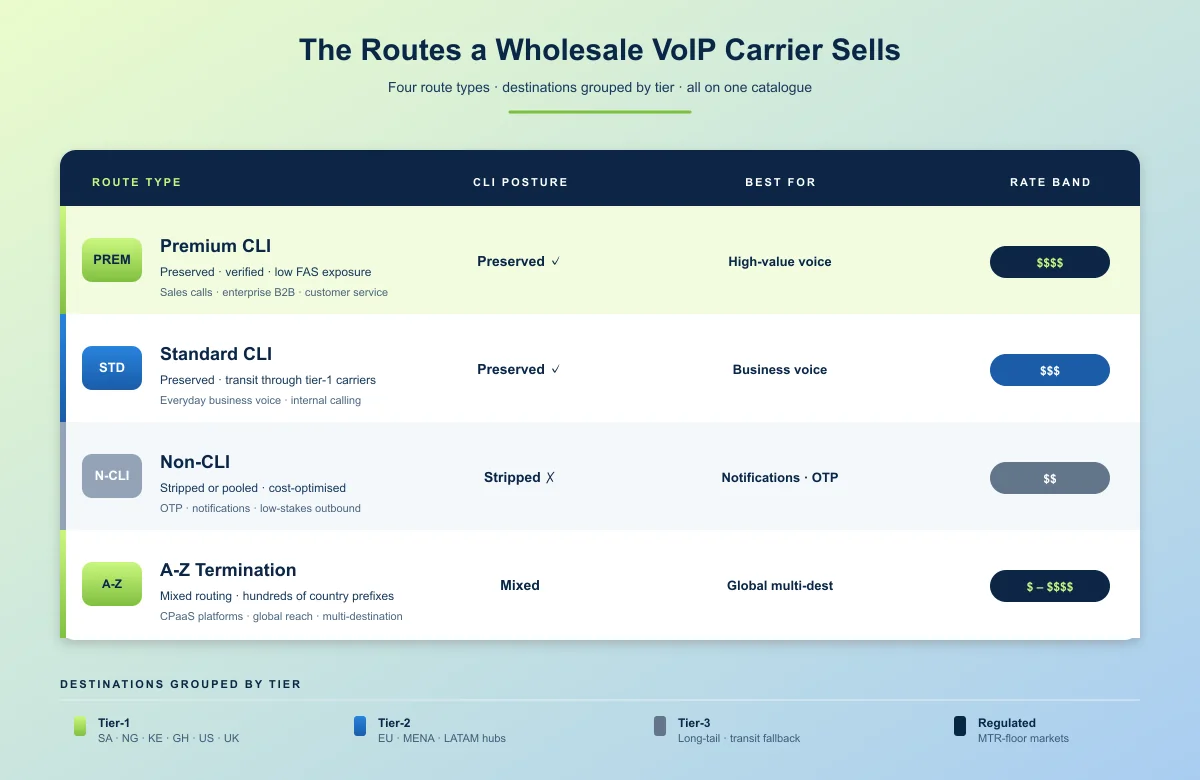
The four route types you'll see most:
- Premium CLI — caller ID preserved. Best for sales calls, customer service, high-value B2B traffic.
- Standard CLI — caller ID preserved. Best for everyday business voice and internal calling.
- Non-CLI — caller ID stripped or pooled. Best for notifications and low-stakes outbound dialing.
- A-Z Termination — mixed routing across hundreds of country prefixes. Best for platforms needing global reach across many destinations.
Match the route to the use case. A premium CLI rate for autodialer traffic burns money. A grey-route rate for healthcare or financial services calls destroys reputation.
How to Choose a Wholesale VoIP Carrier
A real evaluation goes well past the rate sheet. Five questions separate a real carrier from a marketing layer. Industry data on the wholesale voice market shows continued growth across emerging regions.
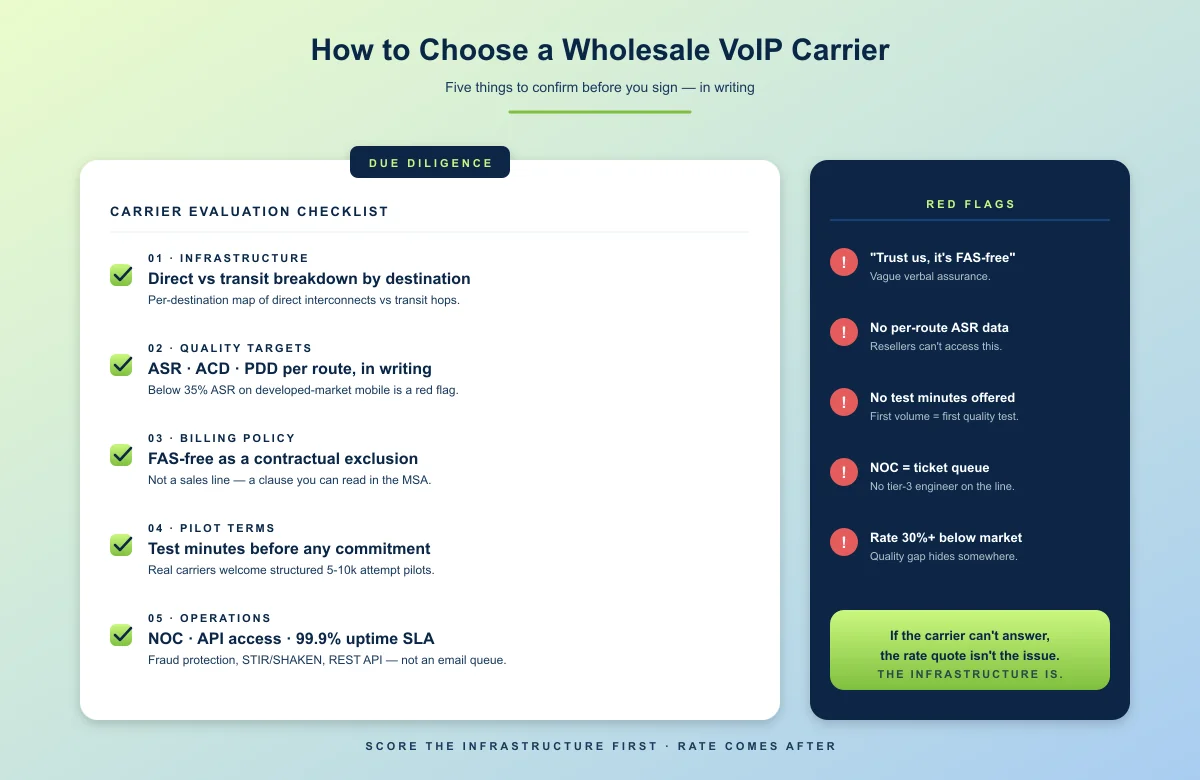
Ask for: Industry data on the wholesale voice market shows continued growth across emerging regions. Industry data on the wholesale voice market shows continued growth across emerging regions. GSMA tracking of the global telecom market shows wholesale voice volumes expanding through 2030.
- Direct vs transit breakdown by destination — direct interconnects vs transit hops.
- ASR, ACD, and PDD targets per route in writing. Below 35% ASR on developed-market mobile is a red flag.
- FAS-free policy as a contractual exclusion, not a sales line.
- Test minutes before any commitment.
- Fraud protection with FCC Guide-mandated STIR/SHAKEN attestation, IRSF detection, and visible NOC monitoring.
- API access for provisioning, routing changes, and CDR retrieval — not just an email queue.
- 99.9% uptime SLA backed by real-time QoS monitoring.
If a wholesale VoIP carrier can't answer those questions clearly, the rate quote isn't the issue. The infrastructure is.
Wholesale VoIP Carriers and African Voice Traffic
Africa is the most fragmented voice termination market on the planet. Mobile penetration is high, regulatory environments differ market by market, and direct carrier relationships are scarce among non-African wholesalers. Most US and European wholesale providers terminate African traffic through one or two transit partners — three or four hops minimum. Latency creeps in. FAS slips through.
MTRs in some African markets are also regulated and high, per GSMA Mobile Economy data. South African mobile MTRs, Nigerian MTRs, and Kenyan termination rates aren't always negotiable. A carrier quoting below the regulated MTR is either burning cash or routing somewhere they shouldn't. TKOS operates from a Johannesburg-anchored network with carrier relationships built across the continent over a decade.
STIR/SHAKEN, Fraud, and Compliance
Wholesale VoIP carriers serving US-bound traffic now operate under STIR/SHAKEN. Calls without proper attestation get flagged, blocked, or shown as "Spam Likely" on the recipient's screen. A carrier without active STIR/SHAKEN can't deliver quality US termination.
For non-US markets, the fraud layer is different — IRSF, wangiri callbacks, SIM-box bypass, and route hijacking. Your carrier should have visible fraud monitoring at the NOC level. TKOS also runs HIPAA-compliant voice infrastructure for healthcare clients and the partners that serve them.
How a Wholesale VoIP Carrier Drives Margin for the Buyer
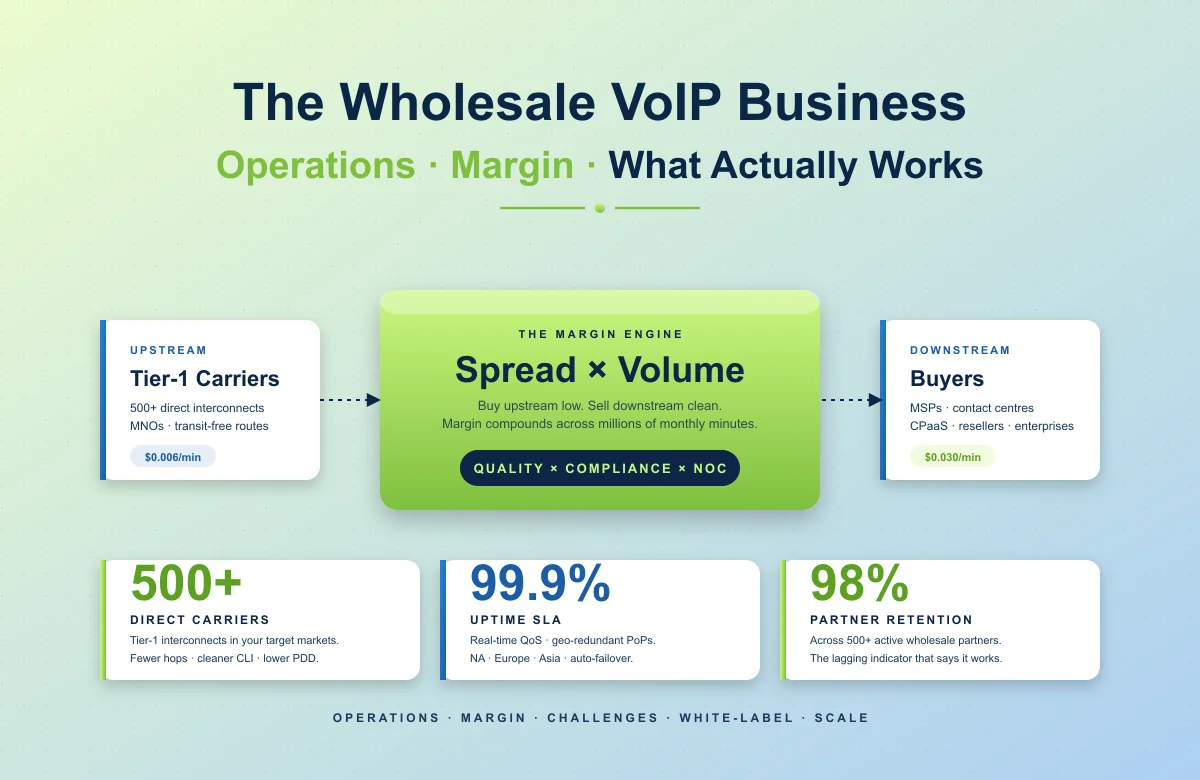
Wholesale economics live or die on three things: route quality, settlement accuracy, and operational responsiveness. A carrier that gets all three right delivers margin you can model. A carrier that misses any one of them turns every billing cycle into a guessing game.
Route quality determines completion rates. Higher ASR means more billable minutes per dial attempt. FAS-free billing means every charged minute reflects a real conversation. PDD under four seconds keeps recipients from hanging up before connect. Each of those metrics flows directly into the unit economics of the platform on top.
Settlement accuracy is the part most buyers underestimate. CDRs that match across both sides of every call, real-time access to those CDRs through an API, and disputes resolved in days instead of weeks — that's how a wholesale VoIP carrier earns the right to recurring volume. Anything less and your finance team spends every month reconciling instead of forecasting.
What TKOS Brings as a Wholesale VoIP Carrier
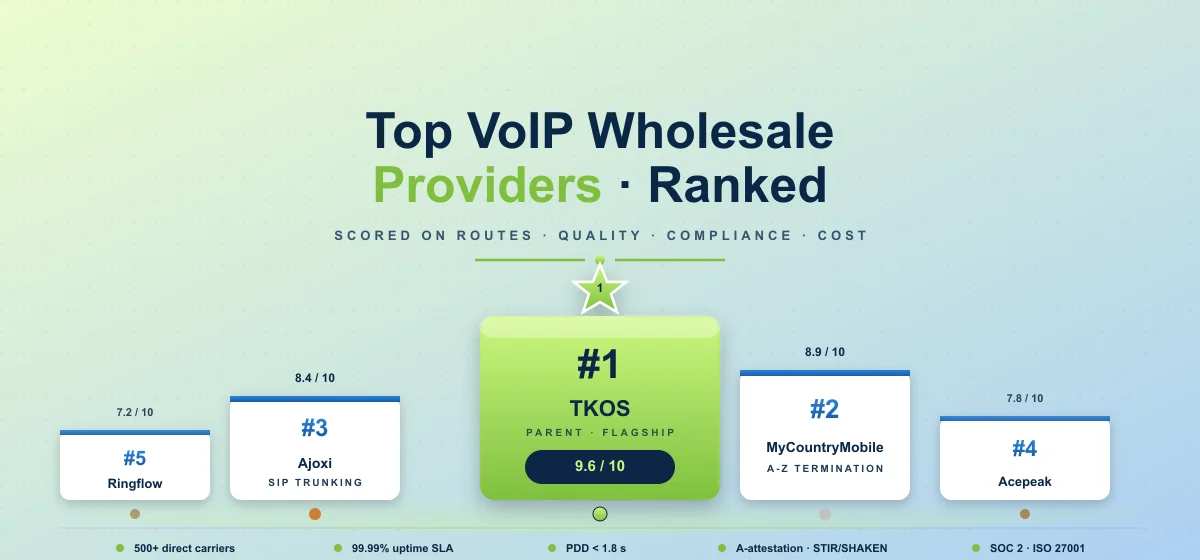
TKOS isn't the cheapest. We don't try to be. What we deliver:
- 500+ direct carrier interconnects for fewer hops and superior audio clarity, especially across Africa.
- Geographically redundant architecture with PoPs in North America, Europe, and Asia.
- 99.9% uptime SLA backed by real-time QoS monitoring at the NOC.
- CLI, Non-CLI, and A-Z routes — FAS-free as a baseline, with route choice per destination.
- STIR/SHAKEN active for proper US-bound attestation.
- HIPAA-compliant voice for healthcare clients.
- 100+ countries DID coverage for local presence in the markets your platform sells into.
- 24/7/365 NOC with tier-3 engineers — issues resolved on the first call, not after a ticket sits for a day.
A decade of carrier relationships across Africa isn't a marketing claim. It's why our partners stay — 98% retention across 500+ active partners.
Conclusion
A wholesale VoIP carrier is the layer that decides whether the voice your platform sells holds up under volume. Five pillars define a real carrier — interconnects, switching, routing intelligence, settlement, and NOC — and stripping out any of them gives you a reseller wearing a carrier's name. Pick on the pillars you can audit. The rate sheet is the last conversation, not the first.
Top international termination destinations