Introduction
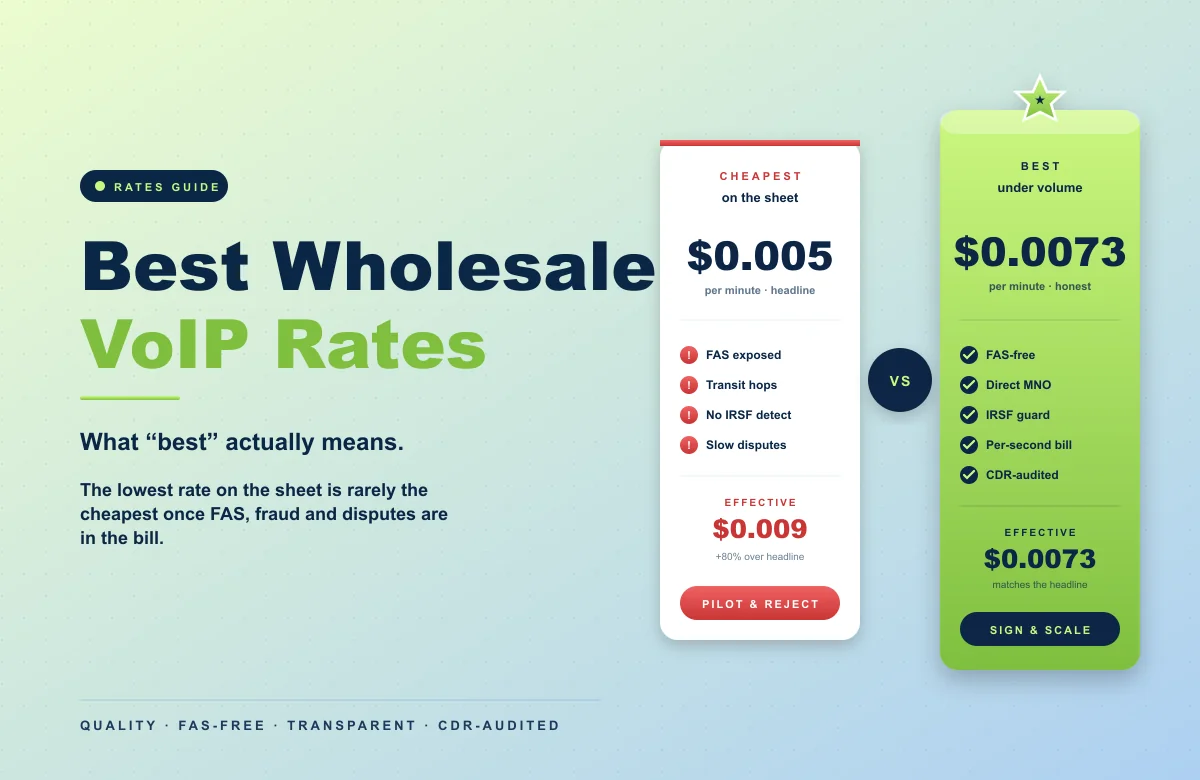
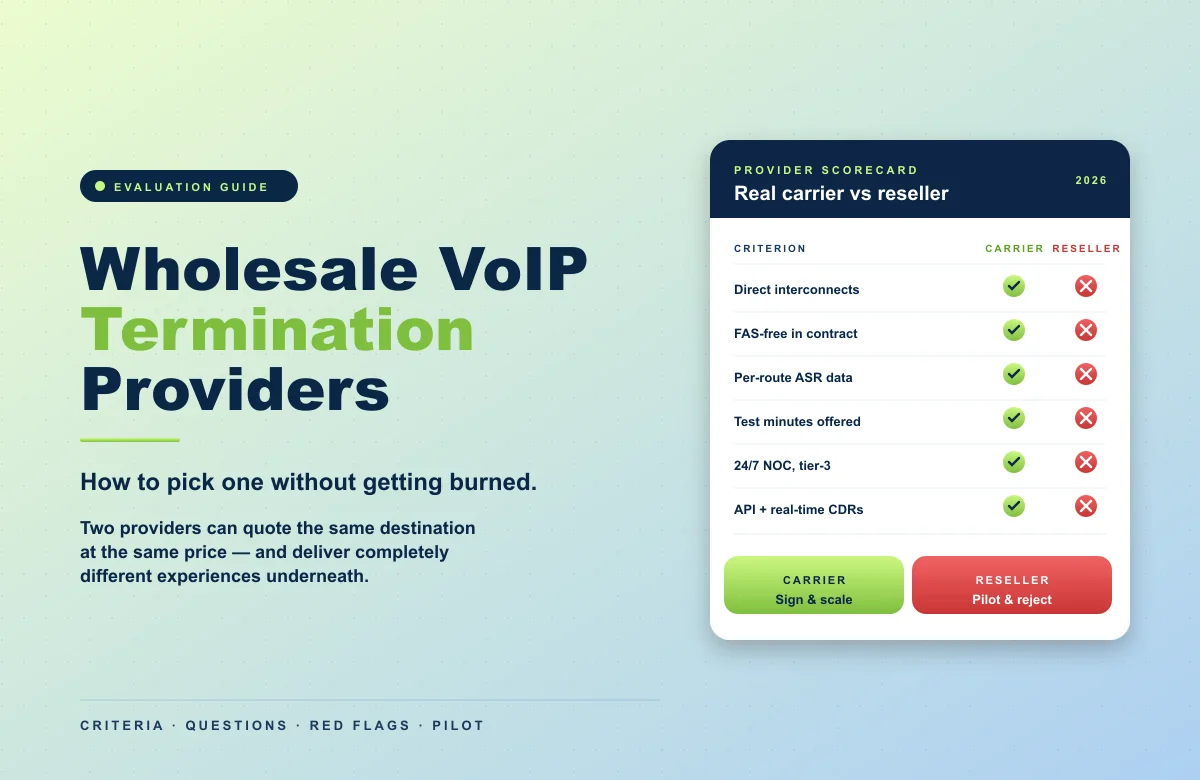
Most wholesale VoIP termination provider quotes are written to obscure the one thing that matters: what the route actually looks like underneath the per-minute rate. Two providers can quote the same destination at the same price and deliver completely different experiences. One runs direct. The other runs through three transit carriers, strips the caller ID, and lets FAS inflate your bill.
This guide breaks down how to evaluate wholesale VoIP termination providers — the criteria that actually matter, the questions to ask before signing, the red flags that mean walk away, and what separates a real termination provider from a reseller pretending to be one. It's written for MSPs, contact centres, CPaaS platforms, and resellers picking the partner that will sit underneath their voice traffic.
How Wholesale VoIP Termination Providers Actually Work
Every outbound call passes through a chain. The originating provider hands the call to a wholesale termination provider. That provider routes the call across one or more interconnects until it lands on the destination operator — a mobile carrier in Lagos, a fixed-line in Manchester, a softswitch in São Paulo. Country codes follow the ITU-T E.164 numbering plan, but the routing path behind any given prefix is provider-specific.
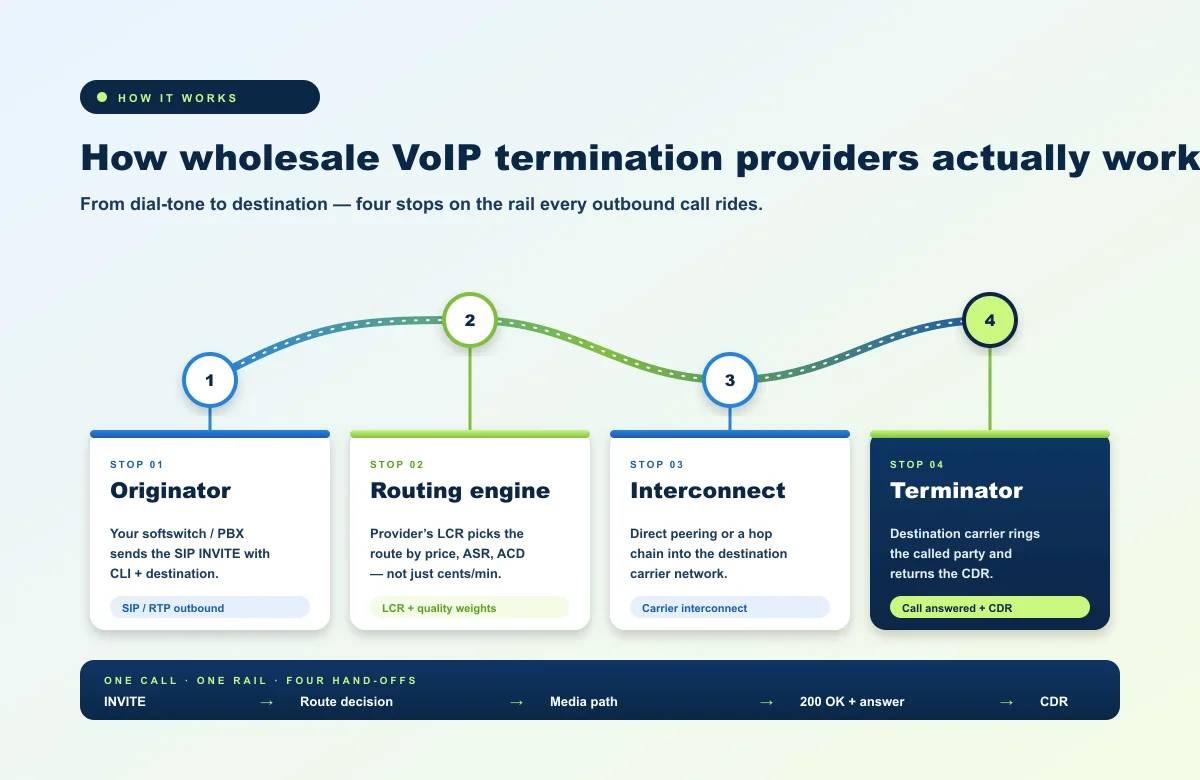
Each hop adds latency, adds margin, and adds a place where audio quality can break. The rate you pay covers that chain plus the provider's margin. The same headline rate can sit on top of one direct interconnect or four transit hops. The number is the same. The route underneath isn't.
Termination Provider vs Reseller — Why the Distinction Matters
This is the gap that catches buyers off guard. The full anatomy lives in the deeper wholesale VoIP termination rates breakdown.
A real wholesale VoIP termination provider owns SIP switching, holds direct interconnect agreements, and runs a NOC. When a route degrades, they reroute. When a customer needs custom routing, they build it because they own the switch.
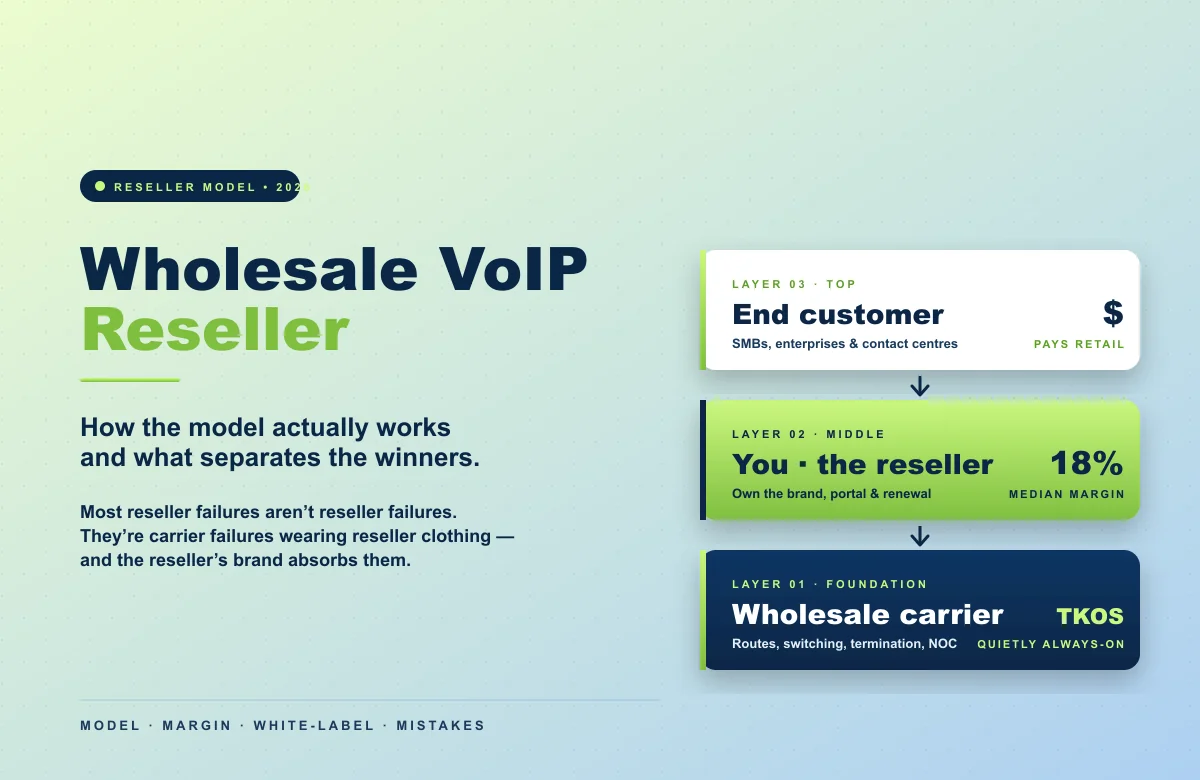
A reseller buys minutes from one termination provider, marks them up, and resells. They don't own the network. When something breaks, they open a ticket with their upstream and wait. The price gap that looks like a deal usually reflects the lack of infrastructure underneath. Both models exist. Both can work. Just know which one you're buying.
The Criteria That Actually Matter
A real evaluation goes well past the rate sheet. Score every wholesale VoIP termination provider against these criteria:
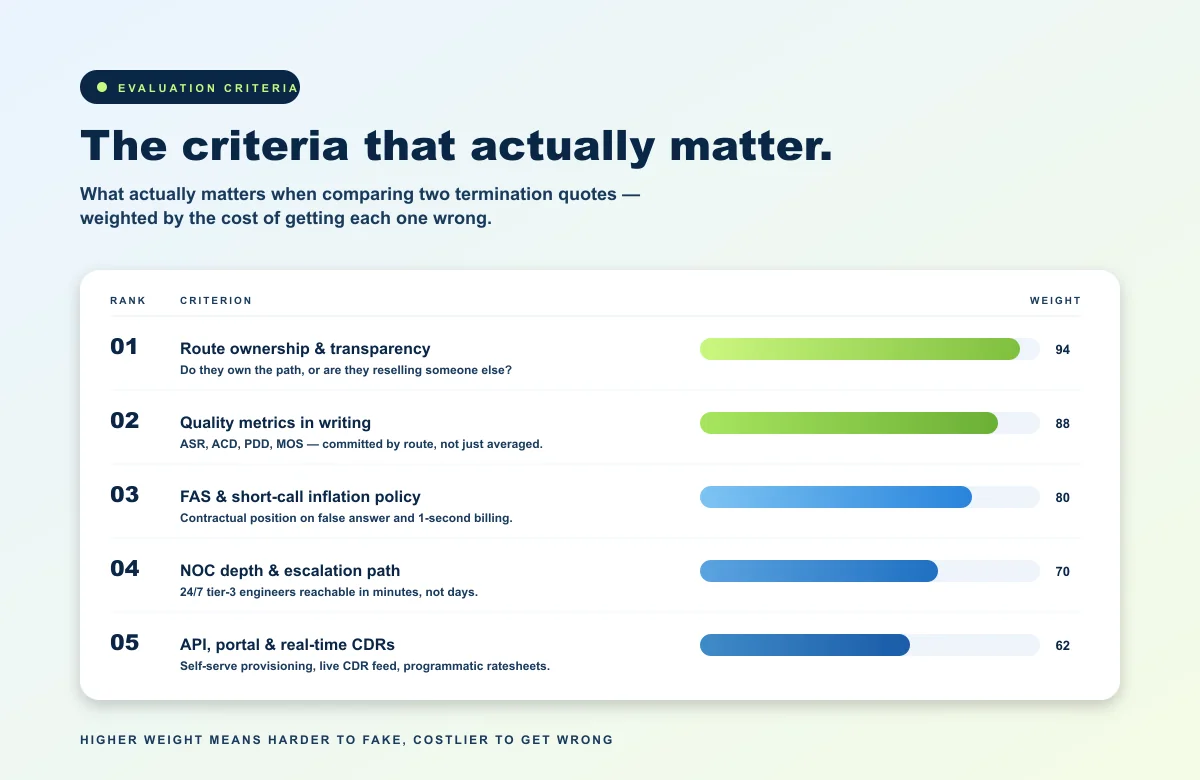
- Direct vs transit — ask which destinations are direct interconnects. Red flag: vague answers or "all routes are direct".
- Route quality — ask for ASR, ACD, PDD, MOS targets per route. Red flag: no per-route data shared.
- FAS policy — confirm FAS-free is contractually excluded. Red flag: verbal assurance, not in writing.
- Test minutes — ask how much test traffic is offered. Red flag: test denied or charged at full rate.
- Fraud protection — confirm FCC Guide-mandated STIR/SHAKEN active and IRSF detection. Red flag: no mention of either.
- NOC response — ask for hours-to-resolution on a degraded route. Red flag: days, or no published SLA.
- API & CDR access — confirm REST API for provisioning and CDRs. Red flag: email queue only.
- Uptime SLA — confirm a contractual uptime number. Red flag: no SLA in writing.
The Questions to Ask Before Signing
Five questions surface most of what a sales pitch hides:
- Are these routes direct or transit, per destination? If the answer isn't a clear breakdown, the route quality probably isn't.
- What ASR and ACD do you commit to per route? Anything below 35% ASR on developed-market mobile is a flag. Anything below 25% is a route to avoid.
- Is FAS-free a contract term? Verbal assurances don't survive billing disputes.
- How many test minutes can I run before commitment? A real termination provider lets you verify quality on real traffic. A reseller often can't.
- How does your NOC handle a degraded route at 2 AM? Real answer: "rerouted within X minutes by the on-call engineer." Bad answer: "our team will look into it tomorrow."
If a wholesale VoIP termination provider can't answer these without consulting their reseller upstream, you have your answer.
How to Run a Test Traffic Pilot Before Signing
A real test pilot tells you more than any rate sheet. Structure it in three phases: Industry data on the wholesale voice market shows continued growth across emerging regions.
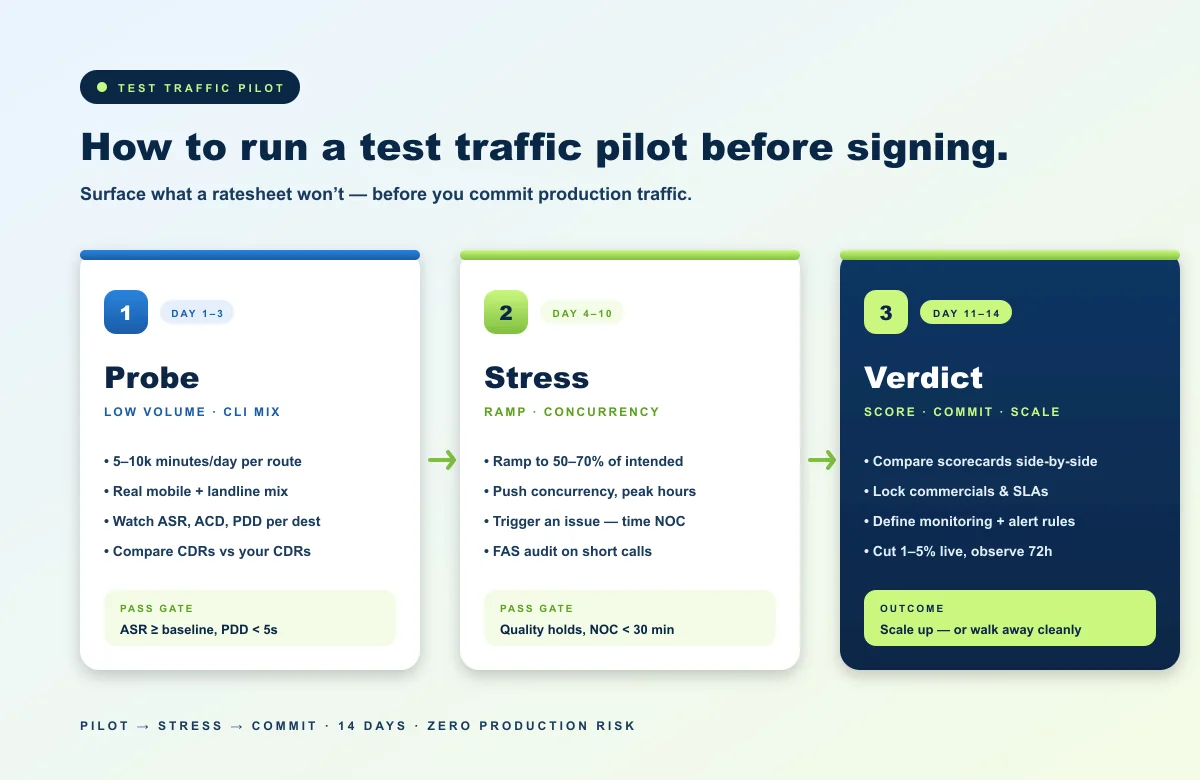
- Phase 1 — Synthetic traffic. Generate 500—1,000 dial attempts spread across your top 10 destinations. Capture ASR, ACD, PDD, and MOS. Reject any provider that won't give you raw CDRs from this phase.
- Phase 2 — Live shadow traffic. Mirror 5—10% of your real traffic to the new provider for two weeks. Compare completion rates and call quality side by side with your incumbent.
- Phase 3 — Volume ramp. Move traffic over in 25% increments, monitoring for FAS spikes, billing discrepancies, and NOC response when issues surface.
Wholesale VoIP termination providers comfortable with this process tend to be the ones worth signing. Providers that flinch at structured testing are usually hiding something the rate sheet won't show.
What Separates Good Termination Providers from Great Ones
Most wholesale VoIP termination providers can deliver acceptable quality on commodity destinations — US, UK, Canada, Australia. The differentiation shows up on the destinations that aren't commoditised. Africa. Parts of Latin America. South Asian mobile. Eastern European mobile. Markets where direct interconnects are scarce among non-local wholesalers, as the GSMA Mobile Economy report shows year after year.
Great providers also publish performance data. Per-route ASR over the last 30 days. PDD trends. FAS dispute resolution times. They treat transparency as a competitive advantage instead of something to hide. Anyone selling wholesale VoIP termination who can't produce that data on request is selling a black box, regardless of what the quote looks like.
Red Flags in a Wholesale VoIP Termination Quote
Walk away when you see:
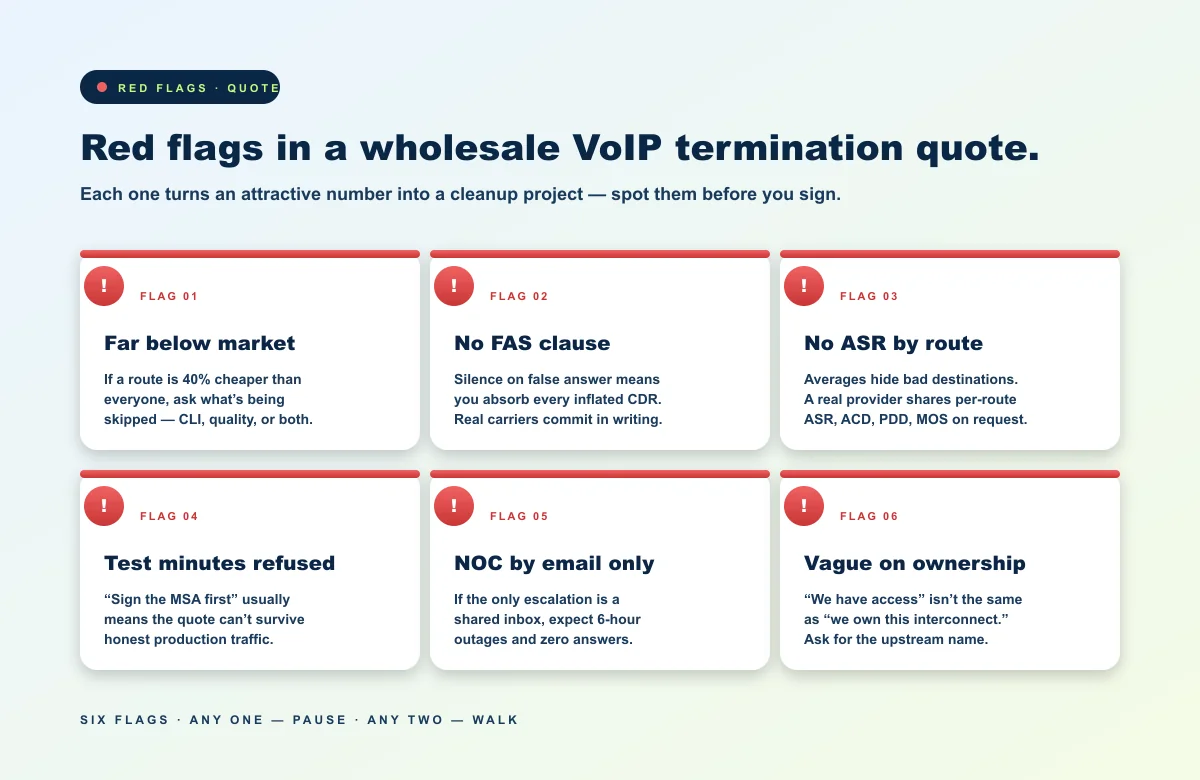
- A per-minute rate 30%+ below the market median for that destination.
- "All-inclusive" rates with no CLI vs Non-CLI distinction.
- No published FAS policy.
- Refusal to share ASR or PDD data per route.
- Test minutes denied, capped, or charged at full rate.
- Long contract lock-ins with no quality SLAs.
- Rate sheets that haven't been updated in 90+ days.
Honest providers compete on quality and direct routing, not on undercutting the floor.
Why African Voice Traffic Needs a Different Provider Profile
Africa is the most fragmented termination market on the planet. Most US and European wholesale VoIP termination providers don't hold direct relationships with major African MNOs (Vodacom, MTN, Cell C, Telkom, Safaricom). They route African traffic through European or US transit partners — three or four hops minimum on most routes.
MTRs in some African markets are also regulated and high. A provider quoting below the regulated MTR is either burning cash or routing somewhere they shouldn't. Picking a wholesale VoIP termination provider with direct African interconnects isn't a nice-to-have for African voice traffic. It's the only way to keep latency, audio quality, and billing integrity intact.
What TKOS Brings as a Wholesale VoIP Termination Provider
A decade of carrier relationships across Africa and 98% partner retention across 500+ active partners isn't a marketing claim. It's why partners stay.
- 500+ direct carrier interconnects for fewer hops and superior audio clarity, especially across Africa.
- CLI, Non-CLI, and A-Z routes — FAS-free as a baseline, with route choice per destination.
- Geographically redundant architecture with PoPs in North America, Europe, and Asia plus automatic failover.
- 99.9% uptime SLA backed by real-time QoS monitoring at the NOC.
- STIR/SHAKEN active for proper US-bound attestation.
- HIPAA-compliant voice for healthcare clients and the partners that serve them.
- 100+ countries DID coverage for local presence in your target markets.
- 24/7/365 NOC with tier-3 engineers — issues resolved on the first call.
See also: A-Z VoIP termination.
Conclusion
Choosing a wholesale VoIP termination provider is less about who has the cheapest rate and more about who can keep their promises under volume. Score on direct vs transit, route quality, FAS policy, fraud controls, NOC response, and uptime SLA — in writing. Run a structured test pilot before scaling. The carriers that survive that process are the ones whose CDRs will match your bills every cycle.