Introduction
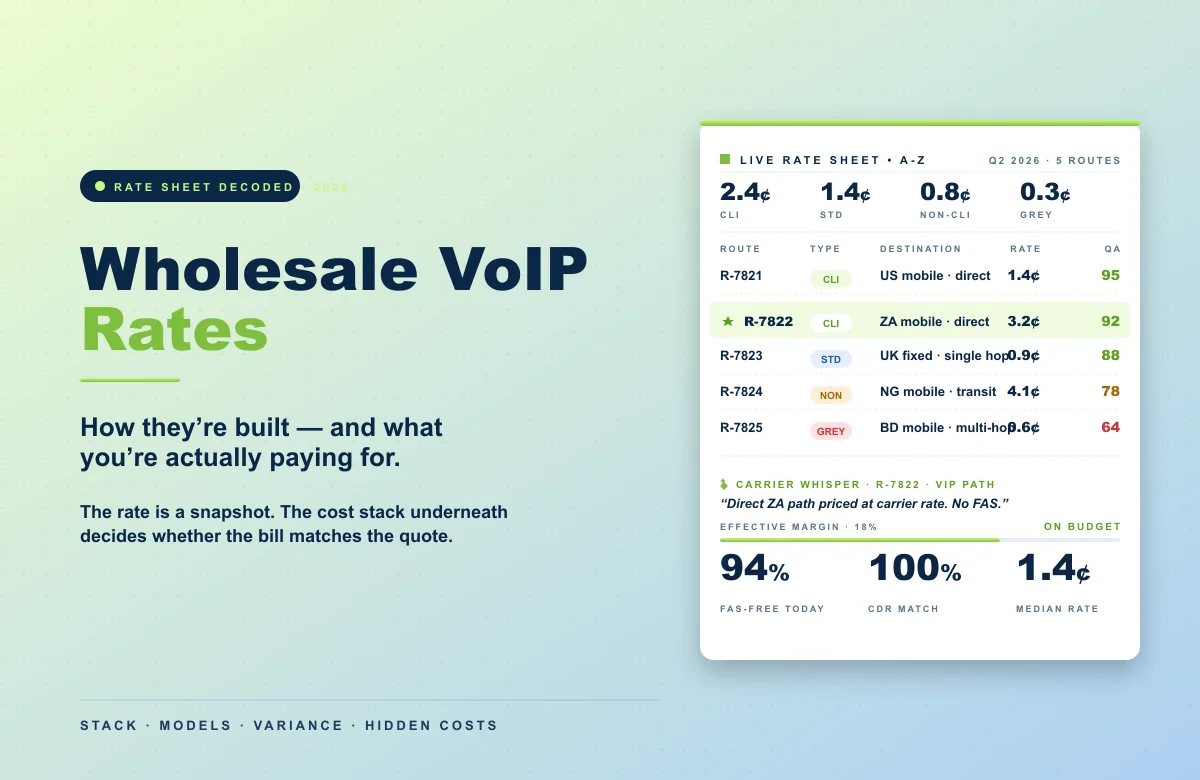
Wholesale VoIP rates can vary 400% between providers for the same destination on the same day, a pattern reflected in GSMA wholesale voice market data. The number on the rate sheet is a snapshot.
The economics underneath — direct interconnect cost, transit margin, fraud protection investment, NOC overhead, FAS exposure — decide whether that number is real or a cosmetic discount that disappears once the bill arrives.
This guide breaks down how those per-minute prices are actually built — the components inside every per-minute price, the pricing models providers use, why rates differ so wildly between carriers, and the hidden costs that turn a "cheap" rate into something more expensive than the premium one. It's written for buyers who want to read a rate sheet the way a carrier-economics analyst would.
Wholesale VoIP Rate Table by Destination (2026)
The table below shows indicative wholesale VoIP rates across major destinations for 2026. Rates reflect CLI routes billed on a per-minute basis. Actual rates vary by volume tier, commitment level, and route classification — use these as a benchmark when evaluating provider quotes, not as a price floor.
| Destination | Route Type | Rate Range / Min (USD) | Billing Increment | Typical ASR |
|---|---|---|---|---|
| United States | CLI / Non-CLI | $0.001 — $0.006 | 6-second | 60—72% |
| United Kingdom — Mobile | CLI | $0.010 — $0.022 | 6-second | 48—60% |
| Germany — Fixed | CLI | $0.006 — $0.014 | 6-second | 55—68% |
| Australia — Mobile | CLI | $0.014 — $0.028 | 6-second | 42—56% |
| India — Mobile | CLI / Non-CLI | $0.003 — $0.010 | 6-second | 45—60% |
| South Africa — Mobile | CLI | $0.018 — $0.040 | 6-second | 36—48% |
| South Africa — Fixed | CLI | $0.007 — $0.018 | 6-second | 52—68% |
| Nigeria — Mobile | CLI | $0.030 — $0.065 | 30-second | 30—44% |
| Kenya — Mobile | CLI | $0.022 — $0.050 | 6-second | 34—46% |
| Ghana — Mobile | CLI | $0.028 — $0.058 | 30-second | 28—42% |
| Egypt — Mobile | CLI | $0.020 — $0.045 | 6-second | 32—44% |
| Brazil — Mobile | CLI | $0.012 — $0.028 | 6-second | 40—54% |
| UAE — Mobile | CLI | $0.016 — $0.038 | 6-second | 42—58% |
Three things to note when comparing these numbers against a provider quote: first, confirm whether the rate is CLI or Non-CLI — Non-CLI routes run 15—30% cheaper but carry stripped caller ID and higher FAS exposure. Second, check the billing increment — 30-second rounding on short calls (under 45 seconds) inflates effective cost significantly compared to 6-second billing. Third, verify whether these are direct-interconnect rates or transit rates — the same destination can carry a $0.005 spread between a direct route and a three-hop transit path.
How These Rates Are Constructed
Behind every per-minute number is a stack of costs. The component breakdown for wholesale VoIP termination rates follows the same pattern. A wholesale VoIP rate covers six layers:
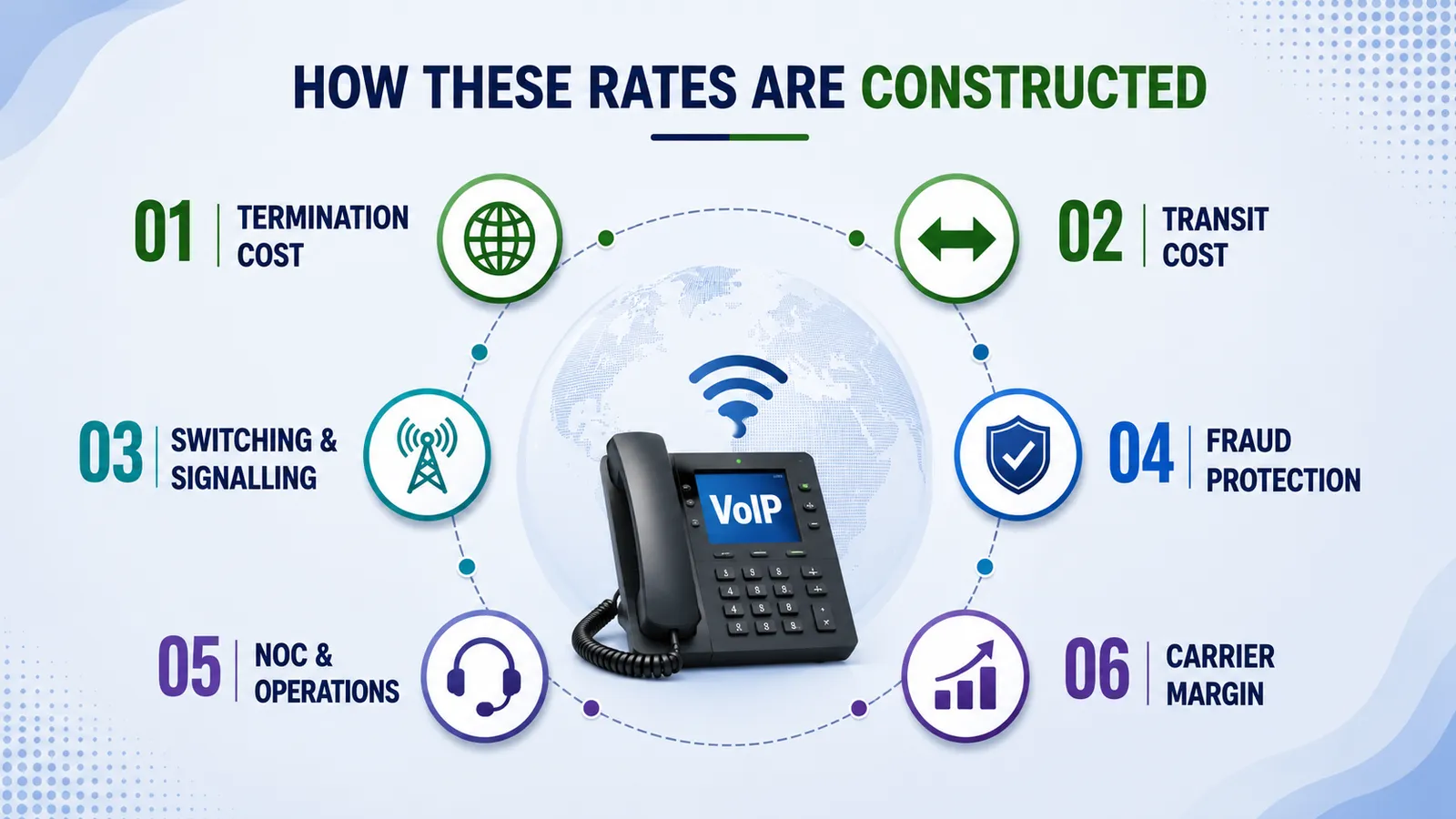
- Termination cost. What the carrier pays the destination operator to land the call. For mobile destinations, this is usually a regulated MTR (mobile termination rate). For fixed-line, it's negotiated.
- Transit cost. If the call passes through one or more intermediate carriers, each takes a margin. Direct interconnects skip this layer.
- Switching and signalling. The cost of running carrier-grade SIP infrastructure — softswitches, SBCs, monitoring, redundant capacity.
- Fraud protection. FCC Guide-mandated STIR/SHAKEN attestation, IRSF detection, anomaly monitoring. Skipping this layer cuts cost; it also cuts buyer protection.
- NOC and operations. 24/7 staffing, dispute resolution, real-time CDR access, customer support.
- Carrier margin. What the carrier keeps after costs.
Two providers can quote the same rate and run completely different cost stacks underneath. One uses direct interconnect with no fraud monitoring. Another uses three transit hops with full STIR/SHAKEN attestation. The headline is the same. The economics aren't.
Understanding the cost stack changes how buyers evaluate quotes. When a provider can't explain what their per-minute rate covers at the component level, that's usually because the margin is embedded in layers the buyer can't see.
Carriers with direct interconnects can show the termination cost, transit cost, and fraud protection layer separately. Resellers operating on someone else's network typically can't. Buyers who ask for the breakdown quickly identify which category they're dealing with.
The Pricing Models Wholesale VoIP Providers Use
Most wholesale VoIP providers price on one of four models. The right model depends on your traffic profile.
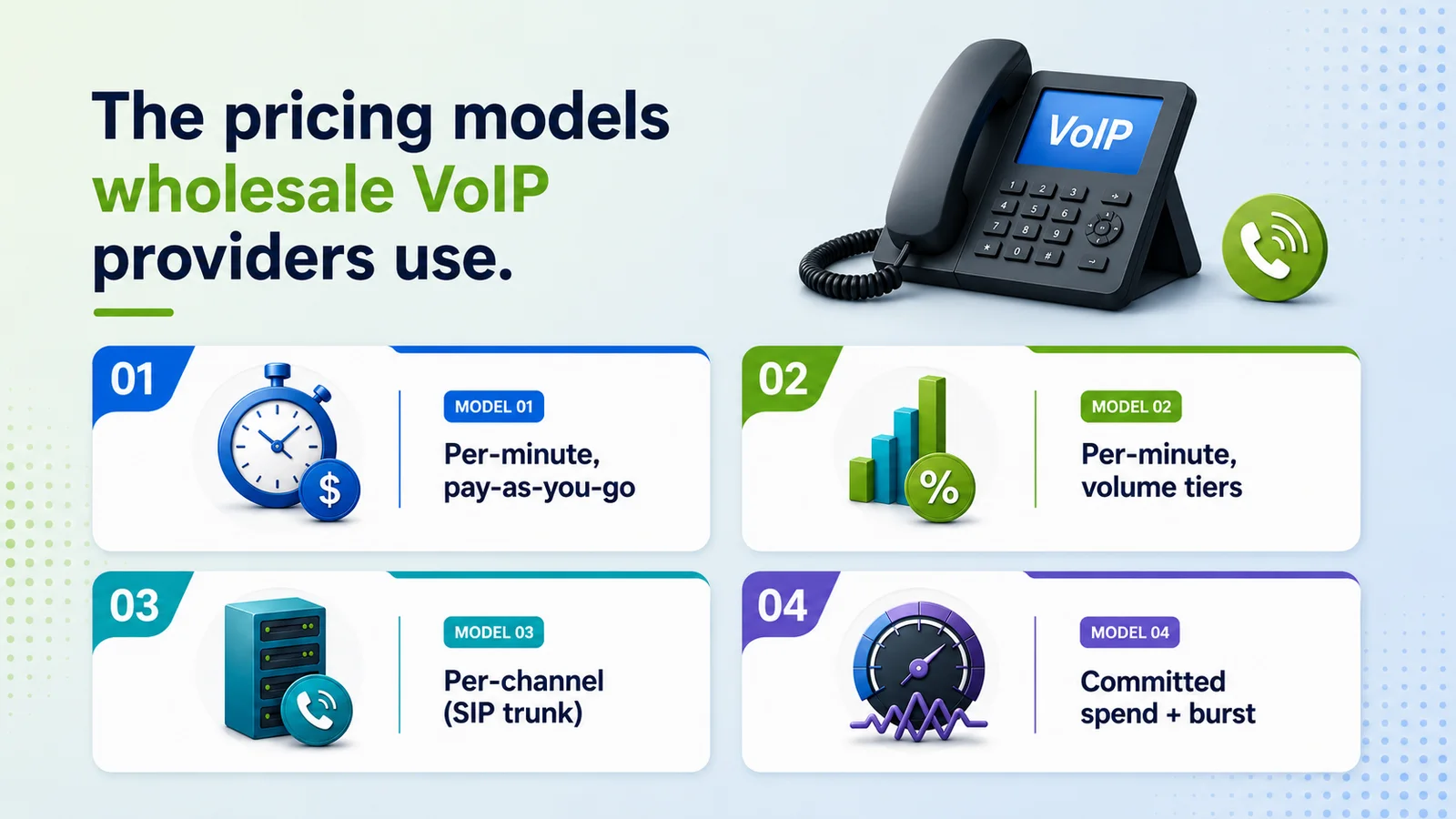
- Per-minute, pay-as-you-go — charged per actual minute terminated. Best for variable or seasonal traffic.
- Per-minute with volume tiers — lower per-minute rate above committed monthly volume. Best for predictable monthly minutes.
- Per-channel (SIP trunk) — flat fee per concurrent call channel. Best for contact centres with steady call volume.
- Committed-spend with bursting — fixed monthly spend covers a base; bursts charged separately. Best for platforms with baseline plus spikes.
Why These Rates Vary So Wildly
The 400% variance isn't random. Three drivers explain most of it.
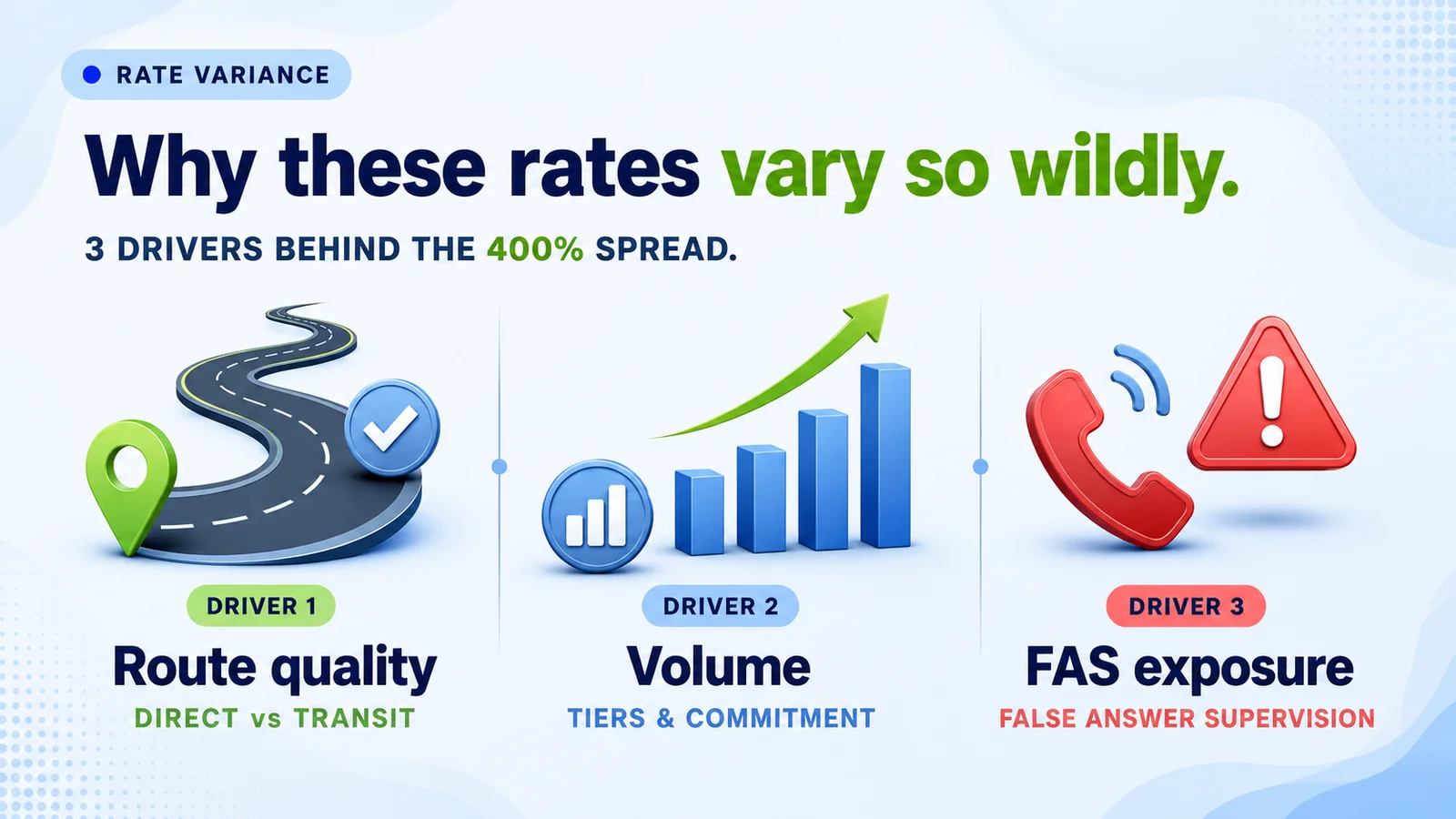
First, route quality. A premium CLI route through direct interconnects costs more than a Non-CLI grey route through three transit carriers. Both terminate to the same destination. Both show up on a rate sheet.
Buyers chasing the lower number often find the route stripped of caller ID, with FAS inflation that doubles effective cost. The same dynamic shows up in wholesale voice termination rates across every market.
Second, volume. A buyer committing to 50 million monthly minutes pays a different rate than a buyer terminating 100,000. Wholesale economics reward predictability, and the rate sheet usually has tiered pricing buried in the fine print.
Third, FAS exposure. False Answer Supervision routes bill you for connect tones, voicemail prompts, and ringing time as if they were live conversations.
A FAS-heavy route at $0.005 per minute can effectively cost $0.009 once inflation is factored in. The cosmetic rate is the lower number; the real rate is what the bill actually shows.
How Volume Tiers and Commitments Affect Rates
Most rate sheets include implicit or explicit volume tiers. Higher monthly minutes unlock lower per-minute rates, and longer commitments unlock better tier breakpoints. The structure usually looks like:
- Tier 1 (low volume): published rate.
- Tier 2 (mid volume): 10—20% discount on the published rate.
- Tier 3 (high volume): 25—40% discount, often with custom routing.
- Custom enterprise tiers: negotiated for very high volume buyers.
If your monthly minutes have been growing, ask for a tier review. Most providers don't volunteer the renegotiation until renewal — buyers who ask mid-contract often get the better rate without changing carriers. GSMA tracking of the global telecom market shows wholesale voice volumes expanding through 2030.
The Hidden Costs That Inflate Wholesale VoIP Rates
Five costs sit outside the per-minute headline but show up on the bill:
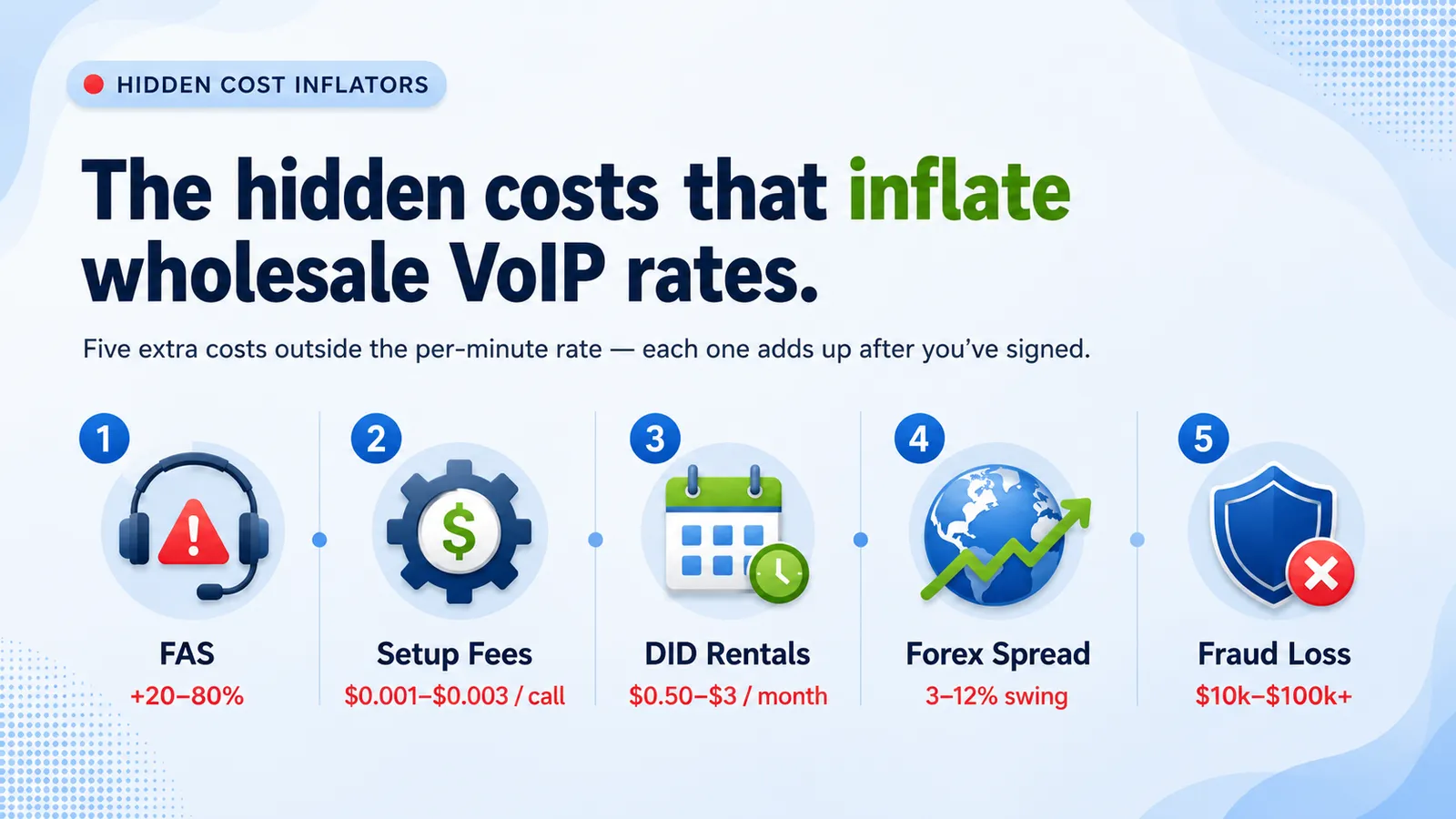
- FAS inflation. Routes billing for non-conversational call signals.
- Setup and connection fees. Per-call charges added on top of per-minute pricing.
- DID monthly fees. If your platform uses inbound numbers, those usually carry separate per-number fees.
- Forex spread. Africa-bound traffic priced in USD adds volatility for buyers paying in ZAR or NGN.
- Fraud loss exposure. Carriers without active fraud detection pass IRSF and SIM-box losses to the buyer in many disputes.
A real wholesale VoIP rate quote itemises these. A polished one buries them. Always ask for an all-in cost projection before signing.
What to Demand From a Wholesale VoIP Provider
Not all wholesale VoIP providers run the same economics. The cheapest headline rate rarely reflects the actual cost once hidden charges are factored in. When evaluating providers, buyers should verify these commitments in writing:
- Direct interconnect access. Fewer transit hops mean lower effective cost and better route quality, especially on Africa-bound traffic.
- FAS-free billing as a contractual term — not a sales claim. Ask for the FAS policy in writing and confirm it covers voicemail connect events.
- Transparent route classification. CLI, Non-CLI, and A-Z rates shown separately so buyers can match route type to use case per destination.
- Volume-aware tier reviews. Real rate breaks for committed monthly minutes, reviewed periodically rather than only at renewal.
- Itemised cost transparency. DID fees, setup costs, and forex spread shown separately on the invoice, not bundled into the per-minute rate.
- Active fraud protection. STIR/SHAKEN attestation and IRSF detection should be standard, not an optional add-on billed separately.
- Uptime SLA with real-time QoS monitoring — the rate should cover the operational infrastructure, not just the call termination.
A provider who resists itemising costs or can't produce a historical bill for reference is usually the one whose real rate diverges most from the headline. The analysis is simple: ask for the cost stack, ask for the FAS policy in writing, run test minutes and verify the rate against actual billing.
How to Read a Wholesale VoIP Rate Sheet Correctly
A wholesale VoIP rate sheet looks like a spreadsheet of destinations and per-minute prices. The real signal is in what the sheet doesn't print upfront. Three rules:
- Read the asterisks first. Footnotes are usually where setup fees, FAS exclusions, billing increments, and forex spreads live. A rate that looks 20% cheaper sometimes loses that advantage in the asterisks.
- Compare per-second vs per-minute billing. Some providers bill in 60-second increments, rounding every call up to the nearest minute. Others bill in 6-second or 1-second increments. Per-second billing alone can change effective cost by 5—15% depending on your call-duration profile.
- Check the validity period. Rate sheets are snapshots. Some providers refresh weekly, others quarterly. A stale rate sheet means the prices you sign on may not match the prices you actually pay.
One underused technique is running 500—1,000 test minutes to a specific destination before committing to volume. Test minutes reveal whether the quoted ASR holds in practice, whether FAS events inflate the bill above the headline rate, and whether the carrier's STIR/SHAKEN attestation is real or nominal.
Most carriers accommodate test runs for buyers evaluating a switch. Providers who resist test-minute runs before a large commitment are almost always protecting a discrepancy between the rate sheet and the real bill.
A serious wholesale VoIP buyer reads the rate sheet, the contract, and the historical billing data together. The headline number is the start of the analysis, not the conclusion.
How Per-Minute Pricing Translates Into Real Margin
The per-minute rate is only half the margin equation. The other half is what completion rates and FAS exposure do to effective cost. A rate of $0.005 per minute on a route with 30% ASR and 5% FAS inflation costs more in real terms than $0.007 on a route with 45% ASR and zero FAS.
Wholesale VoIP buyers who model rates against quality metrics — not just headline price — protect margin from cosmetic discounts that erode it.
Real wholesale providers welcome this analysis. Polished resellers tend to push back, because the spreadsheet doesn't tell their story.
This 400% spread tracks a broader pattern documented in GSMA wholesale voice market data — pricing dispersion widens as more traffic shifts onto direct interconnects.
The margin math changes significantly when buyers move from evaluating headline rates to modelling effective cost per minute. A destination with a published rate of $0.003 and a 25% ASR means far fewer completed calls per dollar than a $0.005 route with 45% ASR. Buyers who include completion rate and FAS exposure in their models consistently find that the premium route is cheaper in practice.
This is not an unusual conclusion in carrier economics — it is the standard one. Rate-sheet buyers who skip this step pay for the education over time in unexplained billing variances.
Conclusion
Wholesale VoIP rates make more sense once you read them as a cost stack instead of a single number. Two providers can quote the same wholesale VoIP rates and run completely different economics underneath — direct vs transit, FAS-free vs FAS-exposed, fraud-protected vs not.
The buyers who model wholesale VoIP rates against the components they actually cover protect their margin from cosmetic discounts that erode it.
The practical checklist is short: verify direct interconnect access, get the FAS policy in writing, confirm fraud protection is standard not optional, and run test minutes before committing to volume. The analysis separates providers who run transparent cost stacks from those who bury margin in footnotes.