Introduction
Wholesale voice termination is the silent layer that decides whether your call connects, how clean it sounds, and how much margin survives the trip from your network to the recipient. Get it right and your platform runs profitably; get it wrong and you spend quarters explaining call-quality complaints.
Picture a Johannesburg call centre running two thousand simultaneous outbound calls into Cape Town and Pretoria, but routed through Frankfurt — a third drop to busy and half the answered ones sound terrible. That isn't a hardware fault; it is wholesale voice termination going wrong. This guide explains the service from the ground up — definitions, mechanics, metrics, and how to pick a partner that won't cost you ASR points or POPIA compliance.
What Is Wholesale Voice Termination?
Wholesale voice termination is the high-volume B2B service of routing calls from one network to a destination network — landline, mobile, or VoIP — across a wholesale provider's carrier interconnects. Buyers (carriers, resellers, call centres) pay per-minute rates and connect via SIP. It is the infrastructure layer behind retail VoIP, contact centres, and dialler operations.
In plain English: when your customer dials a number, that call has to physically reach the recipient's phone. Wholesale voice termination is the part of the journey where the call hands off from your network to whichever carrier owns the destination number's network. You buy this in bulk — millions of minutes — instead of buying individual phone-to-phone connectivity. Two terms get used interchangeably and shouldn't be: the service itself, and the wholesale voice provider that sells it. For the operations angle, see how this layer fits into the broader wholesale voice carrier business.
How a Call Actually Travels
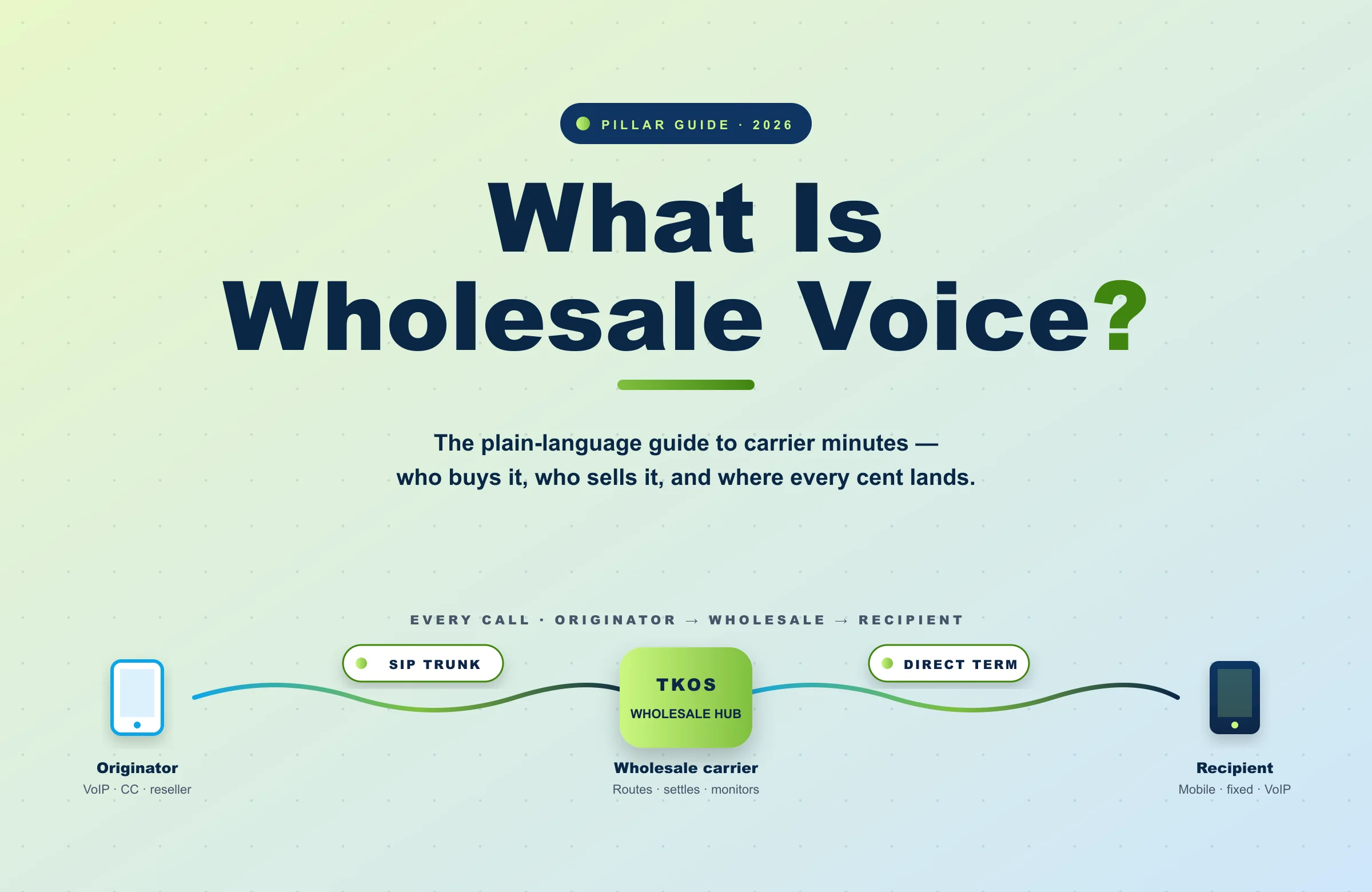
A wholesale voice call covers more ground than most teams realise. Between the dialler and the recipient's handset, five distinct stages decide whether the call connects cleanly and whether the bill reflects what actually happened. The whole sequence runs in milliseconds, but each stage is a separate engineering decision.
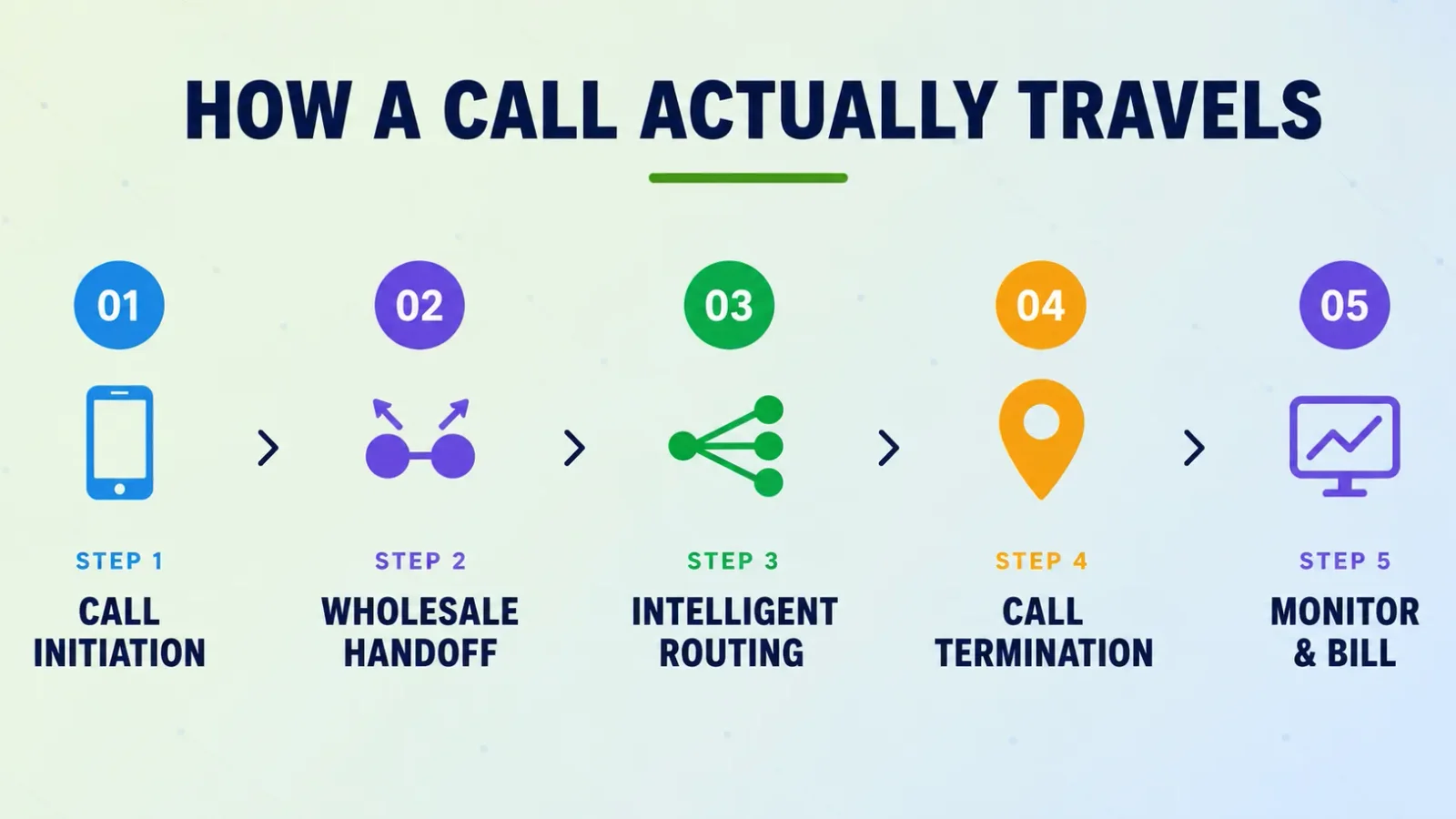
Five steps, every time:
- Call initiation. A user, application, or dialler triggers a call into an IP-based platform (softswitch, PBX, or contact-centre stack).
- Wholesale handoff. The originating network passes the call to a wholesale voice carrier through a SIP trunk.
- Intelligent routing. The carrier's switch selects a path using Least Cost Routing (LCR) or Quality-Based Routing (QBR), or a blend.
- Call termination. The call traverses the chosen path and lands on the recipient's terminating carrier, which rings the destination device.
- Monitoring and billing. The provider monitors ASR, PDD, and MOS in real time, then writes a CDR for reconciliation.
The whole sequence happens in milliseconds. A well-engineered route delivers Post-Dial Delay (PDD) under two seconds. Anything over five seconds is a routing problem worth investigating. A call routed to Durango, Mexico still passes through the same five stages before it ever reaches the handset.
CLI, Non-CLI, and CC Routes
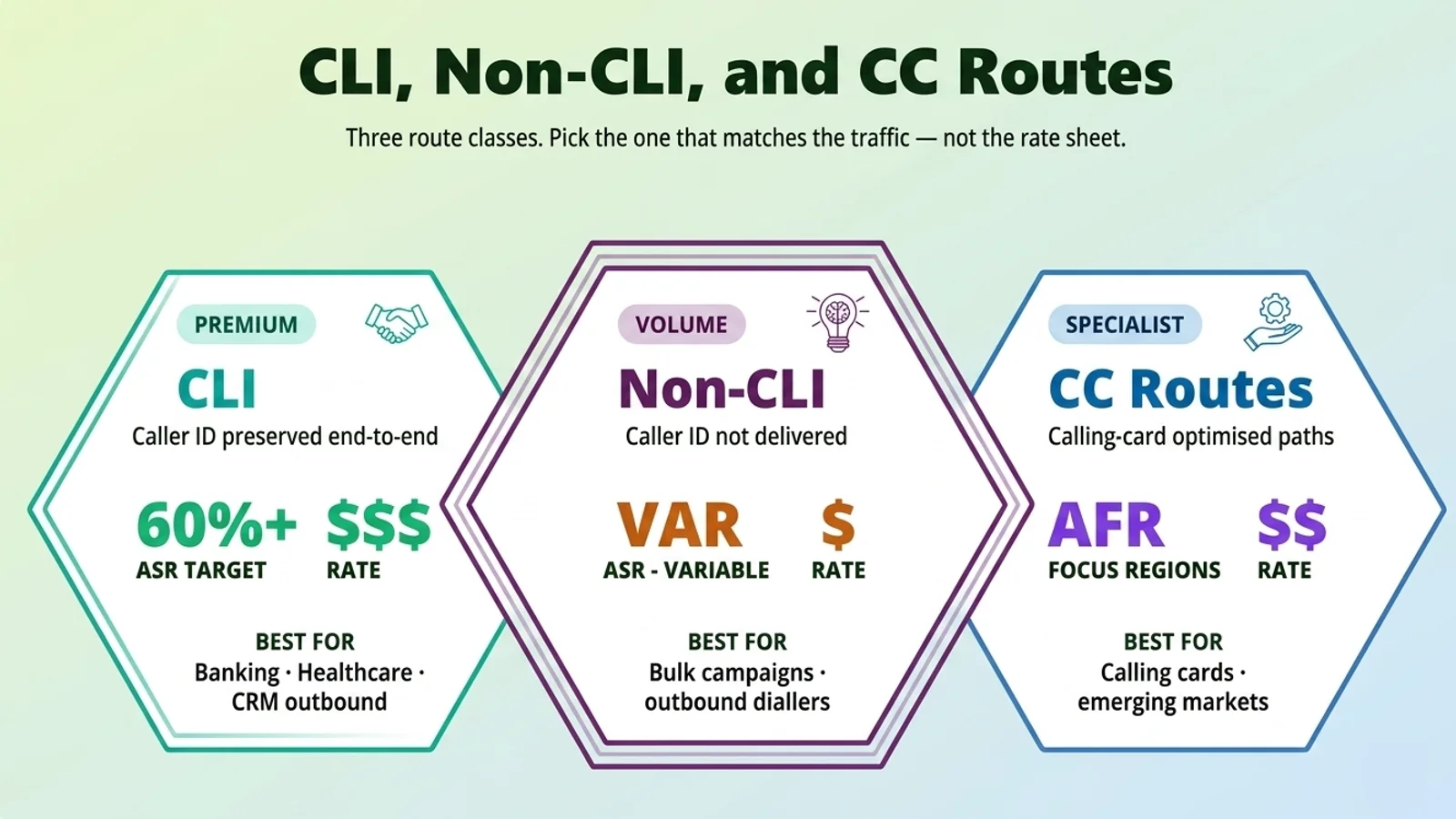
Not every wholesale voice route is the same — three distinct classes serve very different traffic patterns. CLI preserves caller identity for trust-sensitive calls, Non-CLI strips it out for cost-sensitive volume, and CC routes are engineered for specific emerging-market calling-card economics. Picking the right class is the difference between paying for answers and paying for noise.
CLI Routes (Calling Line Identification)
CLI routes preserve the original caller ID end-to-end. Answer rates are higher, customer trust is preserved, and the route works for compliance-sensitive industries (banking, healthcare, regulated outbound). Pure CLI routes target Answer Seizure Ratio (ASR) of 60% or higher on major destinations. They cost more per minute and are worth it wherever a recognisable number drives the conversion.
Non-CLI Routes
Non-CLI (NCLI) routes don't deliver the caller ID. Per-minute cost drops, completion rates vary, and the route suits high-volume diallers and bulk traffic where cost-per-minute matters more than answer quality. Most operators run NCLI for outbound campaigns and reserve CLI for transactional calls.
CC Routes (Calling Card)
CC routes are specialised paths optimised for calling card operators with traffic into Africa, South Asia, and other emerging markets. The routing engineering, settlement structure, and carrier relationships behind these routes are different from standard CLI/NCLI — most global providers don't offer dedicated CC routes at all.
The Hidden Cost of FAS
FAS — False Answer Supervision — is the industry's quiet margin killer. A route reports a call as "answered" before the recipient actually picks up. The billing meter starts. Across millions of monthly minutes, FAS exposure adds up to real money — sometimes 5—8% of total billed minutes, depending on how aggressive the originating route's signalling tricks are. On a 50 million-minute account, that's a margin event measured in months, not weeks.
FAS-free routes start the billing clock only on genuine connection. ACD reports reflect real customer behaviour. ASR data becomes useful for routing decisions instead of polluted by inflated answer events. Ask one question of any vendor: are your routes FAS-free? Anything other than a clear yes is a red flag. Industry data on the wholesale voice market shows continued growth across emerging regions.
Pricing Models in Wholesale Voice Termination
Four common pricing structures show up across wholesale voice termination contracts: Industry data on the wholesale voice market shows continued growth across emerging regions. Industry data on the wholesale voice market shows continued growth across emerging regions. GSMA tracking of the global telecom market shows wholesale voice volumes expanding through 2030.
- Per-minute (pay-as-you-go). Buyer pays only for actual minutes. Best for variable usage or testing.
- Volume-tiered. Per-minute rates drop as monthly volume crosses thresholds.
- Committed-volume. Buyer commits to a minimum monthly volume in exchange for a custom rate deck.
- Flat-rate destination bundles. Less common — fixed cost for unlimited minutes to specific destinations.
Carrier surcharges are usually pass-through. Per-minute rates vary by destination — domestic calls cost cents, international can cost dollars depending on the country's mobile termination rate. A provider transparent about destination-by-destination pricing respects your margin.
One warning: the cheapest per-minute rate almost never wins on actual cost. A 0.5 cent/minute saving on a route with 8% FAS exposure costs more than a slightly higher rate on a clean route. Always model total cost, not headline per-minute.
The Metrics That Matter
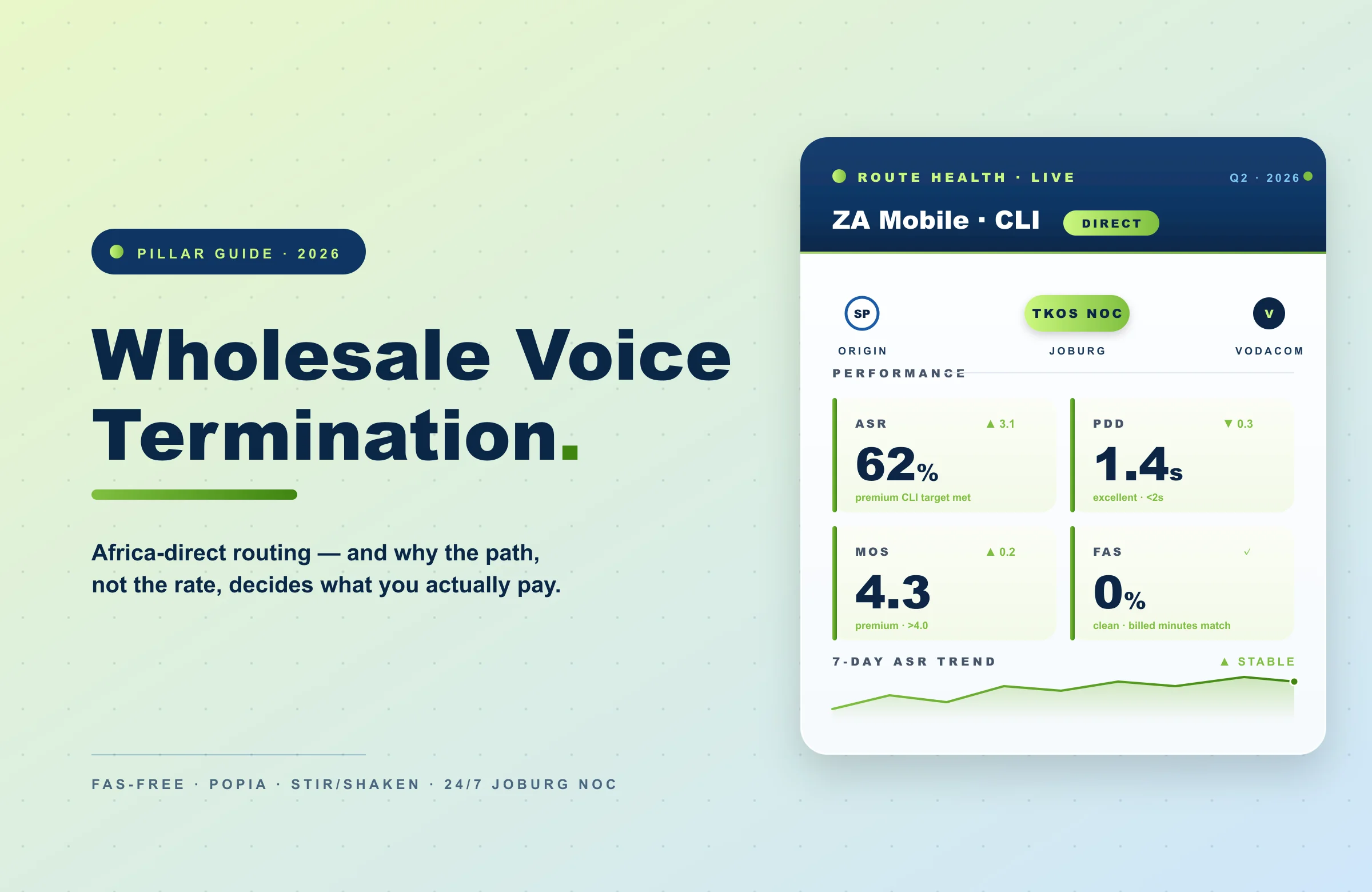
Four numbers separate a wholesale voice network from a wholesale voice spreadsheet. ASR tells you whether the call connected, ACD tells you how long it stayed up, PDD tells you how fast it set up, and MOS tells you how it actually sounded. A serious provider produces all four — per-route, per-destination, per-week.
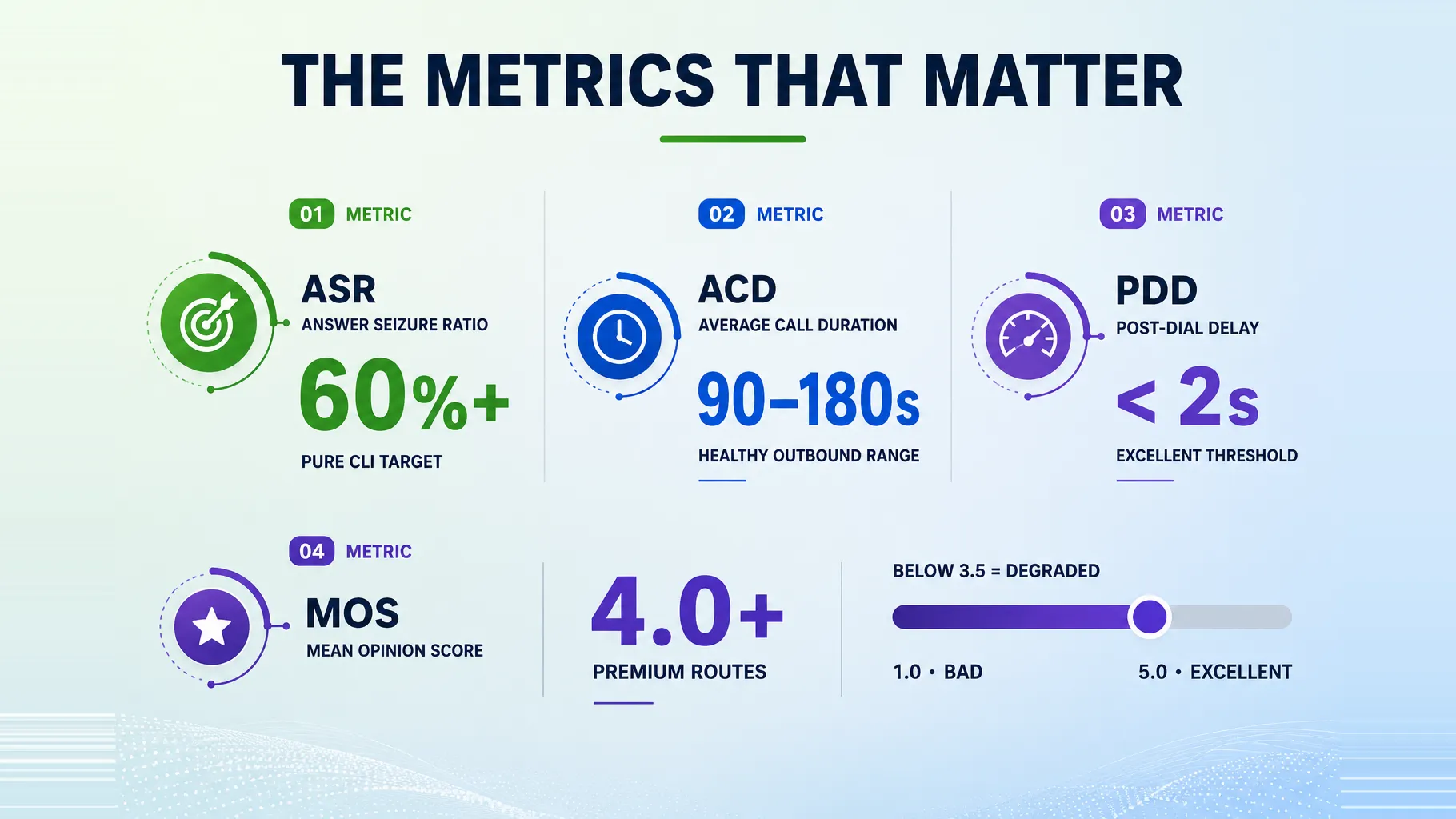
- ASR — Answer Seizure Ratio. Pure CLI: 60%+. CLI Standard: 50—60%. NCLI: variable.
- ACD — Average Call Duration. Healthy outbound: 90—180 seconds. Below 30s suggests FAS.
- PDD — Post-Dial Delay. Excellent: under 2 seconds. Above 5 is a routing problem.
- MOS — Mean Opinion Score. Premium routes: 4.0+. Below 3.5 is degraded.
Buyers should ask for these numbers per-route, per-destination, and per-week. A provider that can't deliver real-time ASR/ACD/PDD/MOS on demand isn't running a network — they're running a black box.
Africa Direct vs Aggregated Routing
What actually happens when a call from São Paulo terminates to a Vodacom subscriber in Cape Town? With most US or European wholesalers, that call routes through Frankfurt or London first, hits an aggregator with a South African relationship, then finally connects to Vodacom. Each hop adds latency, cost, and a potential point of FAS exposure. By the time the call arrives, your call quality is one or two MOS points lower and ASR is suppressed by 5—10 points compared to what's possible.
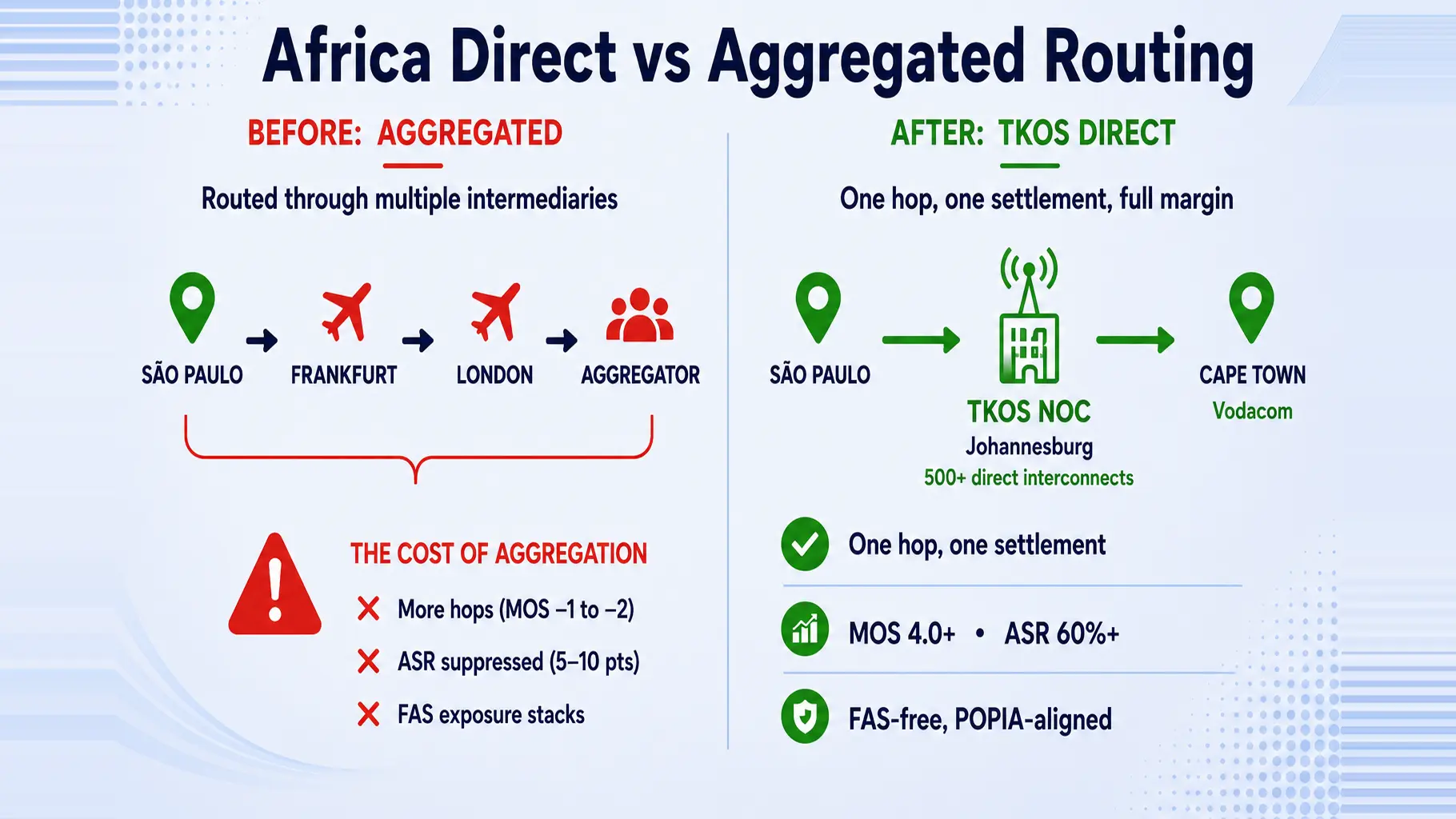
Direct African routing means your provider owns relationships with African MNOs — Vodacom, MTN, Cell C, Telkom — and routes traffic to them without intermediaries. One hop, one settlement, original margin preserved. The TKOS Johannesburg-anchored network is built exactly this way: a 24/7/365 NOC in South Africa with 500+ interconnects that are owned, not aggregated. For any business pushing meaningful traffic into Africa, this architectural choice shows up in every operational metric — ASR, ACD, MOS, and the bill.
Compliance: POPIA, GDPR, HIPAA, STIR/SHAKEN
POPIA
POPIA took effect in South Africa on 1 July 2021 and applies to any business processing personal information of South African residents. For wholesale voice termination, that includes call metadata, CDRs, and any recordings. A provider operating in South Africa must align with POPIA — and most global players don't, because they're regulated elsewhere.
STIR/SHAKEN
STIR/SHAKEN authenticates the legitimacy of US-originating numbers. The FCC Guide STIR/SHAKEN authentication framework became mandatory for US carriers in 2021, with adoption spreading to Canada and parts of Europe since. For US-bound traffic, untagged calls answer at 2—4× the rate of "Spam Likely" tagged ones. Compliance isn't optional for high-volume US routes.
GDPR and HIPAA
GDPR governs how personal data is collected, stored, and transferred for any traffic involving EU residents. HIPAA applies to US healthcare voice — Protected Health Information requires HIPAA-compliant infrastructure. TKOS supports HIPAA-configurable wholesale voice termination for healthcare-adjacent traffic.
How to Evaluate a Wholesale Voice Termination Provider
- Are your routes FAS-free? Anything except a clear yes is a red flag.
- What's your average ASR on my destination mix? Specific numbers per destination, not a global average.
- Where are your direct interconnects? If they don't have them in your major destinations, you're routing through aggregators.
- Contractual uptime SLA? 99.9% with penalties beats 99.99% best-effort marketing.
- Where is your NOC and how do I escalate at 2 AM? A ticket queue is not a tier-3 NOC.
- Free trial on my own traffic? Measure ASR yourself before committing.
- Compliance specifics? POPIA, GDPR, HIPAA, STIR/SHAKEN — names, not platitudes.
- REST API for provisioning and CDR pulls? Now table-stakes for serious wholesale operations.
2026 Trends Reshaping Wholesale Voice Termination
The wholesale voice market is projected to surpass $194 billion by 2027. Four trends drive where wholesale voice termination goes from here:
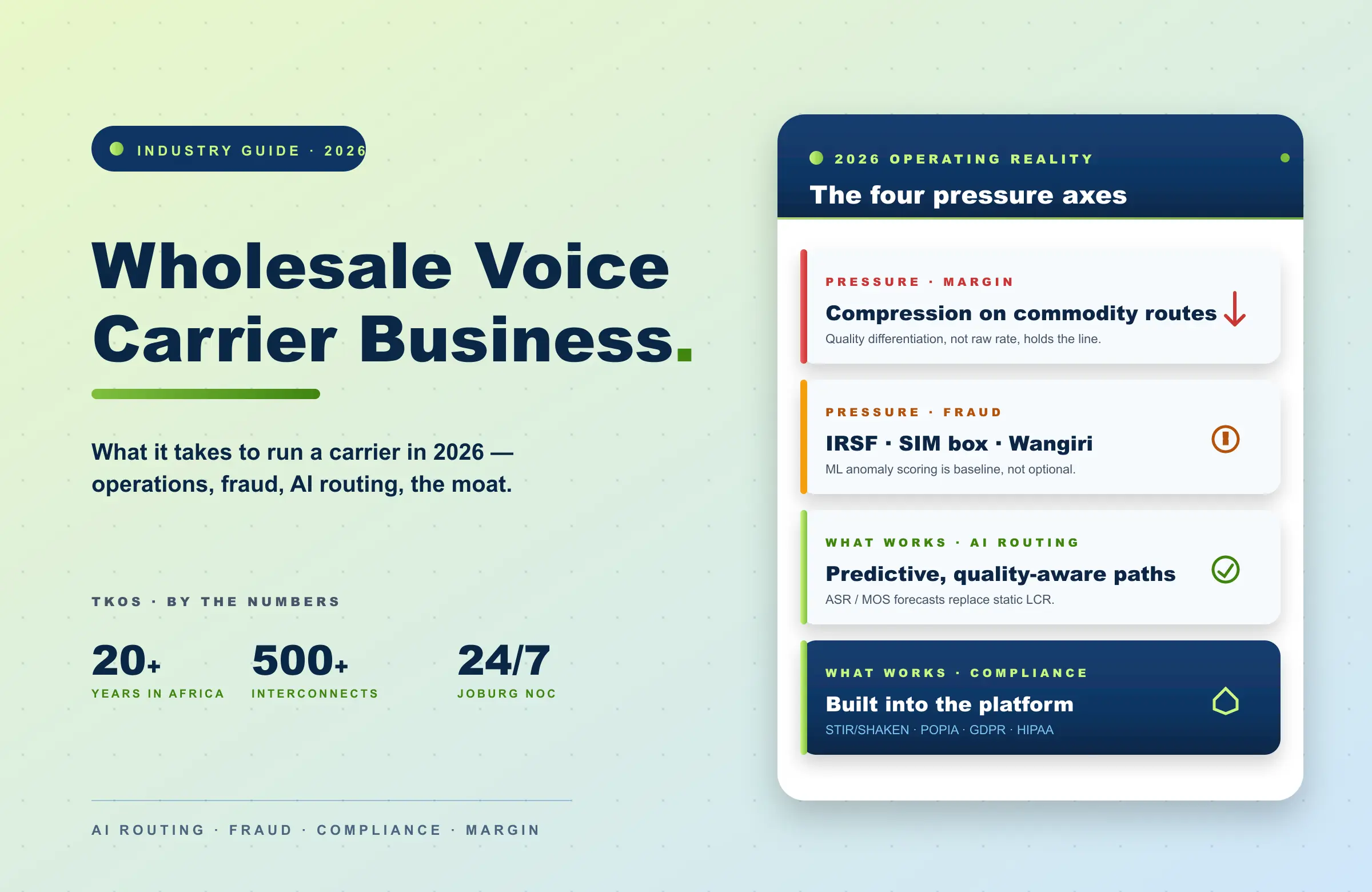
- AI-powered routing matures past LCR. Quality-aware, predictive routing — picking routes based on real-time MOS and ASR forecasts, not just rate tables — is production-ready at major carriers.
- STIR/SHAKEN expands beyond the US into Canada, parts of Europe, and select APAC markets. Cross-border traffic increasingly requires authenticated origination.
- Convergence of voice, messaging, and numbers. Buyers want one provider for voice termination, virtual numbers, and bulk SMS — not three vendor relationships.
- Regional compliance tightens — POPIA in South Africa, DPDP Act in India, evolving GDPR enforcement in the EU. Compliance has to be a product feature, not paperwork.
Conclusion
Wholesale voice termination in 2026 is no longer a commodity buy on per-minute rate. The buyers who win treat it as an engineering decision: FAS-free billing as a baseline, contractual ASR/PDD/MOS targets, direct interconnects in the destinations that matter to their traffic, and compliance built into the platform across POPIA, GDPR, HIPAA, and STIR/SHAKEN.
Africa-bound traffic in particular rewards providers with direct MNO relationships and a Johannesburg-grade NOC — every aggregated hop costs ASR points, MOS points, and margin. Looking forward, AI-driven routing, multi-product convergence, and tightening regional compliance will keep separating engineered wholesale voice termination platforms from the brokers running spreadsheets.