Introduction
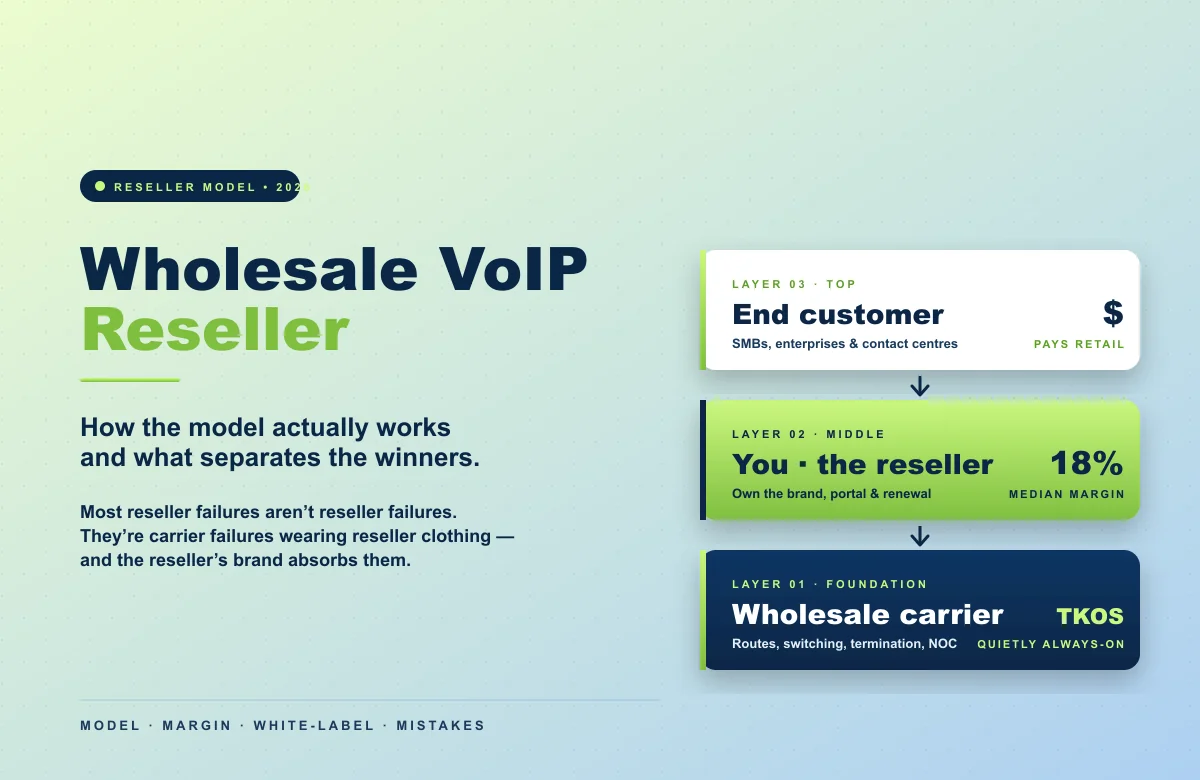
Most wholesale VoIP reseller failures aren't really reseller failures. They're carrier failures wearing reseller clothing. A reseller whose customers complain about call quality, dispute every other invoice, and churn after the second contract usually doesn't have a sales problem — they have an underlying-carrier problem they can't see because the carrier sits one layer below their visibility. The reseller's brand absorbs the consequences.
This guide breaks down how the reseller model actually works, where margin really lives, what to look for in the carrier underneath, and what separates the resellers that grow into profitable platforms from the ones that get squeezed out by the next aggregator with a slightly cheaper rate sheet. It's written for MSPs, IT consultants, and platform builders evaluating whether to enter — or scale — a reseller business.
What is a wholesale VoIP reseller?
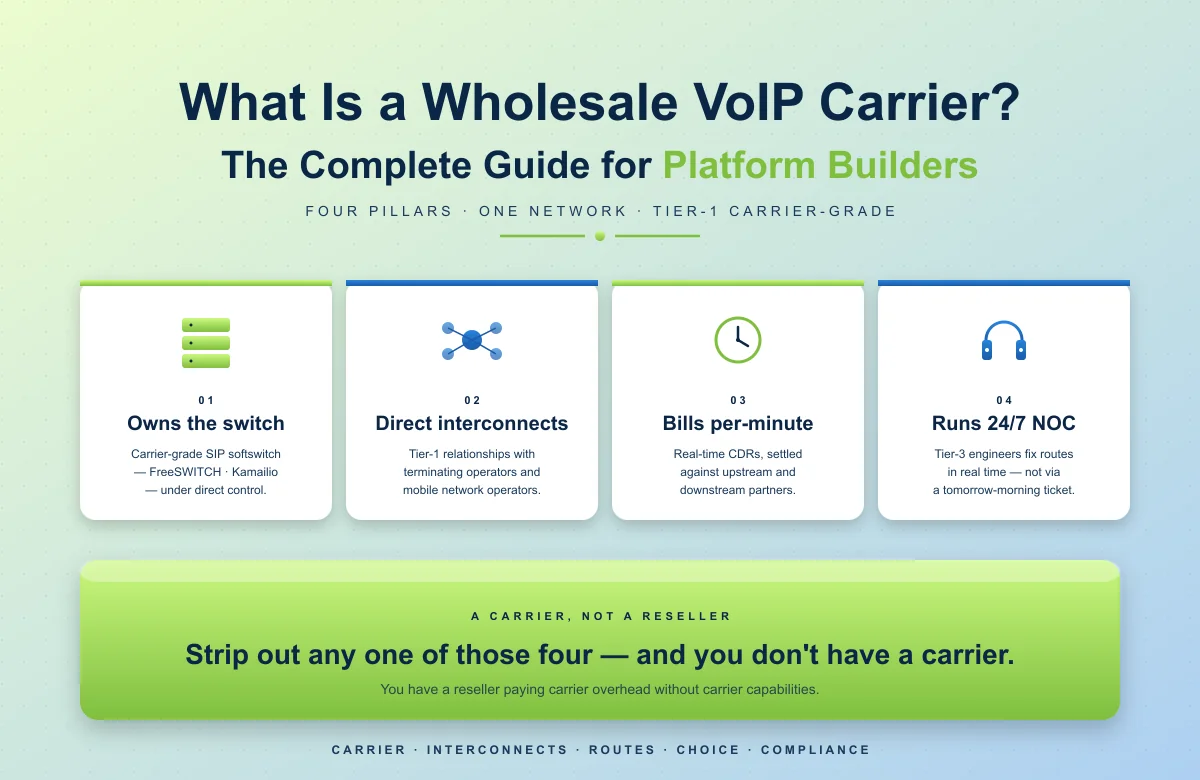
A wholesale VoIP reseller buys voice-call minutes and SIP capacity from an underlying carrier at wholesale rates, brands the service as their own, and sells it to end customers — small businesses, enterprises, contact centres — at retail or near-retail rates. The reseller owns the customer relationship, the brand, and the support layer. The underlying wholesale VoIP carrier owns the routing, switching, and termination.
How the Reseller Model Works
The reseller business sits in the middle of the telecom value chain. Five operational realities define every functional reseller:
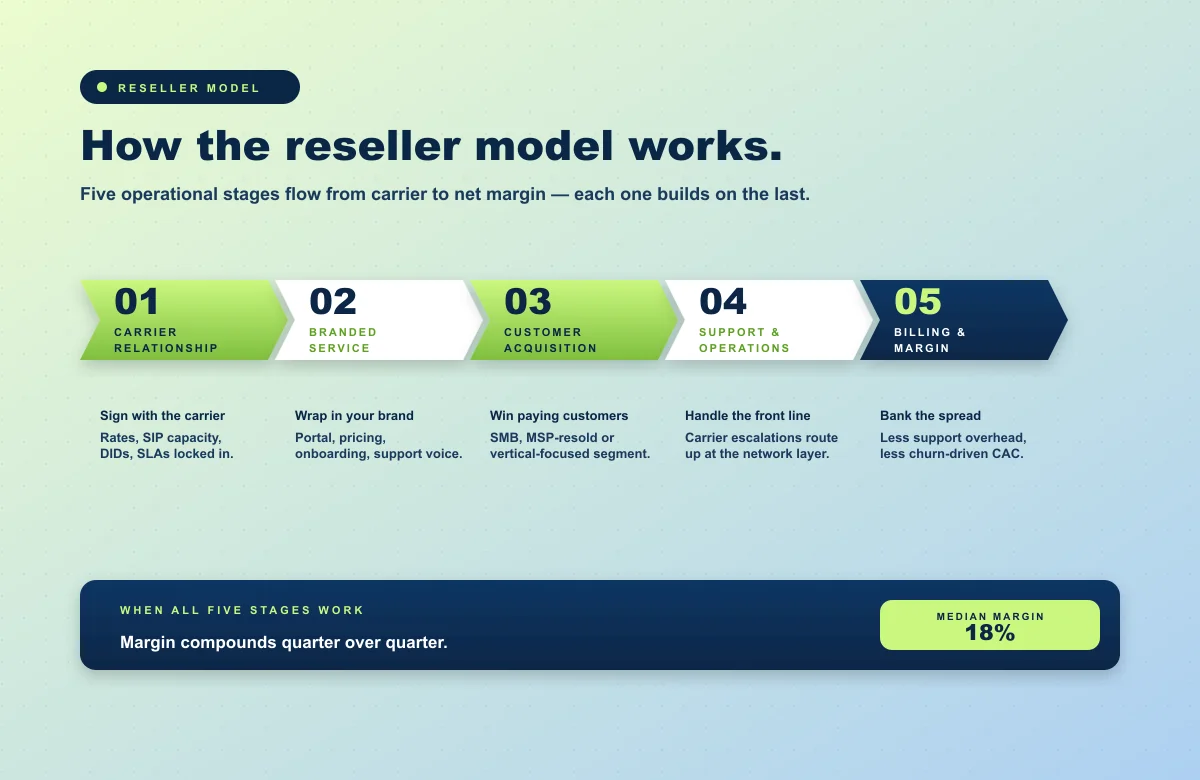
- Carrier relationship. The reseller signs an agreement with one (or more) underlying wholesale carriers. The agreement covers per-minute rates, SIP trunk capacity, DID provisioning, and SLAs.
- Branded service layer. The reseller wraps the underlying capacity in their own brand — own portal, own pricing, own customer support, own onboarding flow.
- Customer acquisition. Sales motion targeted at the reseller's chosen segment — SMB, MSP-resold, vertical-specific (healthcare, financial, real estate).
- Support and operations. Front-line support handled by the reseller. Carrier escalations route upstream when the issue is at the network layer.
- Billing and reconciliation. Reseller bills end customers; carrier bills reseller. Margin is the spread, less support overhead.
The model works when the underlying carrier delivers carrier-grade quality. It breaks the moment the carrier underneath compromises — and the reseller usually doesn't see the breakage until customers start churning.
Where Margin Really Lives in the Reseller Model
Margin in the reseller business isn't a fixed percentage. It's the spread between what the reseller pays upstream and what end customers pay, less support costs and churn-driven CAC. Three factors compound or destroy that margin — and the deeper economics show up clearly when you look at how the wholesale VoIP business is structured end to end:
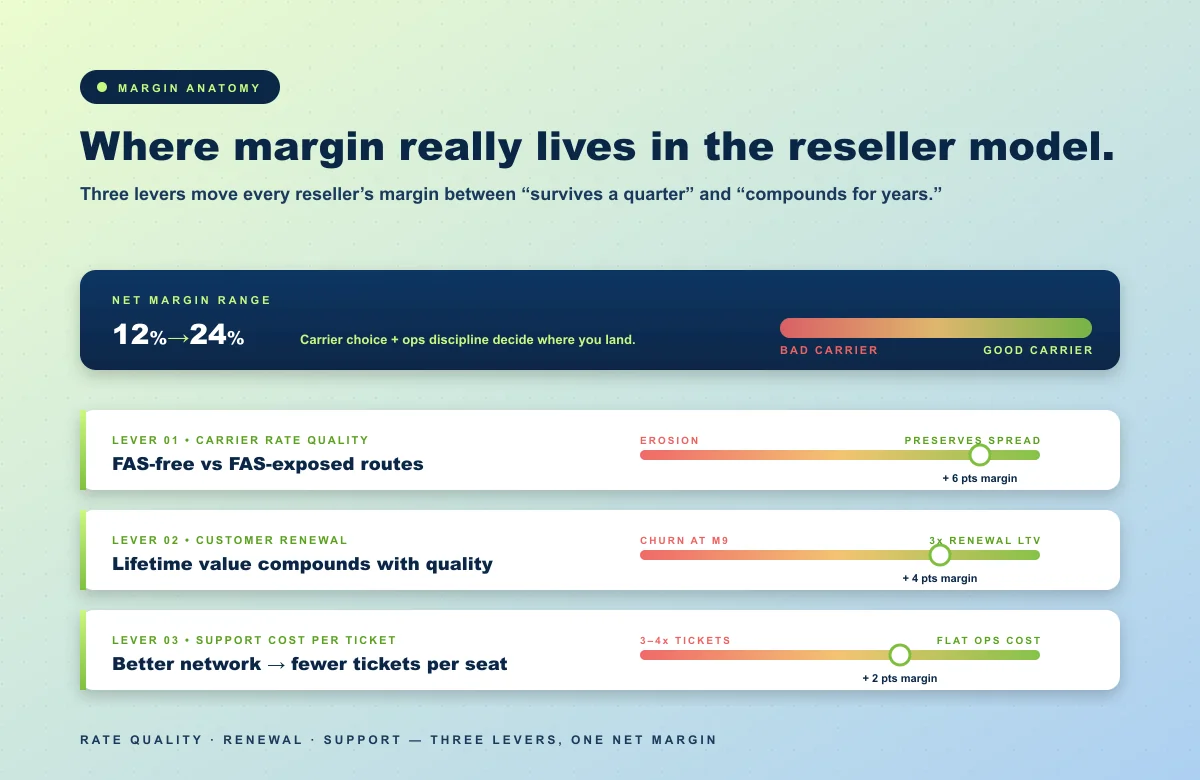
Carrier rate quality. FAS-free routes preserve margin. FAS-exposed routes inflate cost and trigger customer disputes that erode it.
Customer churn. A customer who renews three times produces 3x the lifetime value of one who churns at month nine. Quality drives renewal more than price.
Support cost per ticket. Resellers running on bad carriers spend 3—4x more on support per customer because the underlying network creates more tickets.
The reseller model rewards resellers who pick carriers whose network reduces support tickets and whose CDRs match invoices. It punishes resellers who chase the lowest wholesale rate and absorb the support load that follows.
White-Label vs Reseller Programs — What to Look For
Two carrier program structures support resellers. Each suits different reseller profiles:
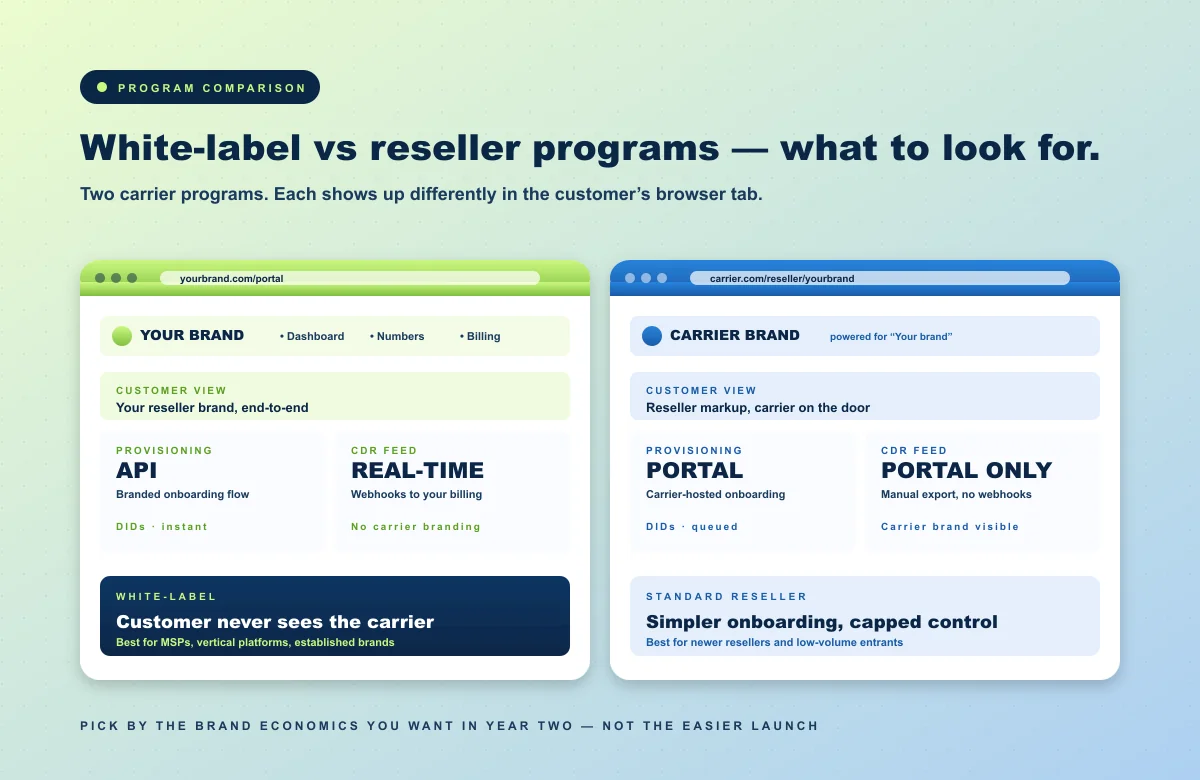
- White-label — branded portal, branded provisioning, full reseller control. Best for MSPs, vertical platforms, established brands.
- Standard reseller — carrier-branded portal, reseller markup, simpler onboarding. Best for newer resellers, low-volume entrants.
A white-label reseller program lets the reseller own the customer experience end to end — the portal looks like the reseller's brand, customers never see the underlying carrier, and provisioning happens through APIs the reseller controls. Standard reseller programs are simpler to enter but cap how much brand and product control the reseller can build.
How to Pick the Carrier Behind Your Reseller Business
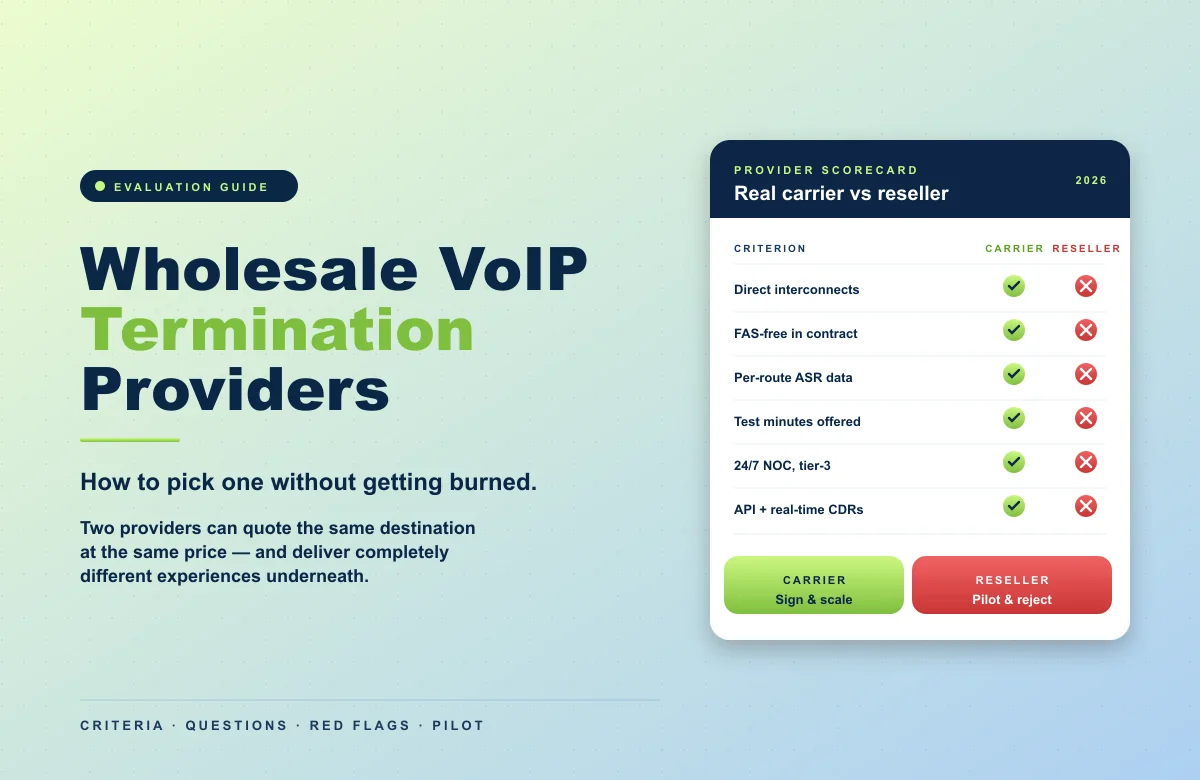
The carrier underneath your reseller business determines almost everything end customers experience. Insist on:
- Direct vs transit breakdown by destination — direct interconnects mean fewer hops and better quality.
- FAS-free routes contractually, with documented route classifications.
- FCC Guide-mandated STIR/SHAKEN attestation for any US-bound traffic.
- HIPAA-compliant voice if your reseller business serves healthcare verticals.
- Real-time CDR access through API for billing reconciliation.
- White-label provisioning via API, not email queue.
- Documented dispute process with response-time SLAs.
- Tier-3 NOC support escalation path, not first-tier ticket queue.
- Contractual uptime SLA 99.9% or better.
Anything missing turns your reseller business into the customer-facing absorber of every quality compromise the carrier underneath chose to make.
Why Africa-Focused Resellers Look Different
Resellers serving customers with material African voice traffic operate under different economics than resellers serving developed markets. Most US and European wholesale carriers don't hold direct interconnects with major African MNOs (Vodacom, MTN, Cell C, Telkom, Safaricom), according to GSMA wholesale telecom market data. They route African traffic through one or two transit partners — three or four hops minimum on most routes.
That gap is a margin opportunity for any reseller serving African-traffic-heavy customers. A reseller whose carrier holds direct African interconnects delivers higher ASR, lower PDD, and FAS-free billing on the destinations that matter most to those customers — and earns the renewal that compounds margin over time.
How TKOS Powers the Reseller Model
TKOS isn't trying to be the cheapest underlying carrier for resellers. We're trying to be the carrier whose network turns the reseller's brand into a renewal engine:
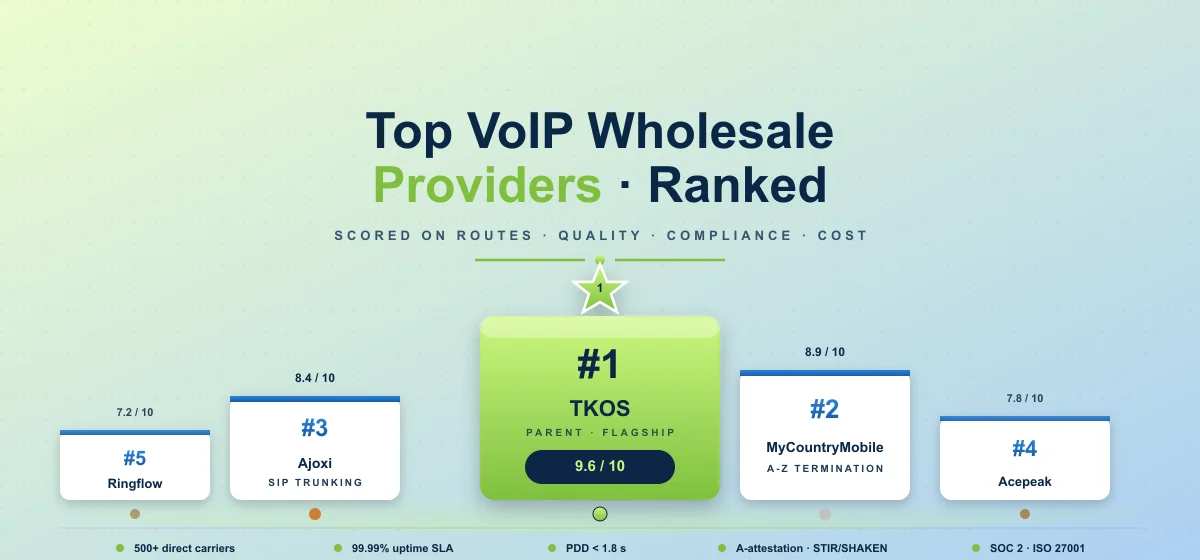
- 500+ direct carrier interconnects for fewer hops and superior audio clarity, especially across Africa.
- White-label provisioning for branded portals and customer experience.
- CLI, Non-CLI, and A-Z routes — FAS-free as a baseline.
- STIR/SHAKEN active for US-bound traffic.
- HIPAA-compliant voice for healthcare-vertical resellers.
- Real-time CDRs through API for reseller billing reconciliation.
- 99.9% uptime SLA backed by real-time QoS monitoring.
- 24/7/365 NOC with tier-3 engineers — escalations resolved on the first call.
98% partner retention across 500+ active partners isn't a marketing line. It's why our wholesale VoIP reseller partners stay — the carrier underneath quietly disappears while the reseller's brand grows.
Common Mistakes Wholesale VoIP Resellers Make
Most struggling resellers repeat the same handful of mistakes. Knowing them upfront saves a quarter of churn pain. Picking the underlying carrier on rate alone — when route quality drives renewal more than per-minute price ever does. Skipping test minutes — when every honest carrier offers them and the carriers that don't are the ones to avoid. Over-discounting on the front end to win logos — when the support cost on bad routes erases the margin those logos were supposed to produce.
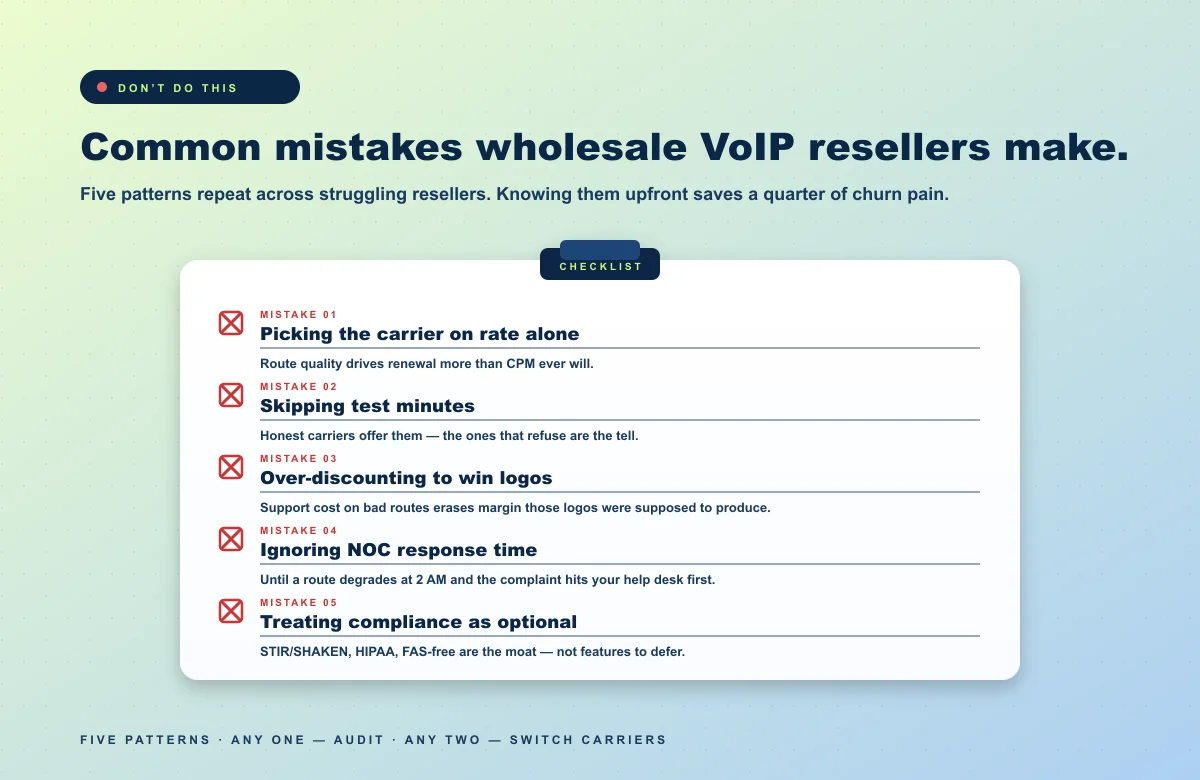
Ignoring NOC response time — until a route degrades at 2 AM and the customer's complaint hits the help desk before any escalation reaches the underlying carrier. Treating compliance as optional — when STIR/SHAKEN, HIPAA, and FAS-free billing are the moat that separates a renewable platform from a price-shopping commodity.
Conclusion
The reseller model rewards resellers who treat the underlying carrier as a strategic decision, not a procurement one. Margin lives in renewal economics, and renewal lives in quality the carrier delivers behind the brand. Resellers who pick carriers on rate alone end up absorbing every compromise that rate represents. Resellers who pick on direct interconnects, FAS-free routes, NOC response, and white-label provisioning compound margin while their competitors fight churn.
Getting Started
If you're evaluating which carrier to put underneath your wholesale VoIP reseller business — or whether to switch the one already there — start with the routing-quality questions, not the rate sheet. Ask for the FAS policy, the white-label provisioning capability, the dispute process, and the NOC escalation path in writing. The answers tell you more about the next twelve months of operations than any rate quote will.