Introduction
Most retail VoIP buyers do not realise how steep the per-line economics get above 50 numbers. A single retail DID at a SaaS-branded provider runs $1 to $3 per month per number, plus per-minute usage. Multiply that by 500 lines for a contact centre, or 5,000 lines for a CPaaS reseller, and the gap between retail and wholesale becomes the entire margin model.
That gap is why MSPs, contact centres, white-label resellers, and A2P aggregators buy DID numbers wholesale. Wholesale DID procurement is not a discount. It is a different product category, with different contracts, different routing controls, and different responsibilities.
What is a DID number?
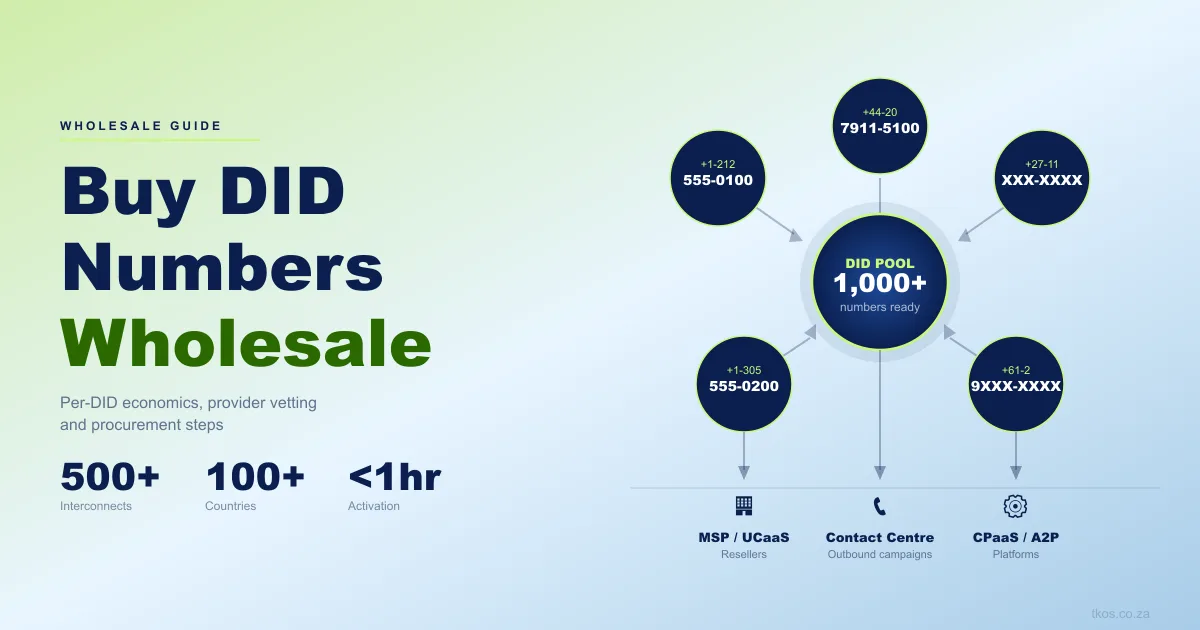
A Direct Inward Dialing (DID) number is a phone number provisioned to a carrier or VoIP platform — whether a US area code, a UK city number, or an African national number — routed directly to a specific endpoint without going through a switchboard. DIDs are the building blocks of every modern phone system.
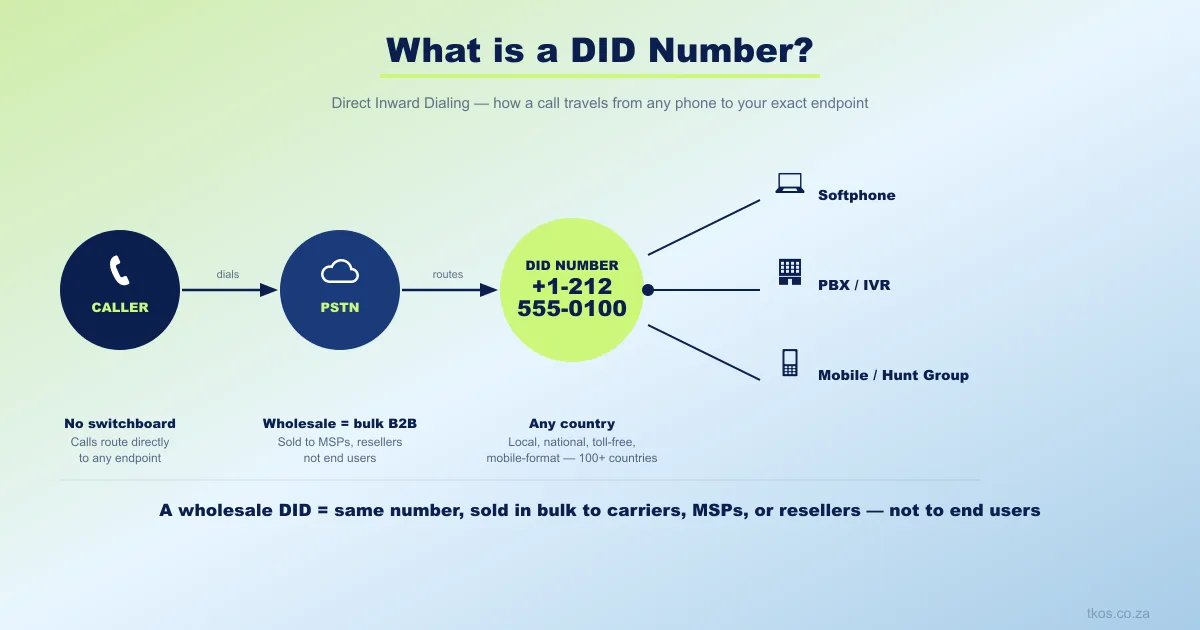
A wholesale DID is the same number, sold in bulk to carriers, MSPs, or resellers rather than to end users. The number behaves identically. The contract, routing control, and economics are fundamentally different.
Why buy DIDs wholesale instead of retail?
Three reasons drive wholesale procurement over retail. They compound at scale.
- Per-DID economics. Wholesale DID pricing is structured for volume — typically a fraction of retail per-line cost, with usage billed separately. For 100+ lines, the savings compound monthly.
- Routing control. Retail providers route through their own platform. Wholesale providers hand you DIDs over SIP and let you route them anywhere — your own softswitch, your customer's PBX, a CPaaS layer, or a white-label voice product.
- Resale rights. Wholesale contracts allow resale to end customers. Retail contracts almost never do. If you are an MSP, a white-label voice provider, or a CPaaS platform, this distinction is non-negotiable.
How wholesale DID pricing actually works
Wholesale DID pricing varies by country, number type, and provider, but the structure is consistent. Four components apply to every quote. Volume discounts kick in at predictable thresholds — usually 50, 250, 1,000, and 5,000 lines.
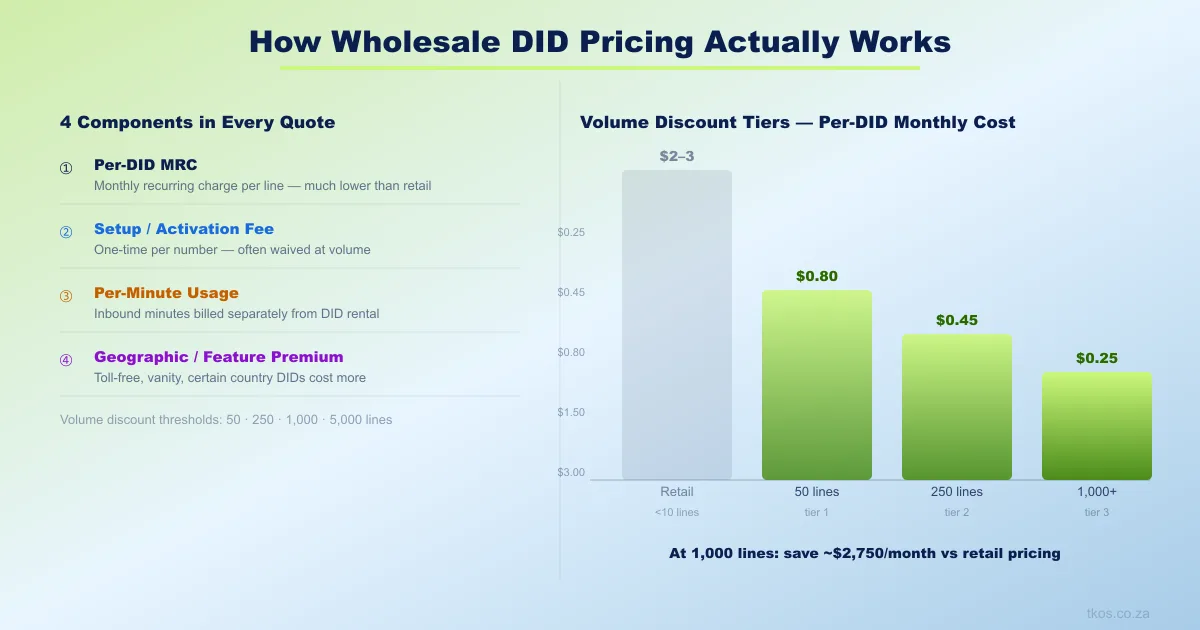
- Per-DID monthly recurring charge (MRC). A flat per-line fee, much lower than retail.
- Setup or activation fee. A one-time fee per number — sometimes waived for volume orders.
- Per-minute usage. Inbound minutes billed separately from the DID rental itself.
- Geographic or feature premium. Toll-free, vanity, and certain country DIDs carry premium pricing across all tiers.
What to look for in a wholesale DID provider
The provider differences that matter most when evaluating a wholesale DID partner:
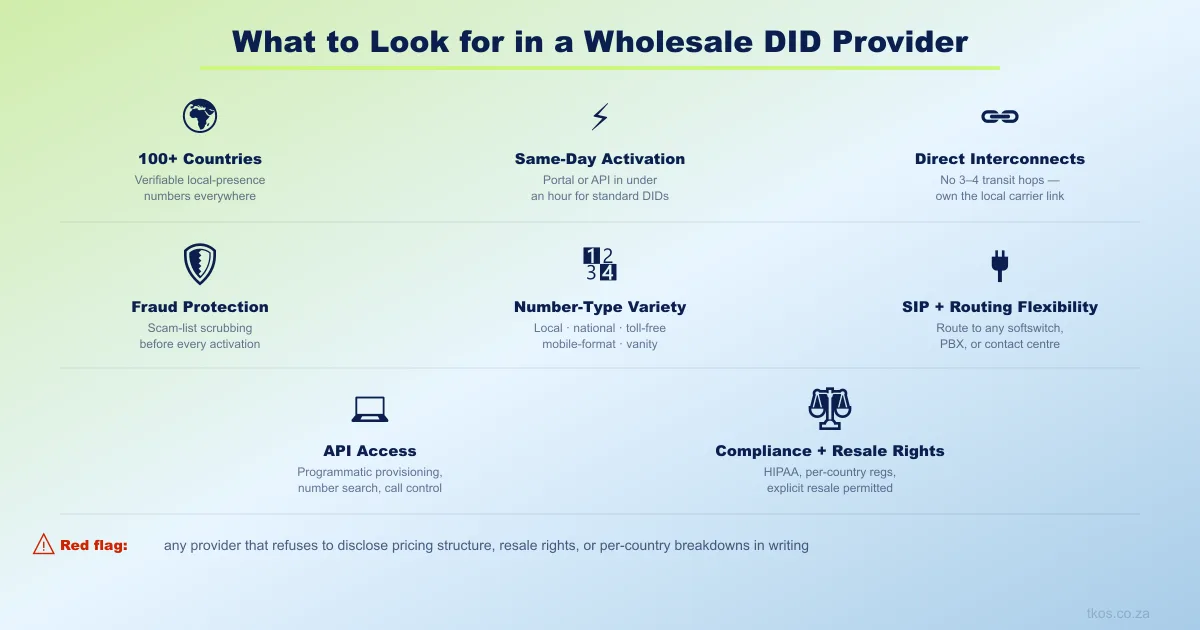
- Country coverage — 100+ countries with verifiable local-presence numbers, not just aggregated DIDs.
- Number-type variety — local geographic, mobile-format, national, toll-free, and vanity numbers all available.
- Provisioning speed — standard numbers activate under an hour through portal or API. Anything beyond same-day is legacy infrastructure.
- Routing flexibility — SIP-based delivery with support for hunt groups, contact-centre platforms, and any softswitch.
- Direct carrier interconnects — not 3 to 4 transit hops. Direct relationship to the local carrier means lower latency and better audio.
- Fraud and reputation controls — scam-list scrubbing and active network-layer fraud protection before every activation.
- Compliance — HIPAA for healthcare resellers, per-country regulatory requirements surfaced at ordering, not after.
- API access — programmatic number search, provisioning, and call control for modern wholesale stacks.
Common use cases for wholesale DIDs
Different buyer profiles reach for wholesale DIDs at different scales. If your DID needs fall below 50 lines, retail is usually faster and simpler.
- MSPs and white-label UCaaS resellers — hundreds to thousands of lines across multiple end customers, with branded delivery.
- Contact centres — high DID volume for outbound campaign rotation, plus geographic-presence numbers for regional credibility.
- CPaaS and A2P platforms — programmable DIDs for verification, notification, and voice-OTP workflows at scale.
- Global enterprises — local DIDs in every country of operation for sales offices, support lines, and regulatory presence.
- Carriers and ITSPs — sub-allocation to downstream resellers.
- VoIP platform builders — foundation lines for a branded voice product.
How to buy DID numbers wholesale (step-by-step)
The modern procurement path is short and operationally repeatable:
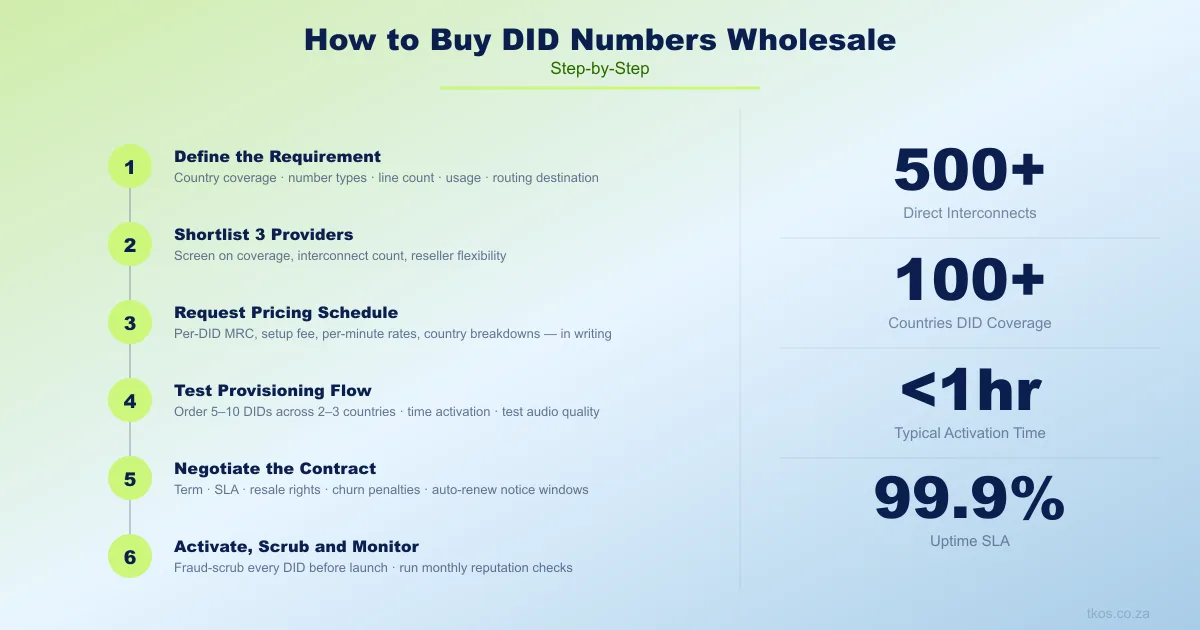
- Define the requirement. Country coverage, number types, expected line count, monthly usage, and routing destination. Concrete numbers, not estimates.
- Shortlist three providers. Use coverage, interconnect count, and reseller flexibility as the screening criteria.
- Request a pricing schedule. Per-DID MRC, setup, per-minute usage tiers, country-by-country breakdowns. Anything verbal-only is unworkable.
- Test the provisioning flow. Order 5 to 10 DIDs across two or three countries. Time the activation, test inbound audio quality, and check SIP delivery integrity.
- Negotiate the contract. Term, payment terms, resale rights, SLA, churn penalties. Push back on auto-renew clauses without notice windows.
- Activate and scrub. Confirm fraud-protection scrubbing on every DID before handing it to an end customer or campaign.
- Monitor reputation. Run periodic outbound-deliverability tests on a representative sample. Numbers degrade if mishandled.
Compliance and fraud considerations
Two areas need explicit attention before any large-volume DID purchase. Skip them and the procurement will hit problems within 60 days.
Compliance first. Each country regulates DID assignment differently. Some require local-presence documentation, others require end-user verification before activation, others restrict resale entirely. The FCC Guide and equivalent national regulators publish assignment rules for their jurisdictions. A reputable wholesale voice provider will surface these requirements during ordering rather than after.
Fraud exposure is the second concern. Toll-fraud, international revenue-share fraud (IRSF), and call pumping attack vulnerable DID pools. A partner running active fraud protection, real-time QoS monitoring, and a 24/7 NOC staffed by tier-3 engineers is meaningfully more secure than a low-cost reseller two layers removed from the underlying carrier. For businesses building on top of a top VoIP wholesale providers stack, this layer of protection is not optional.
Conclusion
Buying DID numbers wholesale is a structural decision — it changes your routing control, your unit economics, and your resale rights, not just your price per line. For MSPs, contact centres, CPaaS platforms, and global enterprises, wholesale procurement is the only credible way to scale. The provider differences that matter are direct carrier interconnects, country coverage, provisioning speed, fraud protection, and contract flexibility. Pick a partner that demonstrates each of these during evaluation, and the procurement becomes a repeatable operational motion rather than a one-time negotiation.
Top international termination destinations