Introduction
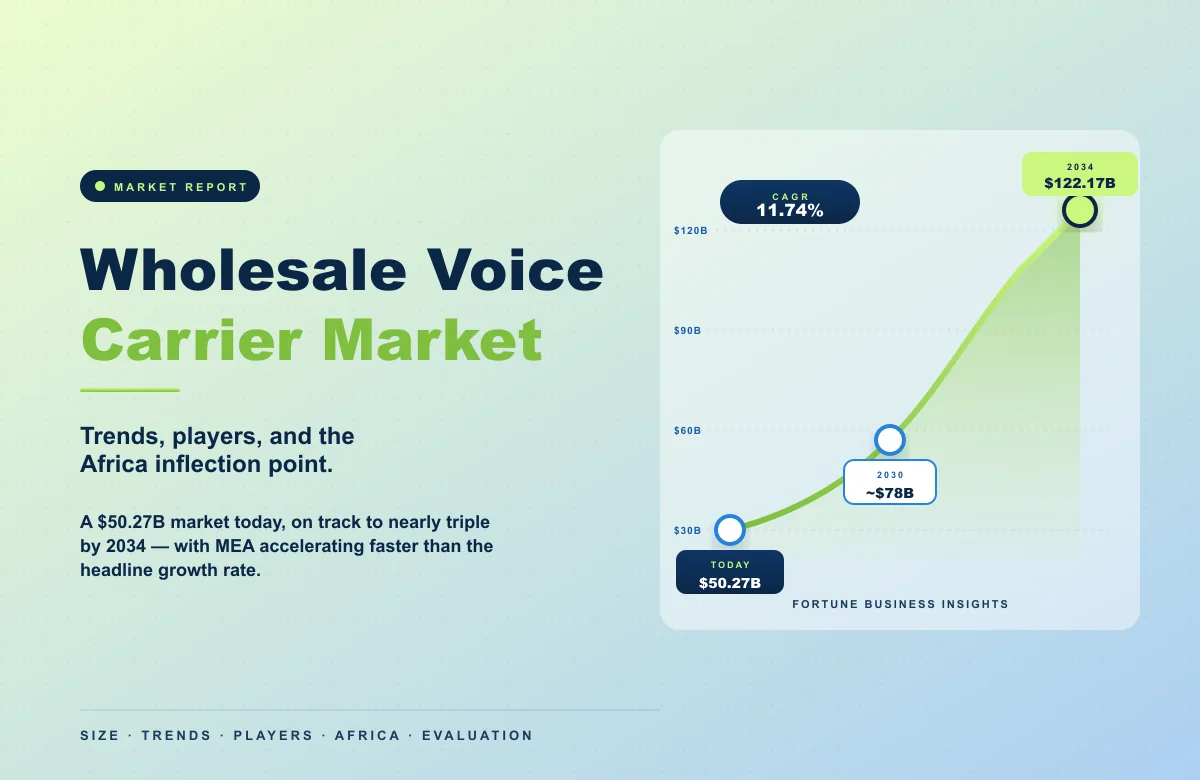
The wholesale voice carrier market is valued at USD 50.27 billion in 2026 and is projected to nearly triple to USD 122.17 billion by 2034 at a CAGR of 11.74%, according to Fortune Business Insights. That is not a slow industry. That is a sector quietly underpinning every cross-border call, every cloud PBX login, every contact centre dial-out.
And the Middle East and Africa now accounts for roughly 10% of that global pie — a share growing faster than the headline rate. South African enterprises, MSPs across Lagos and Nairobi, e-commerce sellers placing London numbers from Cape Town: they all sit on top of a wholesale layer most buyers never see.
This guide breaks down the 2026 state of play. Market size, the five trends actually moving routes and rates, who the dominant players are, why Africa is the most interesting region right now, and the evaluation criteria buyers should hold any carrier to before signing.
What is the wholesale voice carrier market?
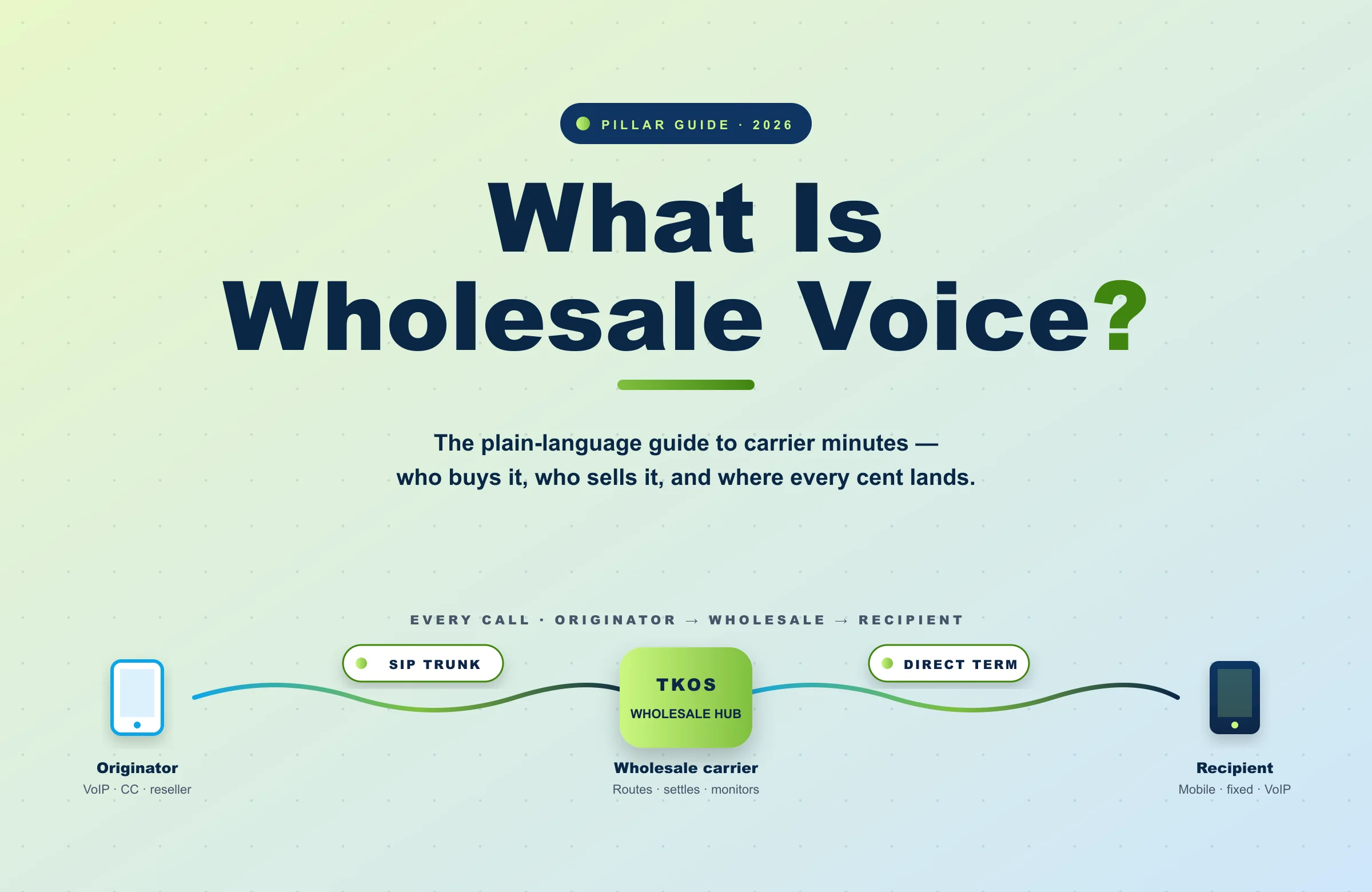
The wholesale voice carrier market is the global business of selling voice traffic between carriers, MSPs, and resellers rather than directly to end-users. Wholesale carriers buy and resell call minutes in bulk, operating interconnects with origination, wholesale voice termination, transit, and value-added services like SIP trunking, fraud control, and DID provisioning.
That definition matters because the wholesale layer is invisible to most end-buyers. A SaaS company sending a notification call to a customer in Kenya is touching three or four wholesale handoffs before that call rings. Each hop is a place where audio degrades, latency stacks, or fraud can be injected. Carriers compete on how clean those hops are.
How big is the wholesale voice carrier market?
Forecasts vary by source, but the direction is consistent. Fortune Business Insights pegs the 2026 market at USD 50.27 billion. The Insight Partners and Mordor Intelligence both project the international segment alone to clear USD 40 billion this year. The Business Research Company forecasts the international wholesale voice segment to grow at roughly 8—10% CAGR through 2030.
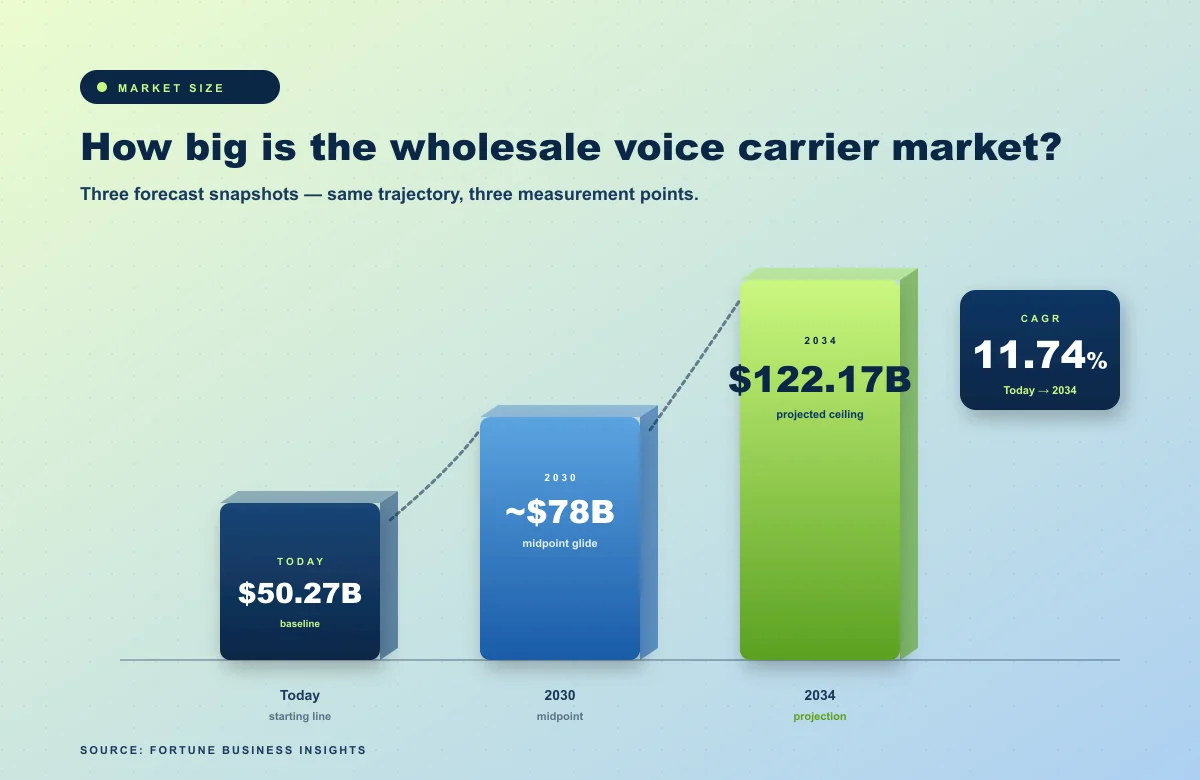
Three structural forces explain the growth:
- Cross-border voice traffic is rising, not falling, despite the "voice is dead" narrative that surfaces every two years.
- A2P (application-to-person) voice for OTPs, verifications, and reminders is now a meaningful slice of wholesale termination.
- Mobile subscriber growth in Asia-Pacific and sub-Saharan Africa is adding minutes faster than developed-market saturation is shedding them.
Put differently: the volume base is shifting south and east, even as the legacy book holds steady in North America and Europe.
What is driving the wholesale voice carrier market?
Five trends are doing the real work this year. Not the buzzwords. The actual shifts changing how routes get priced and provisioned.
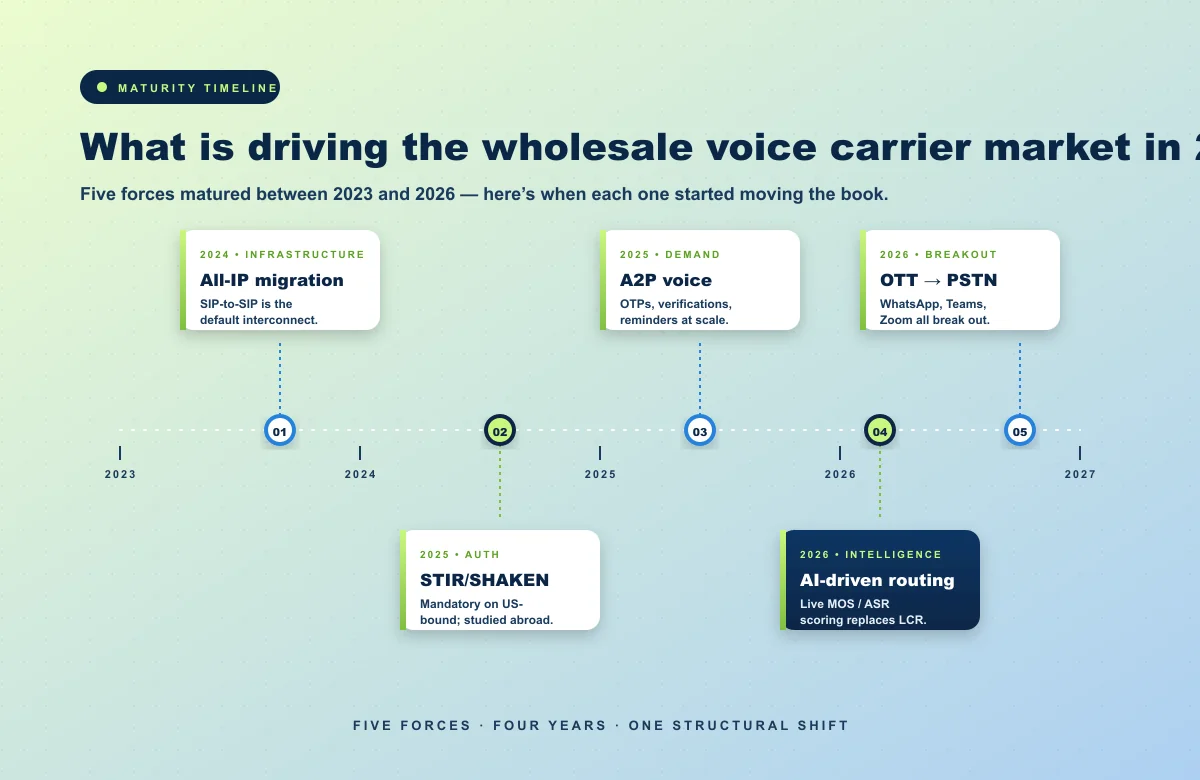
- The all-IP migration finally finished. TDM circuits are functionally retired in major Western markets, and African operators are following. SIP-to-SIP interconnect is the default. This collapses cost structure but also raises the floor on audio quality expectations.
- FCC Guide-mandated STIR/SHAKEN expanded the fraud perimeter. US-bound traffic carries call-authentication overhead, and the framework is being studied for adoption elsewhere. Carriers without active STIR/SHAKEN implementation are quietly losing US-terminating volume to competitors that have it.
- A2P voice grew up. Banks, fintechs, and platforms in emerging markets now ship verification calls at scale. Wholesale carriers that can guarantee delivery rates on short, high-volume A2P traffic are commanding premium positioning.
- AI-driven routing left the lab. Real-time route selection based on completion rate, audio MOS scores, and price signals is operational at the larger backbones. The gap between "least-cost routing" and "intelligent routing" is widening.
- OTT-carrier collaboration normalized. WhatsApp, Telegram, Zoom, Microsoft Teams — all of them eventually break out to the PSTN. The carriers that handle those breakouts at scale are increasingly the same wholesale players selling termination to traditional voice resellers.
Who are the major players in wholesale voice termination?
The top-tier global list still includes the names you would expect — AT&T, Verizon, BT Wholesale, Tata Communications, iBASIS, Telefónica Global Solutions, and Orange International Carriers. Together they account for the bulk of cross-Atlantic and cross-Asia transit minutes.
Tier-2 specialists matter more than the headline rankings suggest. Operators like BICS, Telnyx, IDT, TKOS, and a wave of regional carriers (including African-focused players) compete on direct interconnects, regional expertise, and service responsiveness. TKOS, headquartered in Johannesburg with 500+ direct interconnects, specialises in Africa-direct and US termination routes. The Tier-2 group is where MSPs and white-label resellers most often build their voice backbones, because the global Tier-1s are not optimised for partner-scale volume or African origination.
The honest read on competition: Tier-1 carriers win on global reach and procurement contracts. Tier-2 and regional carriers win on Africa-direct routes, A2P specialisation, and direct engineering access. Both layers are necessary. Neither is sufficient alone. The deeper wholesale voice carrier business deep-dive walks through the operator mechanics underneath.
Why Africa is reshaping wholesale voice routing
Africa is the most interesting region in the wholesale voice carrier market right now, and almost nobody is writing about it correctly.
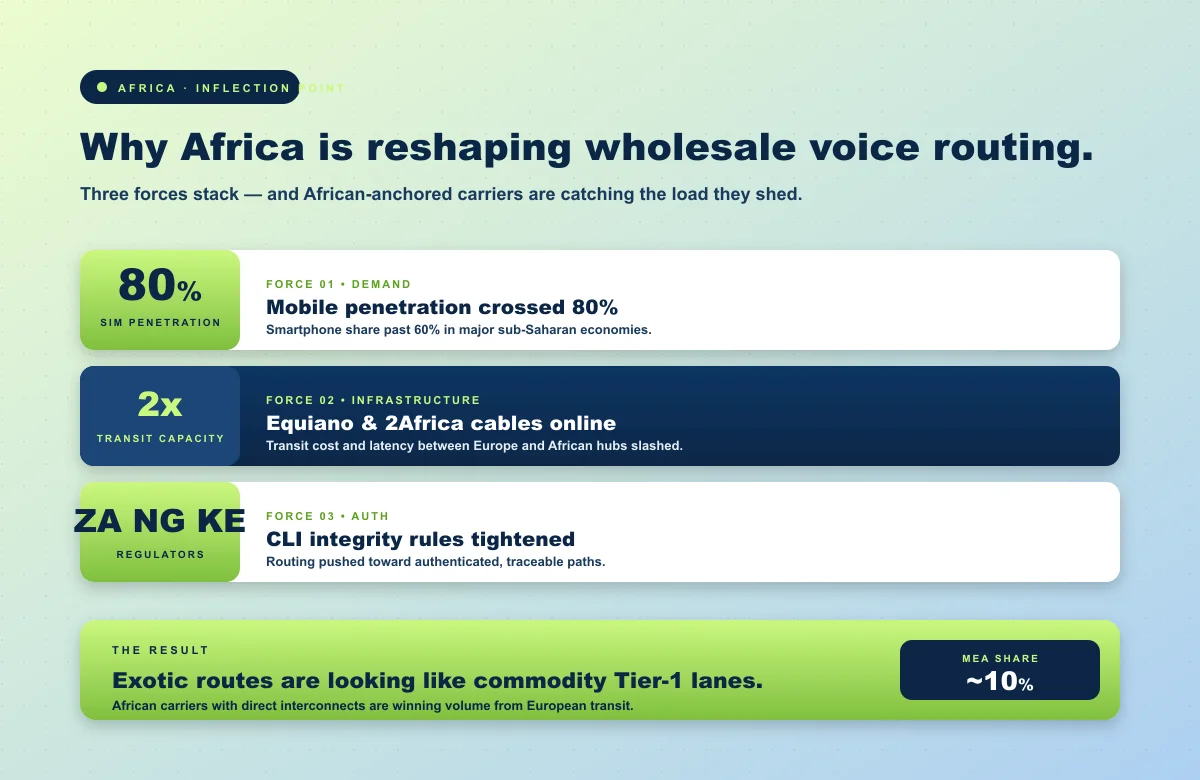
Three things are happening at once. Mobile penetration in sub-Saharan Africa crossed 80% on a SIM basis, with smartphone share climbing past 60% in major economies, per GSMA Mobile Economy data. New subsea cables — Equiano, 2Africa — slashed transit costs and latency between Europe and African coastal hubs. And regulators in South Africa, Nigeria, and Kenya have been steadily tightening fraud and CLI integrity rules, pushing wholesale routing toward authenticated, traceable paths. Industry data on the wholesale voice market shows continued growth across emerging regions.
The result: routes that used to be priced as exotic now look like commodity Tier-1 lanes. Audio quality on a Johannesburg-to-Lagos call is closer to a London-to-Paris call than it was three years ago. African carriers that built direct interconnects rather than depending on European transit are starting to win volume from buyers who used to default to a UK-based wholesaler.
This is the structural opening TKOS works inside. As a Johannesburg-headquartered carrier with 500+ direct interconnects and PoPs across North America, Europe, and Asia, the network is built around African origination and termination as a first-class lane, not an afterthought routed via London. For MSPs and enterprises serving African customers, the difference shows up on the call detail records.
Carrier-grade vs cloud-grade — the distinction buyers miss
A lot of the "VoIP for business" marketing in 2026 conflates two very different things: cloud-grade voice infrastructure and carrier-grade voice infrastructure. They are not the same.
Cloud-grade means the service runs on hyperscale cloud (AWS, Azure, GCP), with elastic scaling and friendly APIs. Easy to integrate. Often great UX. But the voice path itself frequently rides on a third-party wholesale termination layer the buyer never sees.
Carrier-grade means the provider owns or directly peers with the routes that carry the call. Geographically redundant architecture. Automatic failover. Real-time QoS monitoring at the network layer, not just the application layer. Tier-3 engineering on call 24/7/365.
For a contact centre, a healthcare platform, or an MSP serving multiple customers, the difference matters when something goes wrong at 02:30 on a Sunday. A cloud-grade provider files a ticket with their upstream carrier. A carrier-grade provider has engineers reroute the traffic.
How to evaluate a wholesale voice carrier
Use this as a checklist when shortlisting carriers. Anything a vendor cannot answer cleanly is a flag.
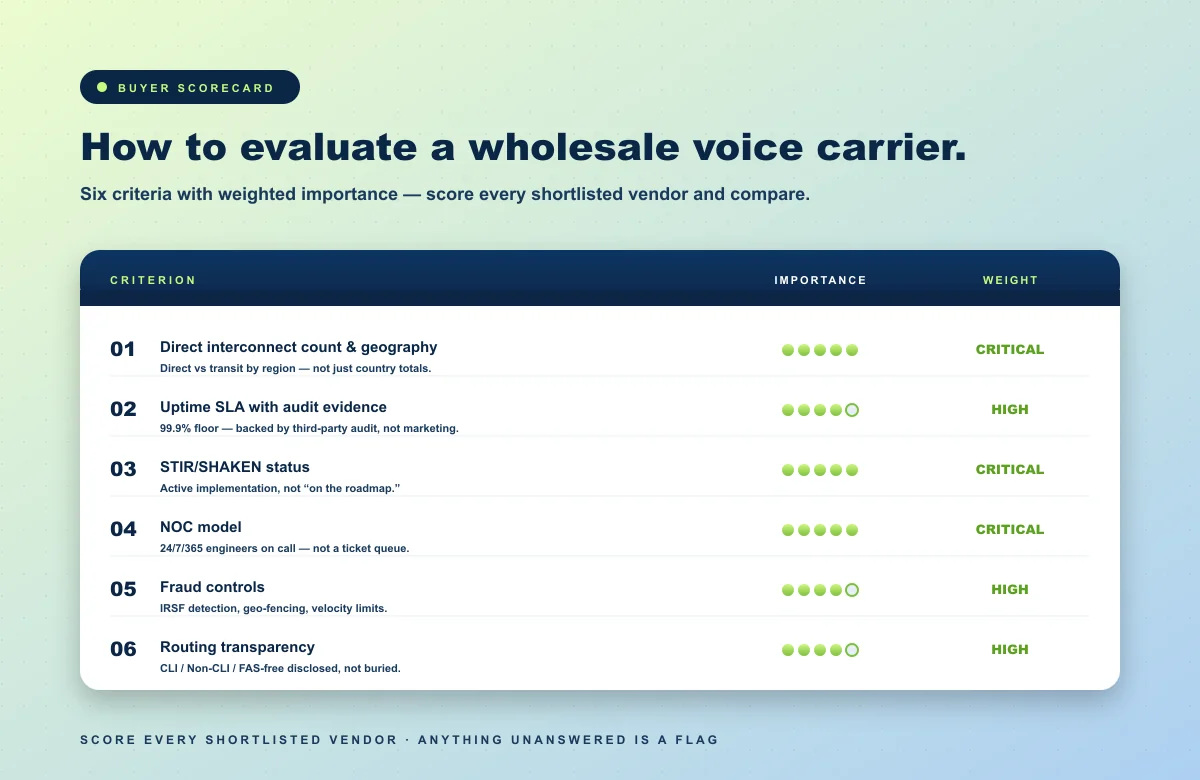
- Direct interconnect count and geography. Ask for a number, then ask which regions are direct vs transited. Africa-bound traffic via European transit is fine; Africa-bound traffic via direct African interconnects is better.
- Uptime SLA and how it is measured. A 99.9% SLA is the modern floor. Anyone claiming 99.999% without a verifiable third-party audit is selling marketing.
- STIR/SHAKEN status. Active implementation, not "on the roadmap." Required for US-terminating volume.
- HIPAA or sector-specific compliance. Required if you serve healthcare, fintech, or regulated industries.
- NOC model. A 24/7/365 NOC staffed by engineers (not a ticket queue) is the only acceptable answer for carrier-grade voice in 2026.
- Fraud controls. Ask specifically about IRSF detection, geo-fencing, and velocity limits — not just "fraud protection."
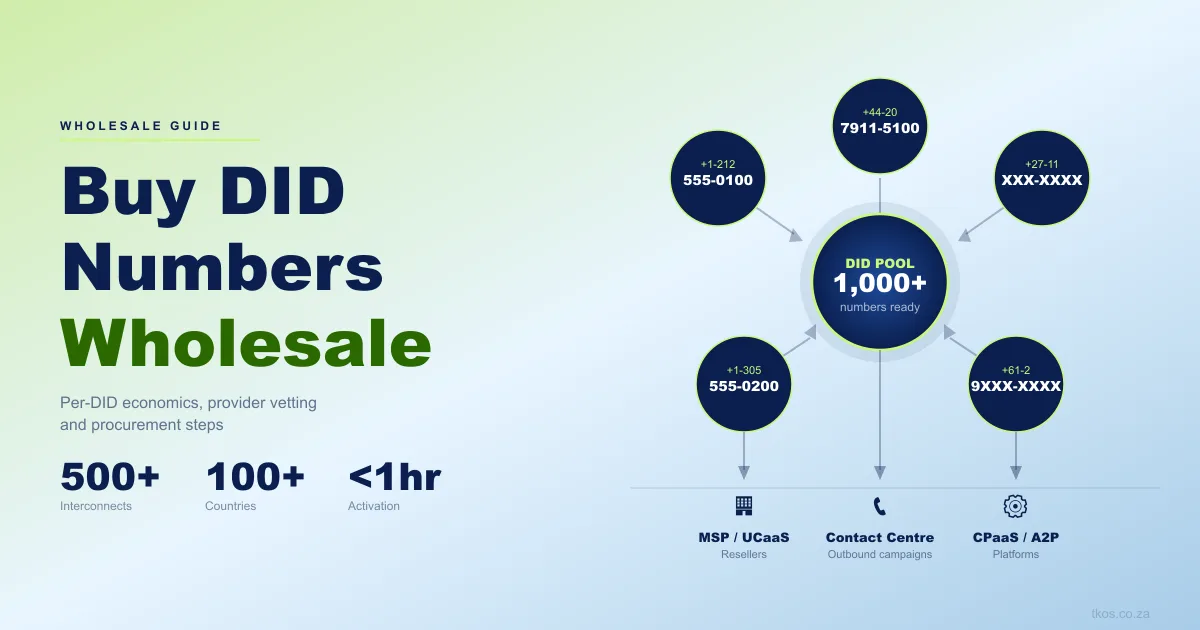
- DID coverage and provisioning speed. 100+ country footprint with sub-hour activation is the current bar for global enterprise.
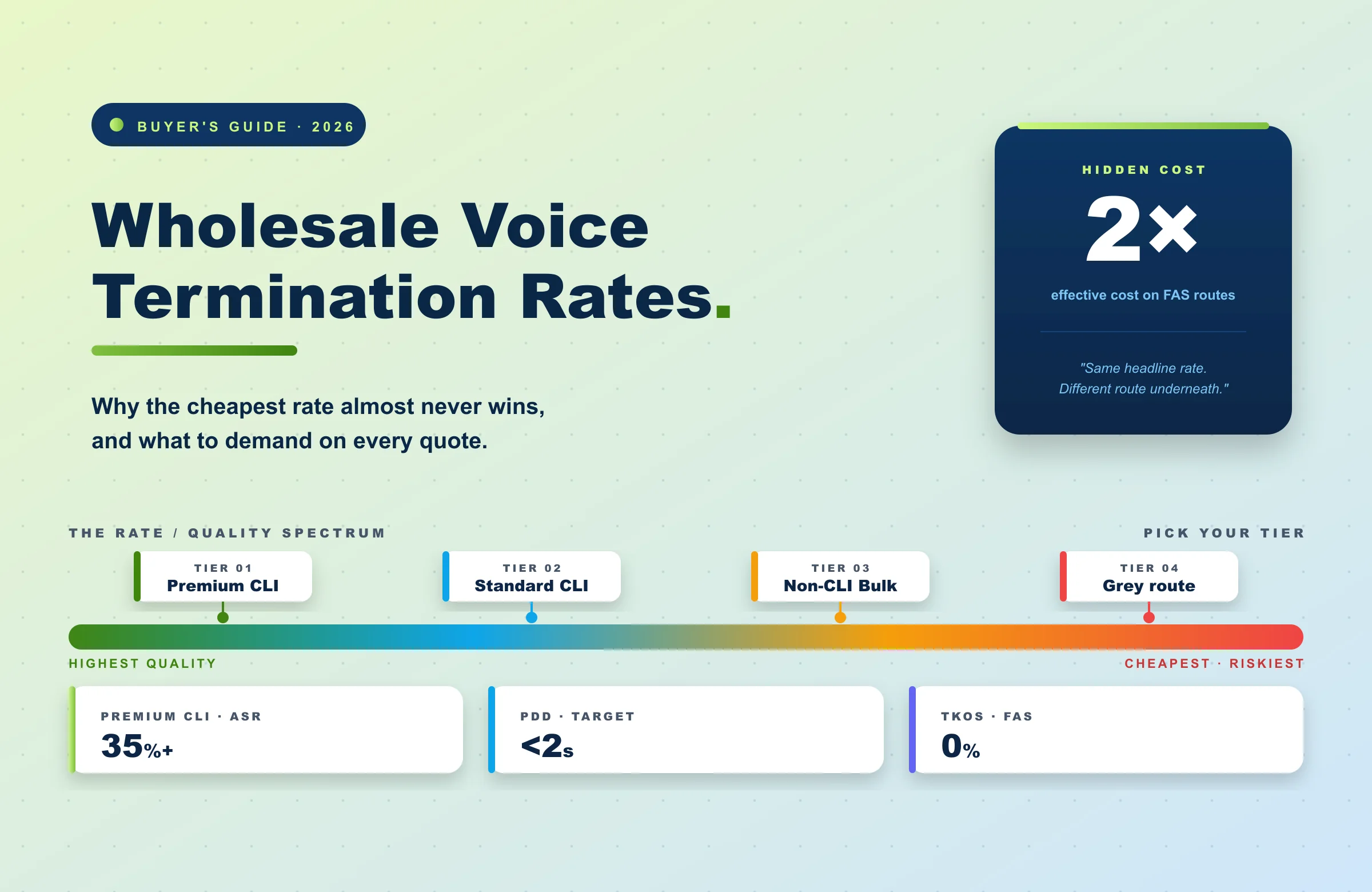
- Transparency on routing. CLI vs Non-CLI, FAS-free options, A-Z termination quality tiers — these should be disclosed, not buried.
The carriers that breeze through all eight are usually the ones MSPs and large enterprises end up signing.
What this means for MSPs and enterprises
For MSPs, the wholesale layer is now a margin lever. Choosing a partner with white-label UCaaS, SIP trunk enablement, and a 24/7/365 NOC means you can launch a branded voice product without standing up your own network. The pace of MSPs hitting market in under a month is only possible because the wholesale carrier handles infrastructure.
For enterprises, the lesson is different. Voice quality issues are almost never the application's fault — they are the wholesale path's fault. If your contact centre is bleeding minutes to call clarity tickets, the answer usually lives in your termination provider, not your softphone client.
Either way: pick the layer you are buying with intent. Then make the carrier prove it.
Conclusion
The wholesale voice carrier market is bigger, faster-moving, and more African-influenced than the headline number suggests. A $50.27B sector compounding at 11.74% rewards carriers that own direct routes — particularly into markets where transit hops still dominate — and rewards buyers who score every provider on more than the rate sheet. Read the eight criteria the way you'd read a balance sheet, run the test traffic, and pick on routing reality instead of routing language.
Ready to test what carrier-grade actually feels like?
TKOS runs the wholesale voice infrastructure behind 500+ active partners across Africa and globally — 99.9% uptime, 500+ direct carrier interconnects, 100+ countries of DID coverage, and a 24/7/365 NOC staffed by tier-3 engineers. If you are evaluating wholesale voice carriers and want to see audio quality on your specific routes, start a free trial.
Top wholesale termination destinations