Introduction
Wholesale voice termination rates look like a simple number on a quote and almost never are. The cheapest rate usually costs more in the long run — once FAS, dropped calls, post-dial delay, and stripped CLI start eroding answer rates and margin. This guide unpacks how wholesale voice termination rates actually work in 2026: what drives the per-minute price, the difference between CLI and Non-CLI tiers, why "cheap" routes aren't cheap, what A-Z really means, the quality signals to demand on every quote, and what's specific to African voice traffic. It is written for carriers, MSPs, contact centres, and platform builders choosing a voice partner. For deeper coverage of the underlying service, see our pillar on wholesale voice termination.
How Wholesale Voice Termination Rates Actually Work
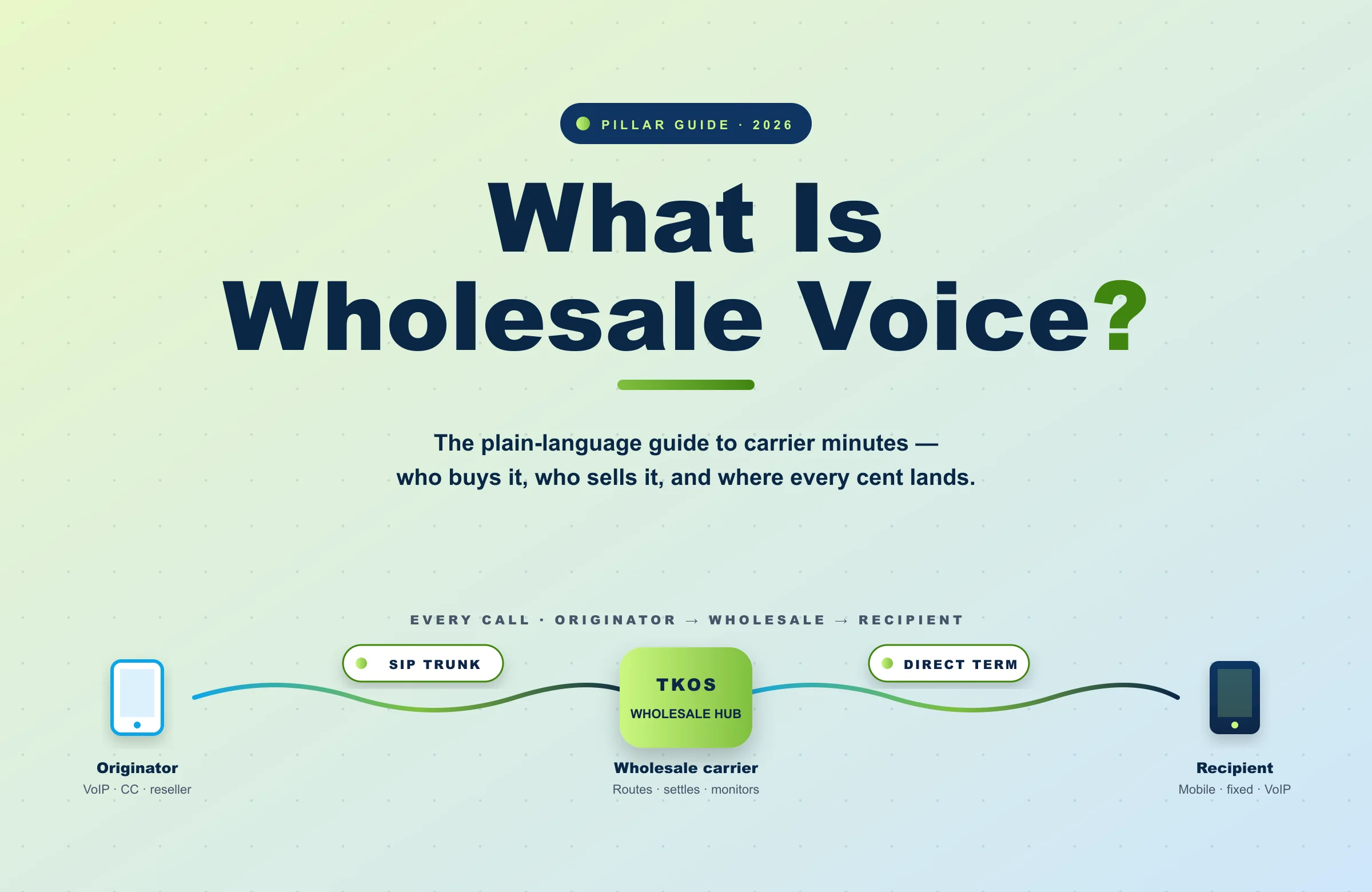
Every outbound call passes through a chain of carriers. The originating provider sends the call to a wholesale voice termination provider, which hands it off to transit partners, until it lands on the destination network: a mobile carrier in Nigeria, a fixed-line in the UK, a softswitch in Brazil. Each hop adds latency, adds a margin, and adds a place where audio quality can break. Wholesale voice termination rates cover the carrier's cumulative cost across that chain plus margin.
That's why two providers quoting $0.0042 per minute to the same destination can deliver wildly different experiences. The number is the same. The route underneath isn't. Route fragmentation remains the single biggest driver of inconsistent termination quality across emerging markets — the headline rate is just the snapshot. Smart buyers compare quotes side-by-side with route topology, not in isolation.
What Drives the Per-Minute Rate?
The per-minute number on a quote is the output of six different inputs — destination economics, route class, volume commitment, hop count, contractual QoS, and currency exposure. Two providers can show identical headline rates and run completely different routing tables underneath. Read the rate and the structure together, not the rate alone.
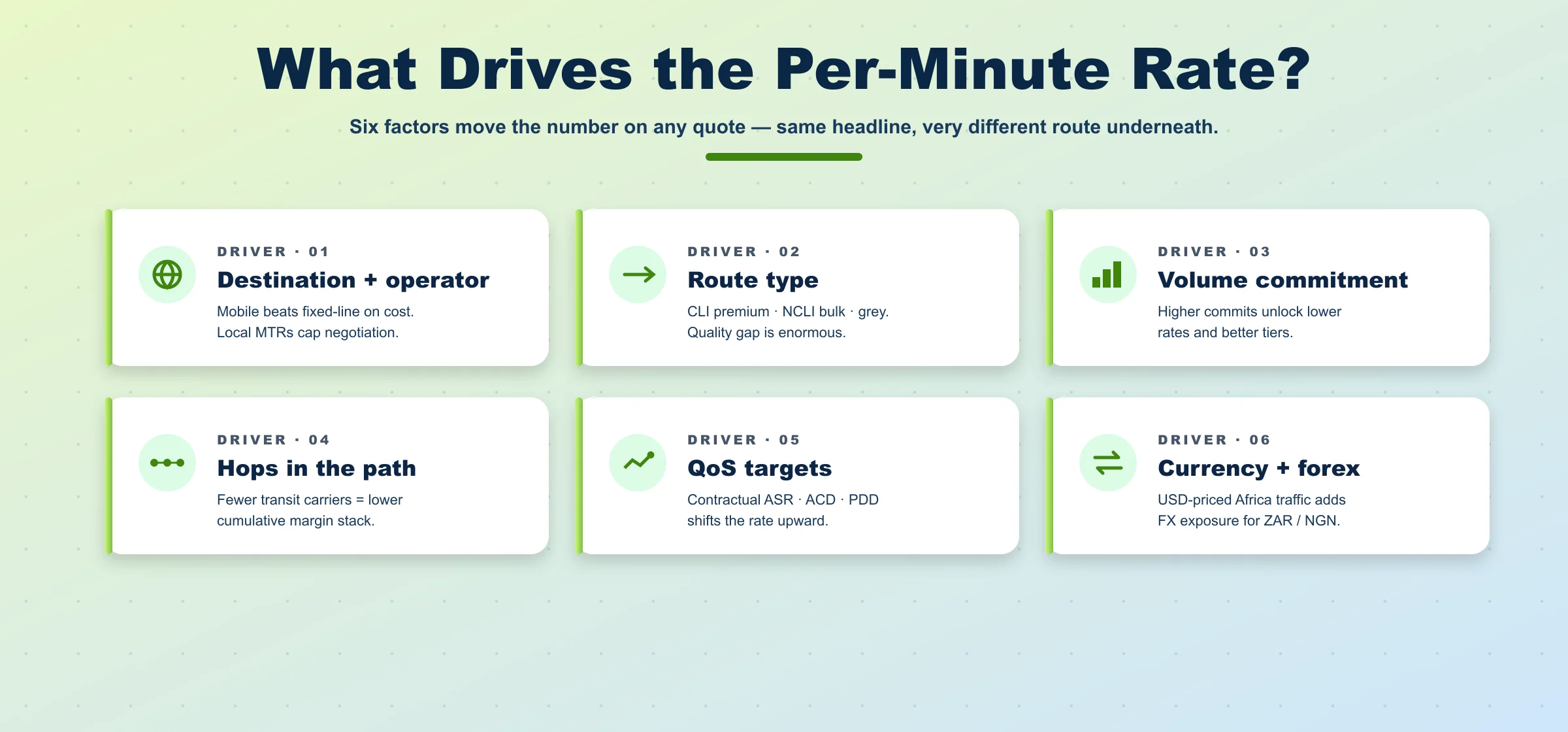
Six things move the rate on any given destination:
- Destination country and operator. Mobile termination is almost always more expensive than fixed-line. Some operators charge premium MTRs (mobile termination rates) regulated by national authorities.
- Route type. A direct CLI route to the destination carrier costs more than a Non-CLI grey route, but the quality gap between them is enormous.
- Volume commitment. Higher monthly minute commitments unlock lower rates and better routing tiers.
- Hops in the path. Fewer transit carriers mean lower cumulative margins. Direct interconnects beat aggregated routes on price and quality.
- Quality of service requirements. Contractual ASR, ACD, and PDD targets shift the rate.
- Currency and forex risk. Africa-bound traffic priced in USD adds a layer of volatility for buyers paying in ZAR or NGN.
Two providers can show identical numbers on a quote and run completely different routing tables underneath.
CLI vs Non-CLI: The Rate Gap
CLI (Caller Line Identification) routes preserve the caller's number from origin to destination. The person you're calling sees who's calling. Mobile networks and contact centres need this; so do enterprises whose customers screen unknown numbers.
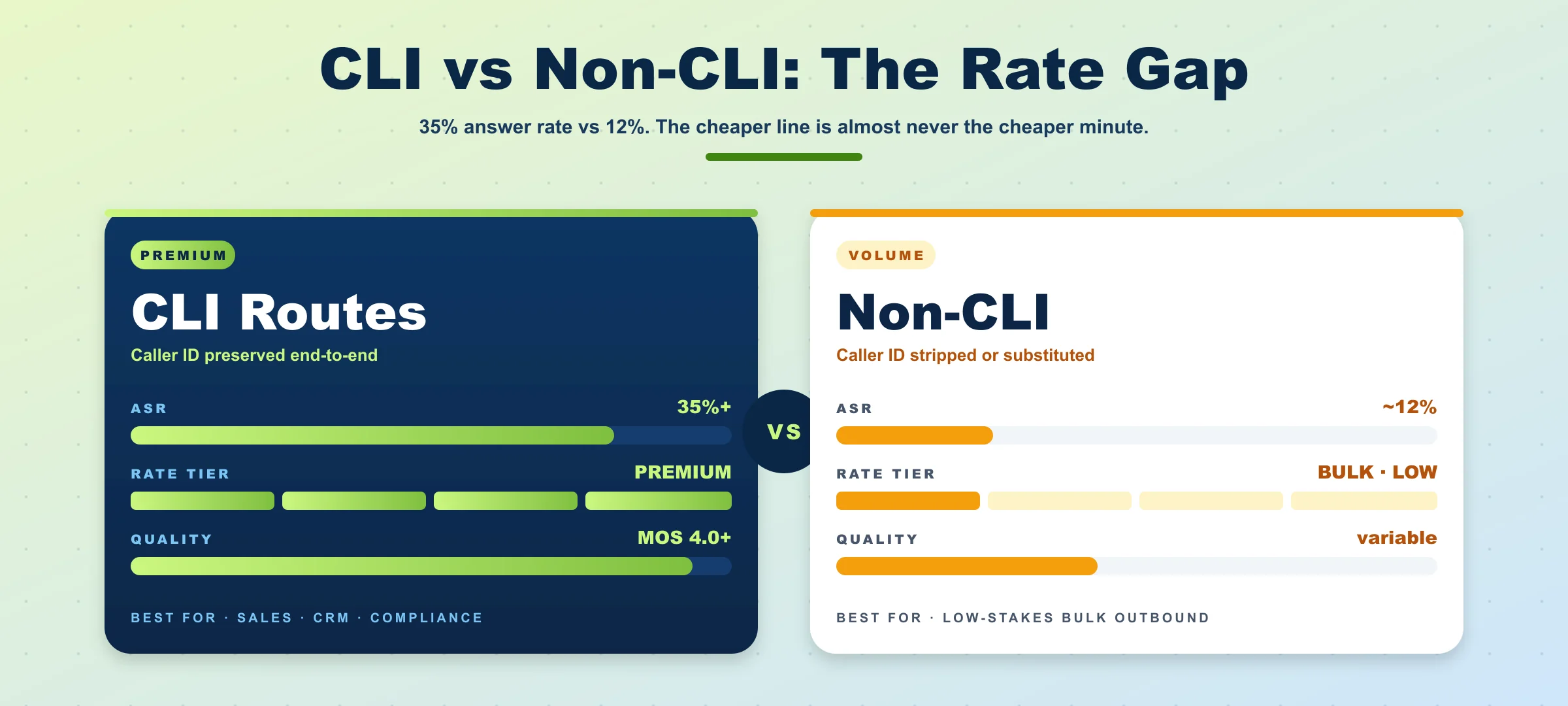
Non-CLI routes strip or substitute the caller ID, often using a pool of generic numbers. They're cheaper because they bypass premium interconnects and pass through routes carriers reserve for low-priority traffic — and they are where most call-quality complaints and fraud-flagging cluster. If you're terminating sales calls or contact-centre traffic, CLI isn't optional. The gap is the difference between a 35% answer rate and a 12% one.
FAS: Why Cheap Wholesale Voice Termination Rates Aren't Cheap
False Answer Supervision (FAS) is the dirty secret of low-cost wholesale voice. A FAS route triggers billing the moment a call signal crosses a threshold, even if the called party never picks up. You pay for connect tones, voicemail prompts, and ringing time as if they were live conversations.
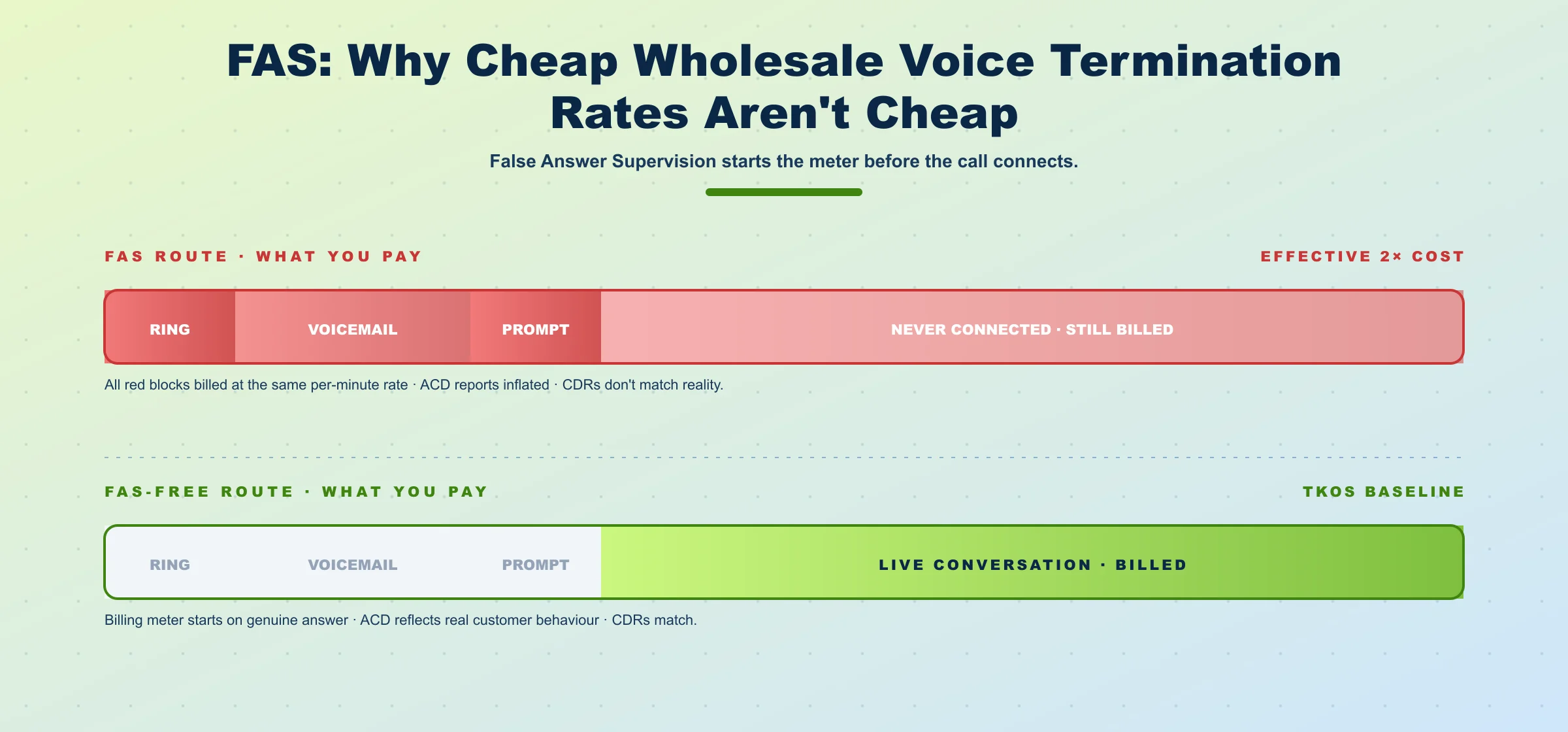
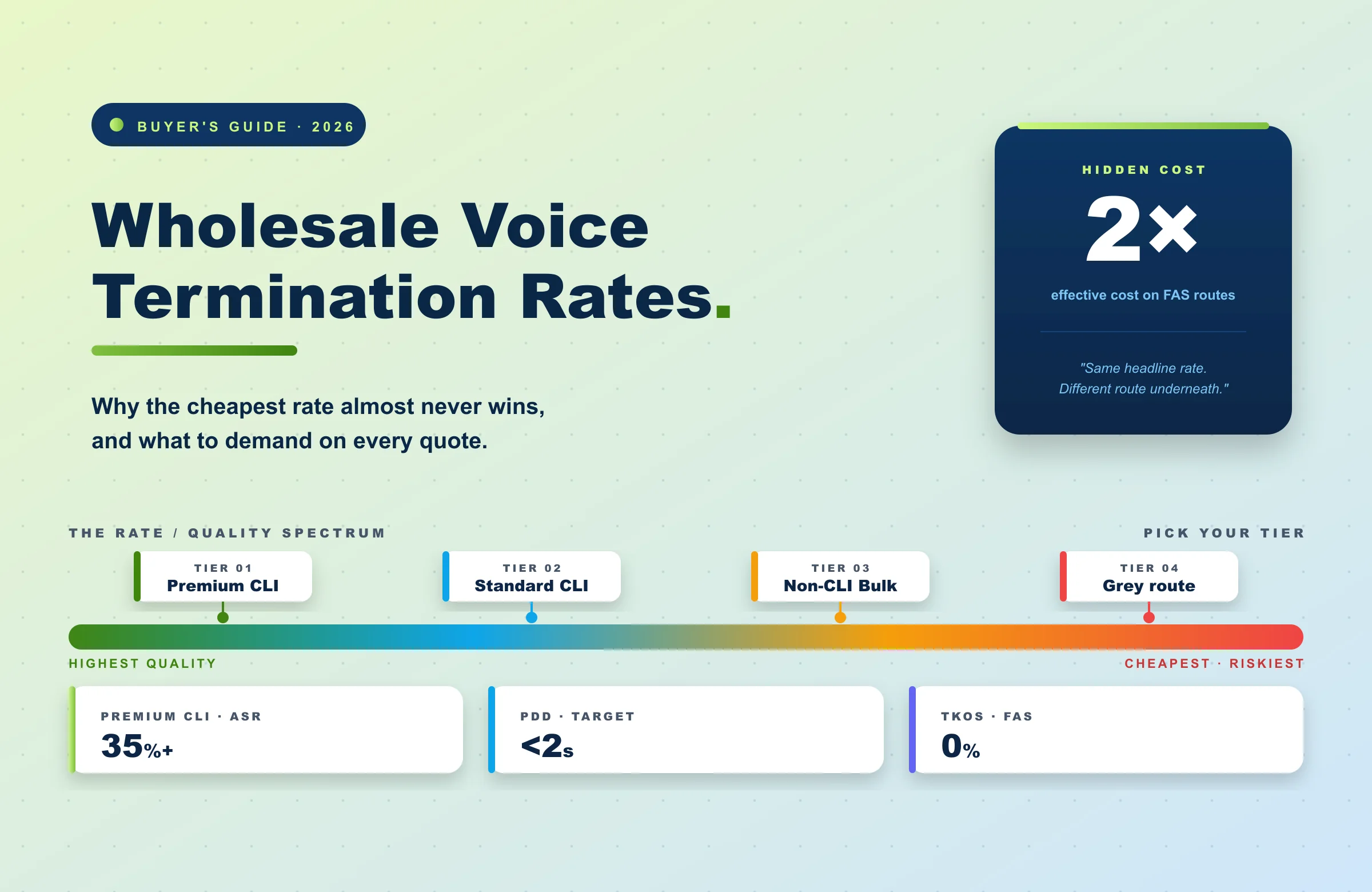
A route advertising $0.005 per minute can effectively cost double once FAS inflation is factored in — which is exactly why headline pricing is not the right comparison metric. FAS also distorts your customer's billing if you're a reseller. They see ACD numbers that don't match their CDRs, and trust evaporates inside one quarter.
TKOS publishes its routes as FAS-free. That's not a feature; it's a baseline contractual commitment. If a wholesale provider can't certify FAS-free in writing, walk away.
A-Z Termination: What the Letter Range Means
A-Z termination means the carrier covers every destination from country A through country Z, with hundreds of country-prefix codes mapped to active routes. It's the opposite of bilateral termination, which covers only specific country pairs. For most VoIP platforms, A-Z is what you want — a contact centre dialling into 30 markets can't manage 30 separate carrier relationships.
The catch: not every A-Z route on the rate sheet is the same quality. Some are direct. Some are aggregated through three transit carriers. Rate sheets won't always tell you which is which. Ask, then verify with test minutes. Industry data on the wholesale voice market shows continued growth across emerging regions.
Wholesale Voice Termination Rates by Quality Tier
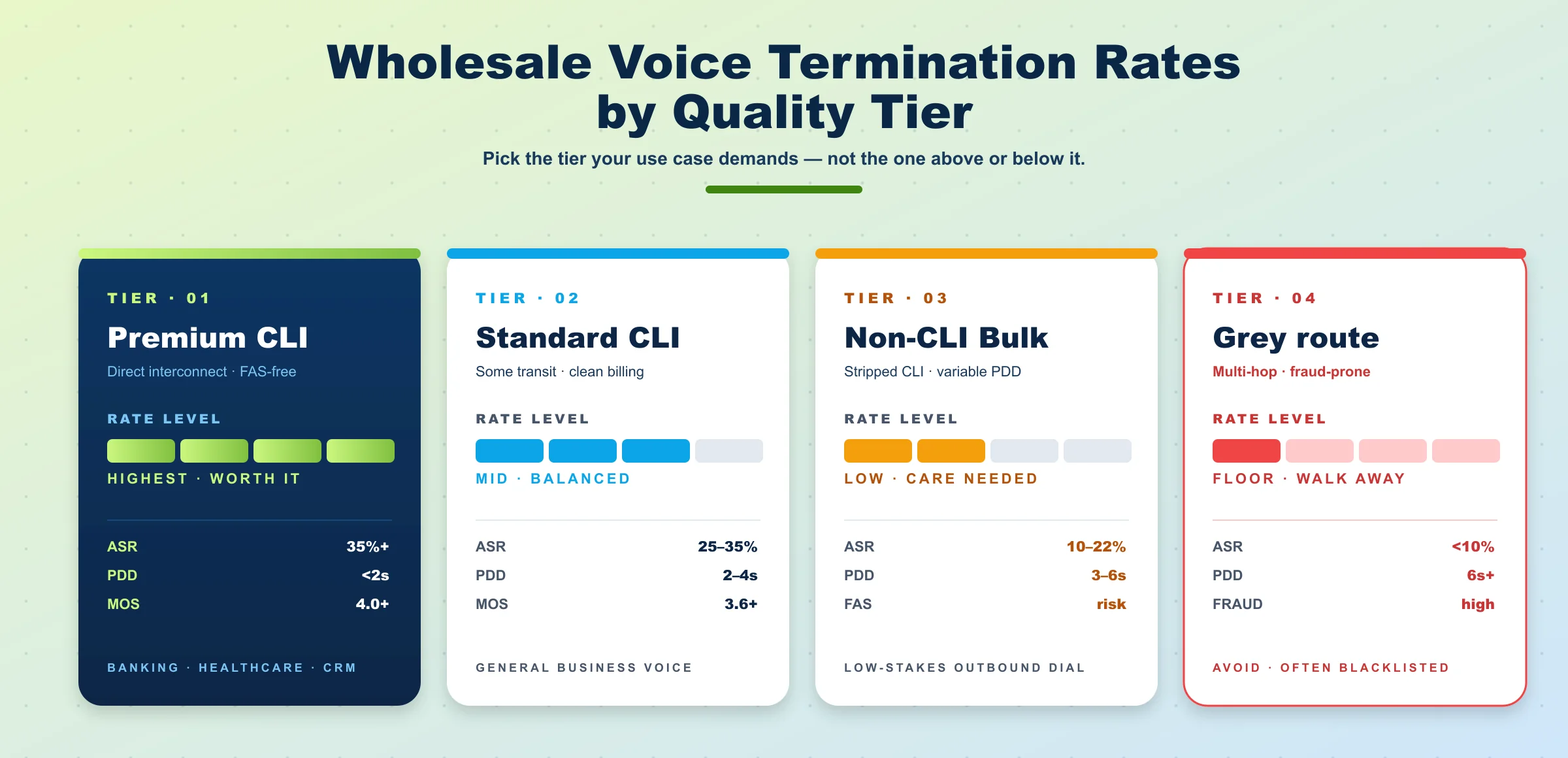
Wholesale voice termination rates cluster into four tiers — Premium CLI at the top, Standard CLI in the middle, Non-CLI Bulk below that, and Grey routes at the bottom. The right pick depends on the use case rather than the headline price. A premium CLI rate for autodialer traffic burns money; a grey rate for healthcare calls destroys reputation. Industry data on the wholesale voice market shows continued growth across emerging regions. Industry data on the wholesale voice market shows continued growth across emerging regions. GSMA tracking of the global telecom market shows wholesale voice volumes expanding through 2030.
Quality complaints cluster around carriers competing primarily on price. The math is simple. To undercut market rates, a carrier has to skip somewhere: direct interconnects, fraud filtering, or NOC investment.
For a low-stakes outbound dialer that doesn't care about audio fidelity, the cheapest route works. For everyone else, the rate-quality tradeoff looks like this:
- Premium CLI — highest rate. Direct interconnect, FAS-free, ASR over 35%.
- Standard CLI — mid rate. Some transit carriers, mostly clean billing.
- Non-CLI Bulk — low rate. Stripped CLI, variable PDD, FAS risk.
- Grey — lowest rate. Multi-hop, fraud-prone, often blacklisted.
Pick the tier your use case demands. Don't get talked into a tier above or below it. A premium CLI rate for autodialer traffic burns money. A grey rate for healthcare or financial services calls destroys reputation.
How to Evaluate a Wholesale Voice Termination Rates Quote
A real quote does more than list per-minute rates. Insist on:
- Direct vs transit breakdown. Which destinations are direct interconnects? Which go through transit?
- ASR and ACD targets per route. Anything below 35% ASR on developed-market mobile is a red flag.
- PDD commitment. Post-dial delay above 4 seconds kills answer rates on every channel.
- FAS policy in writing. "FAS-free" must be a contractual term, not a sales line.
- Test minutes. A serious wholesaler offers test traffic before any commitment.
- Fraud protection. FCC Guide-mandated STIR/SHAKEN attestation, IRSF detection, dispute timelines.
- NOC response time. Hours, not days, when a route degrades.
- Transparent CDR access. Real-time or near-real-time reporting through portal or API.
Anything else is marketing collateral.
African Termination: The Carrier Reality
Africa is the most fragmented termination market on the planet. Direct African interconnects are scarce among non-African carriers — most US and European providers terminate African traffic through one or two transit partners, which means three or four hops minimum on most routes. That's where latency creeps in and FAS slips through.
MTRs in some African markets are regulated and high. South African, Nigerian, and Kenyan termination rates aren't always negotiable in the way developed-market rates are. A wholesaler quoting below the regulated MTR is either burning cash or routing somewhere they shouldn't. South African operators must also align with POPIA — see the Information Regulator (POPIA) for the source framework on personal-information processing.
TKOS operates from a Johannesburg HQ with carrier relationships built across the continent over a decade. That's the difference between a quote that holds up under volume and one that breaks the moment your traffic crosses an African border.
STIR/SHAKEN and the Fraud Layer
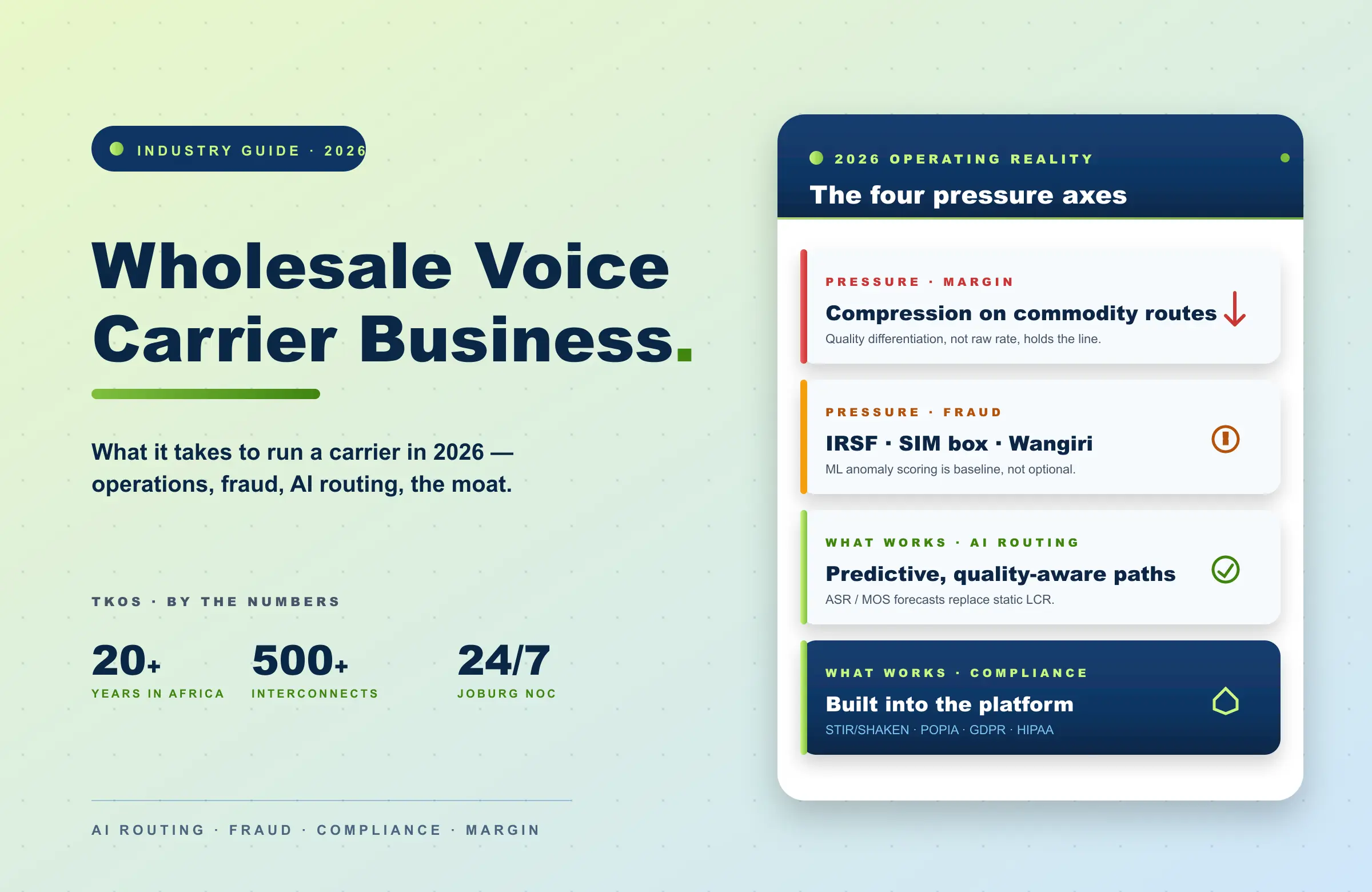
US-bound termination changed once STIR/SHAKEN became mandatory. Calls without proper attestation get flagged, blocked, or displayed as "Spam Likely" — a death sentence for any contact-centre application. A carrier without active STIR/SHAKEN cannot deliver quality US termination in 2026.
For non-US markets, the fraud layer is different. IRSF (International Revenue Share Fraud), wangiri callbacks, and route hijacking are the threats. Your partner should run visible fraud monitoring at the NOC level — suspicious traffic patterns trigger investigation, not silence.
Red Flags in Low Termination Rates
The wholesale voice market has tightened. Honest providers compete on quality and direct routing, not on undercutting the floor — and the smart way to negotiate is to ask for measurable performance commitments alongside the per-minute number.
- A per-minute price 30%+ below the market median for that destination.
- "All-inclusive" rates with no CLI vs Non-CLI distinction.
- No published FAS policy.
- Refusal to share ASR or PDD data per route.
- Test minutes denied, capped, or charged at full rate.
- Vague answers about transit vs direct routing.
- Long contract lock-ins with no quality SLAs.
- Rate sheets that haven't been updated in 90+ days.
Conclusion
Honest wholesale voice termination rates in 2026 are a function of route engineering, not just rate-sheet maths. The buyers who win treat CLI/Non-CLI selection, FAS-free billing, A-Z direct interconnects, MTR realities, and STIR/SHAKEN attestation as engineering choices — not procurement line items.
They model total cost per connected minute, demand quality data per destination, and walk away from quotes that look too cheap to be real. Looking forward, AI-driven routing, expanding STIR/SHAKEN adoption, and tighter African MTR regulation will keep separating the carriers earning their wholesale voice termination rates from the ones discounting their way to a margin call.