Introduction
In August 2019, phones in the 206 area code received 6,188,095 negative robocalls in a single month — the highest of any area code in the United States, according to a Truecaller study. If your phone rang from a 206 number that month, the odds it was a real neighbour were not great.
That stat captures the strange status of the 206. One of the most recognisable area codes in North America. Also one of the most spoofed. Owning a clean, well-routed 206 number in 2026 is more valuable than ever, and a little more complicated than the marketing pages let on.
What is the 206 area code?
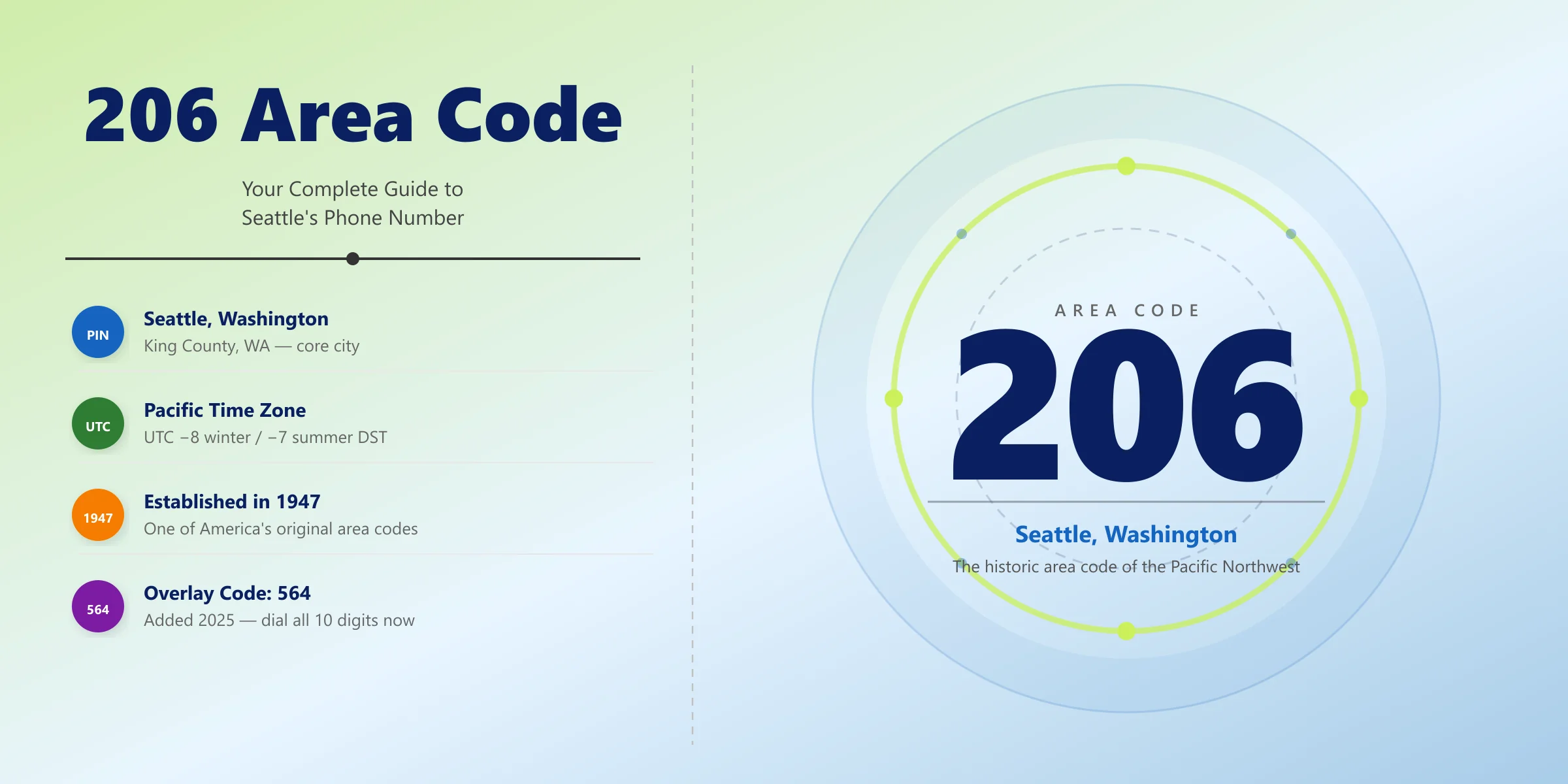
The 206 area code is a North American Numbering Plan code serving Seattle and parts of King and Kitsap counties in Washington State. Introduced in 1947 as one of the original 86 area codes, it originally covered the entire state before multiple splits left it covering only the Seattle core and surrounding islands.
In the Pacific Northwest, the 206 reads as a marker of belonging, the same way 212 reads as New York, 415 reads as San Francisco, or 510 area code reads as Oakland and the East Bay.
Which cities does the 206 area code cover?
The 206 covers the western core of King County and slices of Kitsap County. The footprint reaches:
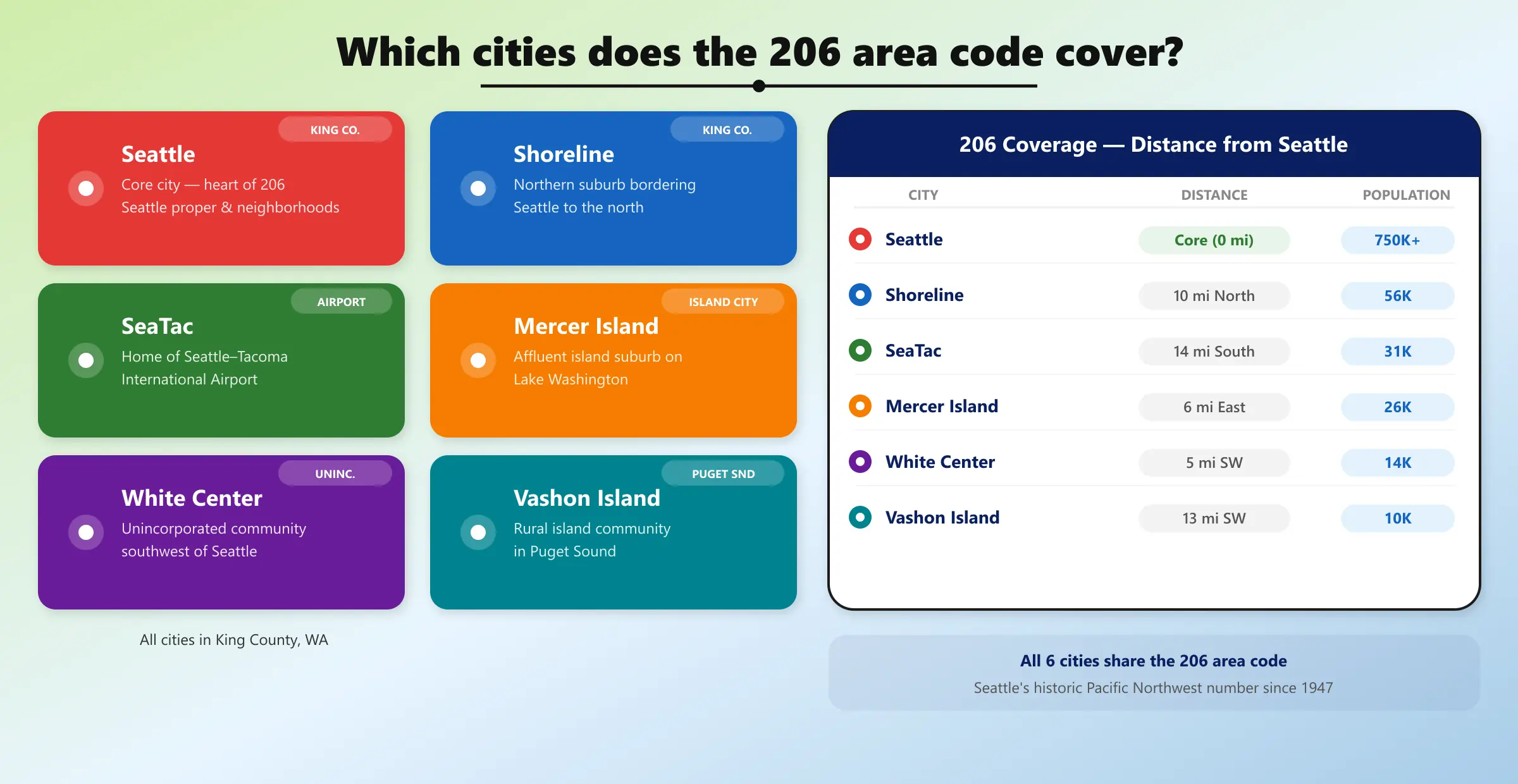
- Seattle (all neighbourhoods)
- Shoreline, Lake Forest Park
- Mercer Island, Burien, SeaTac, Tukwila
- Northern Des Moines
- Bainbridge Island, Vashon Island
ZIP codes inside the 206 service area run roughly 98033 through 98199. Tacoma uses 253. Bellevue and the Eastside use 425. Outlying western Washington uses 360.
A brief history of the 206
Six dates tell the story:
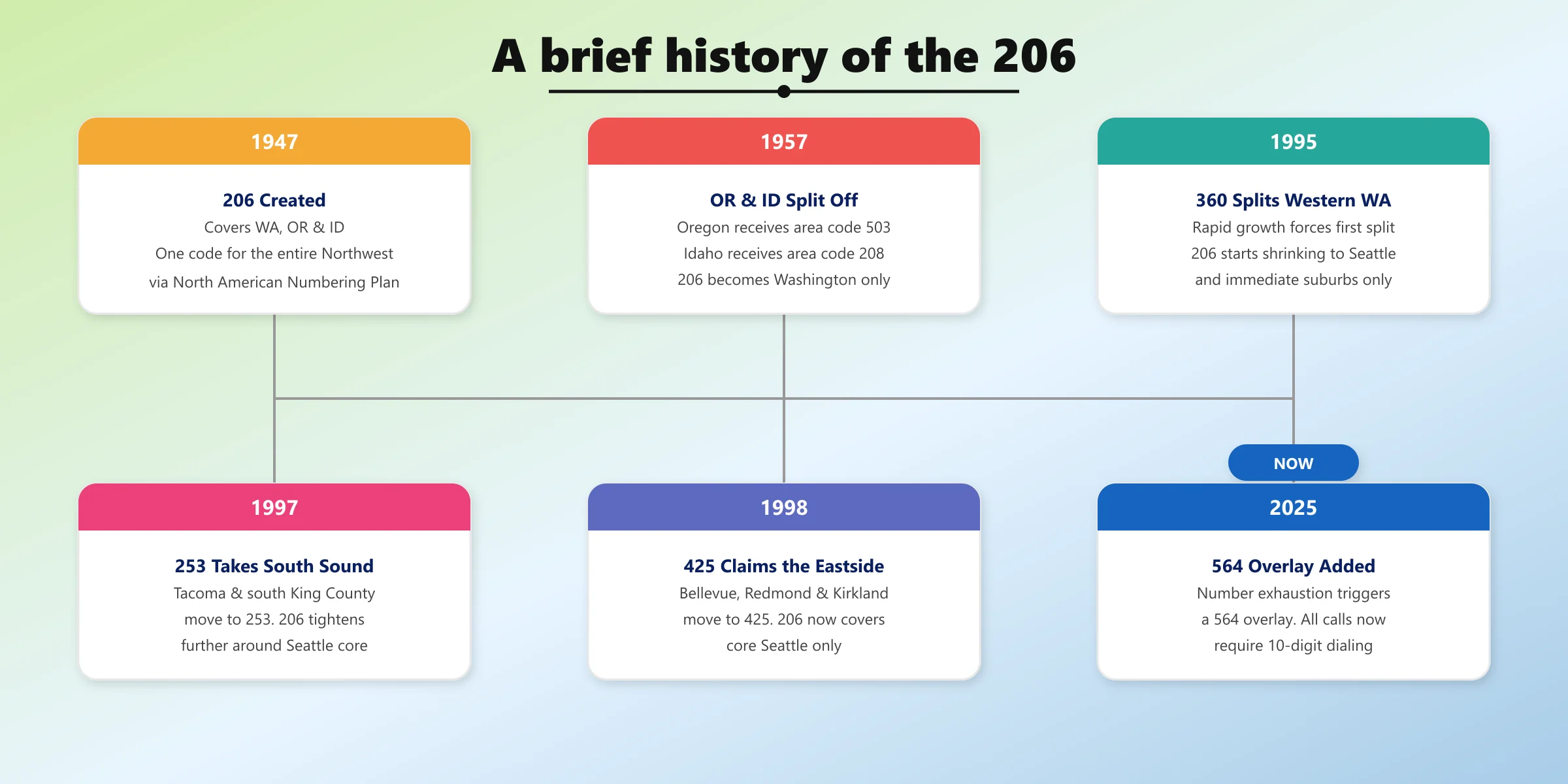
- 1947 — 206 launches as one of the original 86 NANP area codes, covering all of Washington.
- 1957 — Eastern Washington splits off as 509.
- 1995 — 360 splits off for western Washington outside the Seattle-Tacoma metro.
- 1997 — 253 splits off for the southern suburbs.
- 1998 — 425 splits off for the Eastside.
- 2025 — 564 is approved as an overlay on the same region as 206.
Every change happened for the same reason: Seattle kept growing.
Why does the 564 overlay exist?
In 2025, the Washington Utilities and Transportation Commission approved a 564 overlay on the same region as 206. An overlay adds a second area code to the same footprint, rather than splitting it.
Three practical changes followed:
- Existing 206 numbers stay 206. Nothing was renumbered.
- New numbers may be 206 or 564. Carriers pull from whichever pool has inventory.
- All local calls now require ten-digit dialing. Seven-digit dialing was retired.
The 564 is regulatorily identical to the 206. Culturally, it is not the same digital handshake. A 206 still signals Seattle native; a 564 reads as recently assigned. Fresh 206 inventory is finite, so when it runs out, you take a 564 or you port one in.
How to dial 206 numbers in 2026
The rules tightened in 2025:
- Inside the region: 206-XXX-XXXX or 564-XXX-XXXX (ten digits only)
- From elsewhere in the US: 1-206-XXX-XXXX
- From outside North America: +1-206-XXX-XXXX
- Toll-free: 1-800, 1-888, 1-877, 1-866, 1-855, 1-844, 1-833
- Emergency: 911, always
Older PBX configurations that strip leading digits will fail silently on the new rule. Update them.
Why Seattle businesses still ask for the 206
A local area code is no longer a phone-book decision. It is a brand decision and a connect-rate decision — the same logic behind demand for 929 numbers in NYC's outer boroughs.
A 206 caller ID lifts answer rates for local prospects. People answer numbers they recognise, and 206 reads as familiar to anyone in King County. Inbound, a 206 on a website or invoice signals local economy participation, not a call centre two time zones away.
Companies headquartered elsewhere routinely buy 206 numbers as part of their Seattle go-to-market kit, then route those calls to wherever their teams sit. Cloud telephony makes the number live anywhere.
The 206 robocall problem and how to defend against it
The flip side of brand recognition is targeting. The 206 sits near the top of US robocall volume, and the 6.18 million figure from 2019 was not a one-off spike.
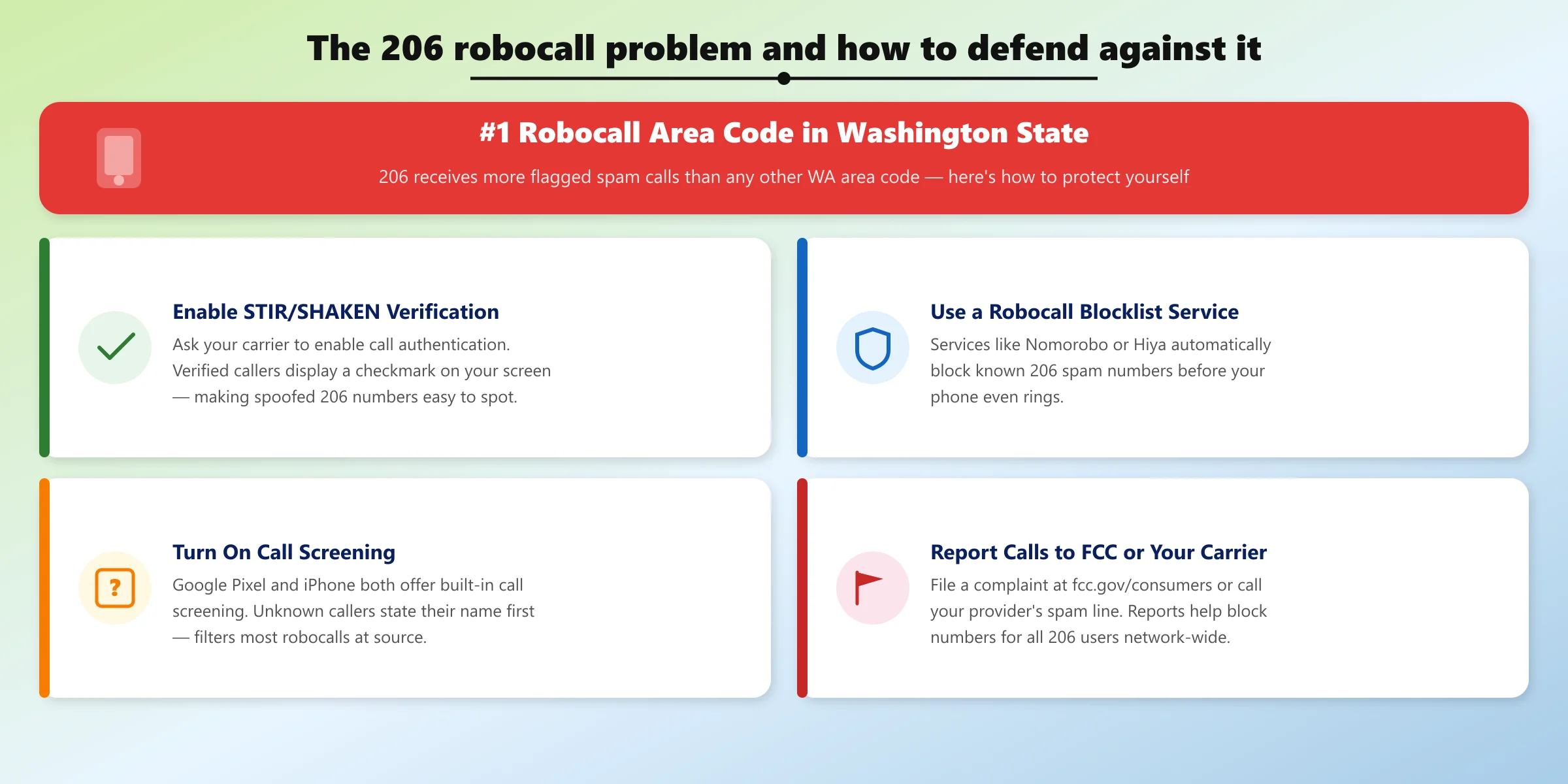
Three things are happening at once:
- Neighbour spoofing. Scammers forge a 206 caller ID so the call looks local.
- A2P abuse. Cheap bulk dialers ship voice OTPs and fake fraud alerts.
- Tech-support and IRS impersonation. The 206 prefix gets disproportionately spoofed because Seattle reads as high-income and high-trust.
For individuals, defences work in layers: register with the National Do Not Call Registry, enable your mobile carrier's built-in spam filter, install a call-blocking app like Hiya or Robokiller, never share personal information on inbound calls, and report suspicious activity to the FTC at reportfraud.ftc.gov. The FCC's robocall guide covers every consumer protection available.
For businesses, the picture is different. Outbound calls from a 206 line risk being flagged as Scam Likely if the number has reputation history with carrier spam databases. The fix is a carrier that offers wholesale VoIP with active fraud protection and number scrubbing built in.
Seattle industries the 206 hits hardest
Different sectors weight a 206 differently. Where it matters most:
- Technology and software. Amazon, Microsoft, Expedia, T-Mobile, plus a deep startup bench.
- Healthcare and biotech. UW Medicine, Fred Hutch, Seattle Children's. Buyers favour vendors with HIPAA-compliant communication.
- E-commerce and DTC. Seattle is one of the highest e-commerce concentrations per capita in North America.
- Maritime and logistics. Port of Seattle handles billions in container traffic.
- Aerospace. Boeing and its supplier ecosystem.
For any company selling into these verticals, a 206 is part of the credibility stack. Routing it through a wholesale voice carrier ensures clean delivery and optimal pricing on outbound minutes.
How to get a 206 area code number for your business
The modern path is short:
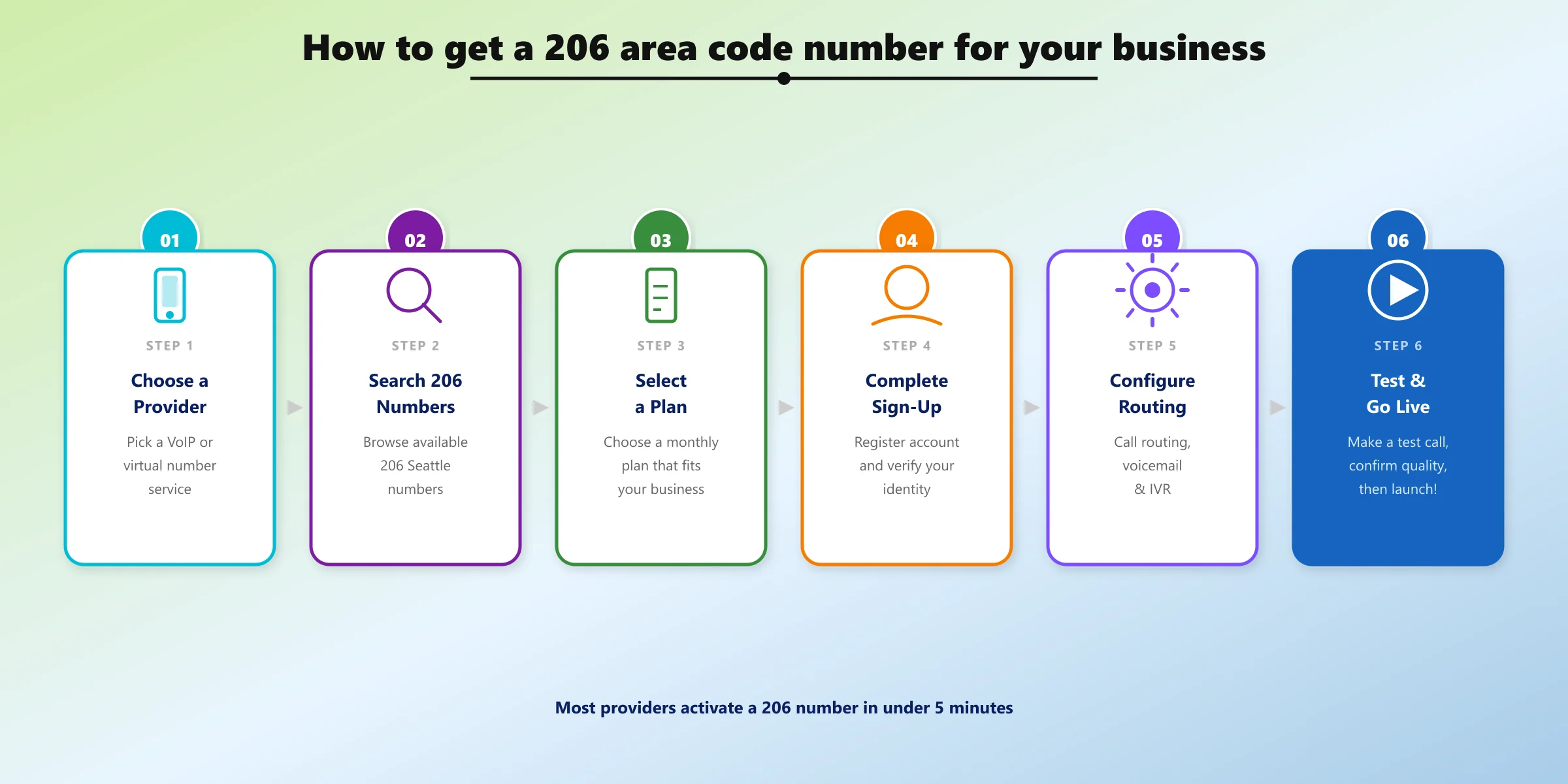
- Pick a carrier with current 206 inventory. Stock varies; ask before signing.
- Choose number type. Local, vanity, or a ported aged number. Aged numbers carry cleaner reputation history.
- Confirm fraud protection. Ask which controls the carrier runs at the network layer.
- Set up routing. Forward to a softphone, contact centre, mobile, or hunt group. Activation takes minutes.
- Scrub the number against scam lists before launch.
- Test outbound deliverability with calls to Verizon, T-Mobile, AT&T, and Comcast handsets to confirm no Scam Likely flags.
Modern virtual phone number platforms run this end-to-end in under an hour.
Conclusion
The 206 area code is more than a prefix. It is a piece of Seattle identity earned over eight decades of growth, through the 1957 split into 509, the 1995 break with 360, the 1997 and 1998 carve-outs, and the 564 overlay added in 2025. For businesses selling into the Pacific Northwest, a clean 206 line in 2026 is one of the most direct ways to signal local presence, lift answer rates, and compete inside Seattle's tech, healthcare, maritime, and e-commerce verticals. The setup is faster than most carriers admit. The follow-through — keeping the number's reputation clean, dialing it correctly, and routing it through a fraud-protected carrier — is where most businesses underinvest.