Introduction
Most "Bay Area" marketing copy still defaults to San Francisco — the 415 — as the regional identity. That assumption misreads the market. The East Bay holds the Port of Oakland (one of the largest container ports on the US West Coast), the entire UC Berkeley research and biotech corridor, Pixar in Emeryville, Kaiser Permanente's headquarters, and a deeper concentration of working-class and middle-class Bay Area customers than San Francisco itself. All of that runs on a different area code: the 510.
For businesses serving the East Bay, treating the region as "SF adjacent" costs answer rates and credibility. A 510 caller ID reads as Oakland and Berkeley in a way 415 never does. The 341 overlay added in 2019 doubled the available inventory, so getting one is faster now than ever.
What is the 510 area code?
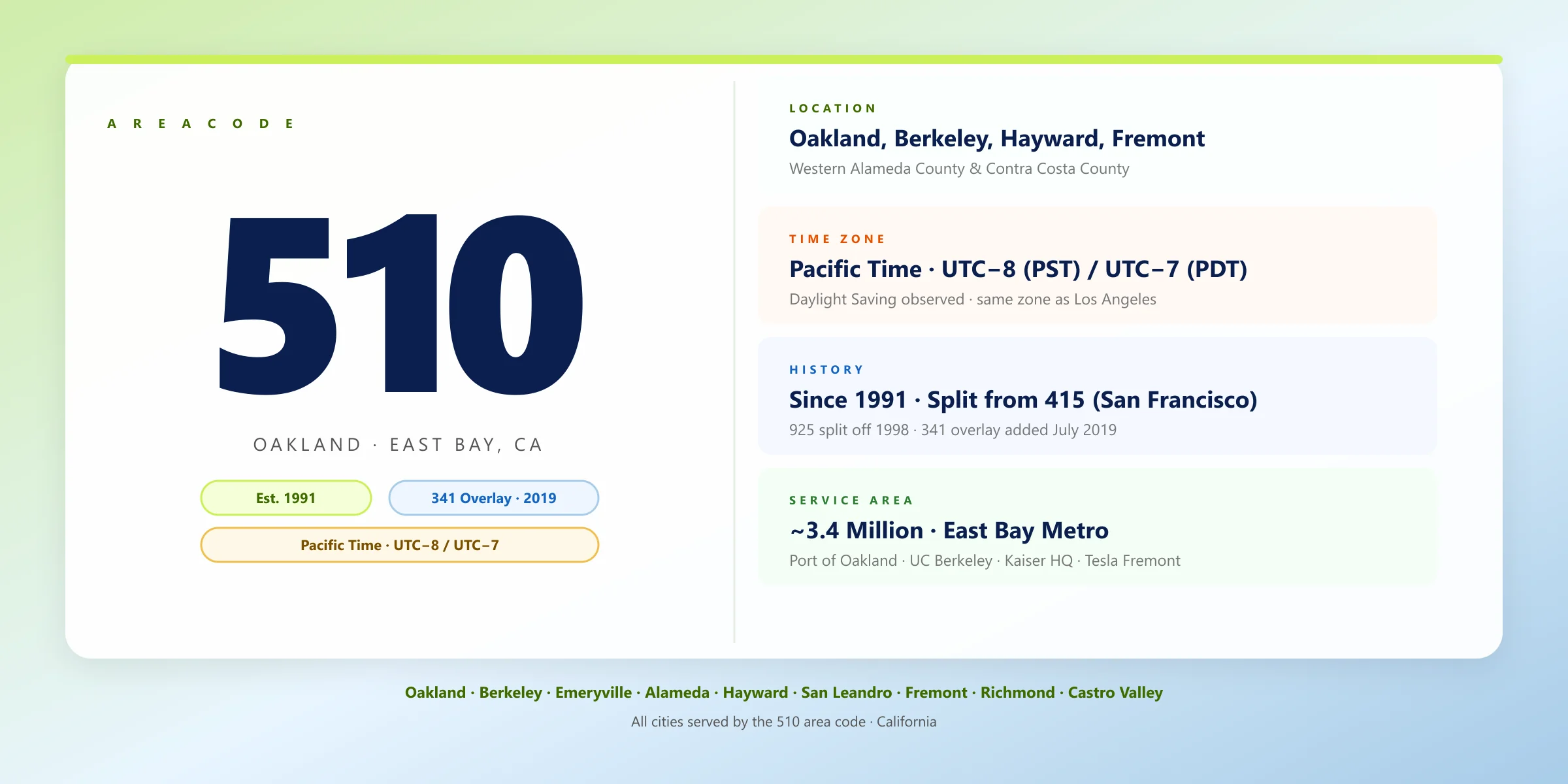
The 510 area code is a North American Numbering Plan code serving western Alameda County and parts of Contra Costa County in California. Activated on September 2, 1991, the 510 was created by splitting it off from the 415 (San Francisco), separating the East Bay from the San Francisco peninsula. In 1998, the inland portion split further into 925, leaving the 510 to cover the East Bay west of the Berkeley Hills.
Which cities does the 510 area code cover?
The 510 covers western Alameda County and a slice of Contra Costa County.
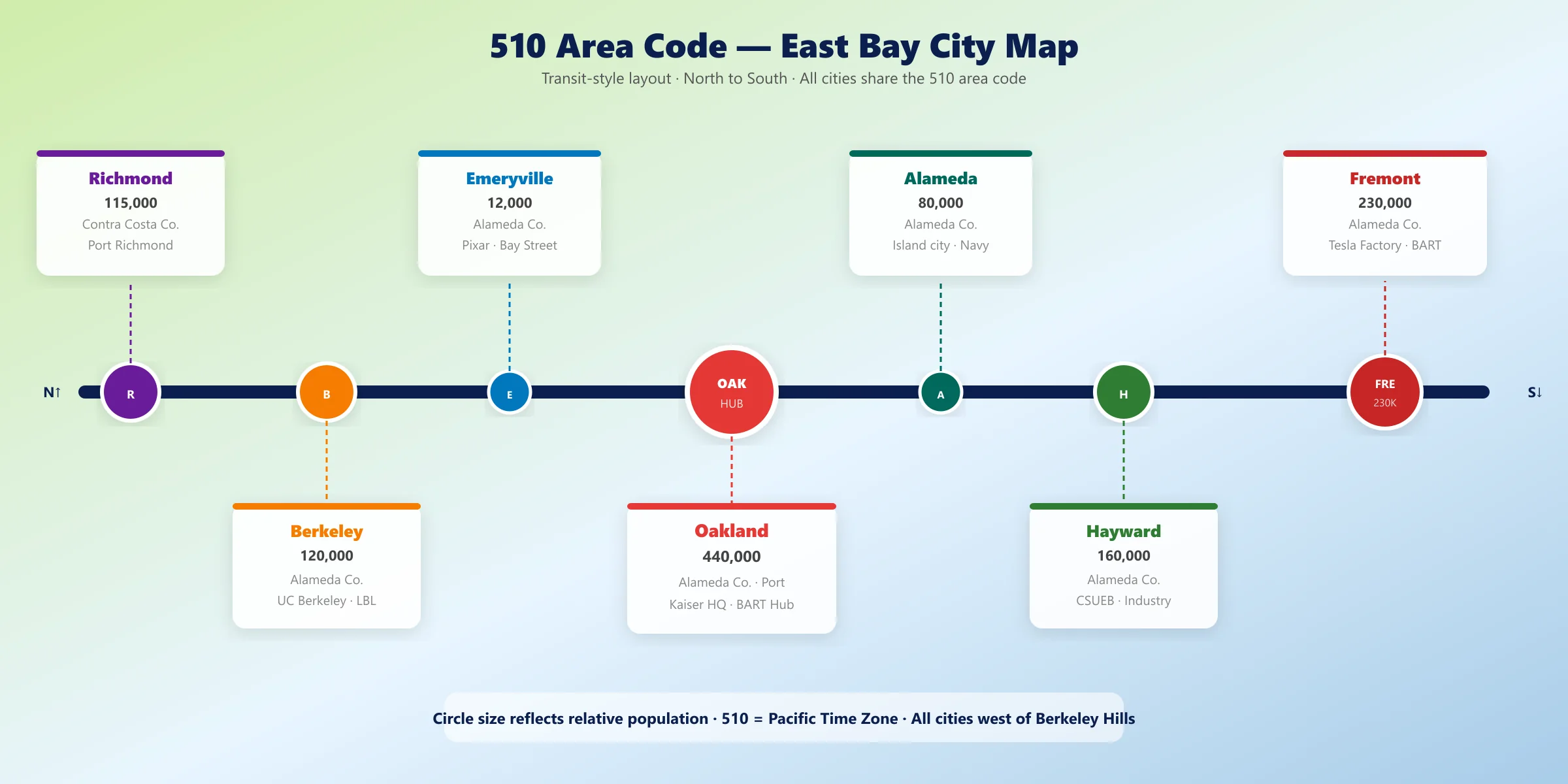
The footprint reaches:
- Oakland (downtown, Rockridge, Temescal, Fruitvale, West Oakland)
- Berkeley and Albany
- Emeryville
- Alameda
- Hayward, San Leandro, San Lorenzo
- Fremont, Newark, Union City
- Castro Valley
- Richmond, El Cerrito, Pinole, Hercules (Contra Costa portion)
- Piedmont, Orinda (partial)
The 510 does not cover Dublin, Livermore, Pleasanton, Sunol, or anything east of the Berkeley Hills — those use 925. San Francisco itself uses 415 with a 628 overlay.
A brief history of the 510
Four dates tell the story of how the East Bay got its own area code.
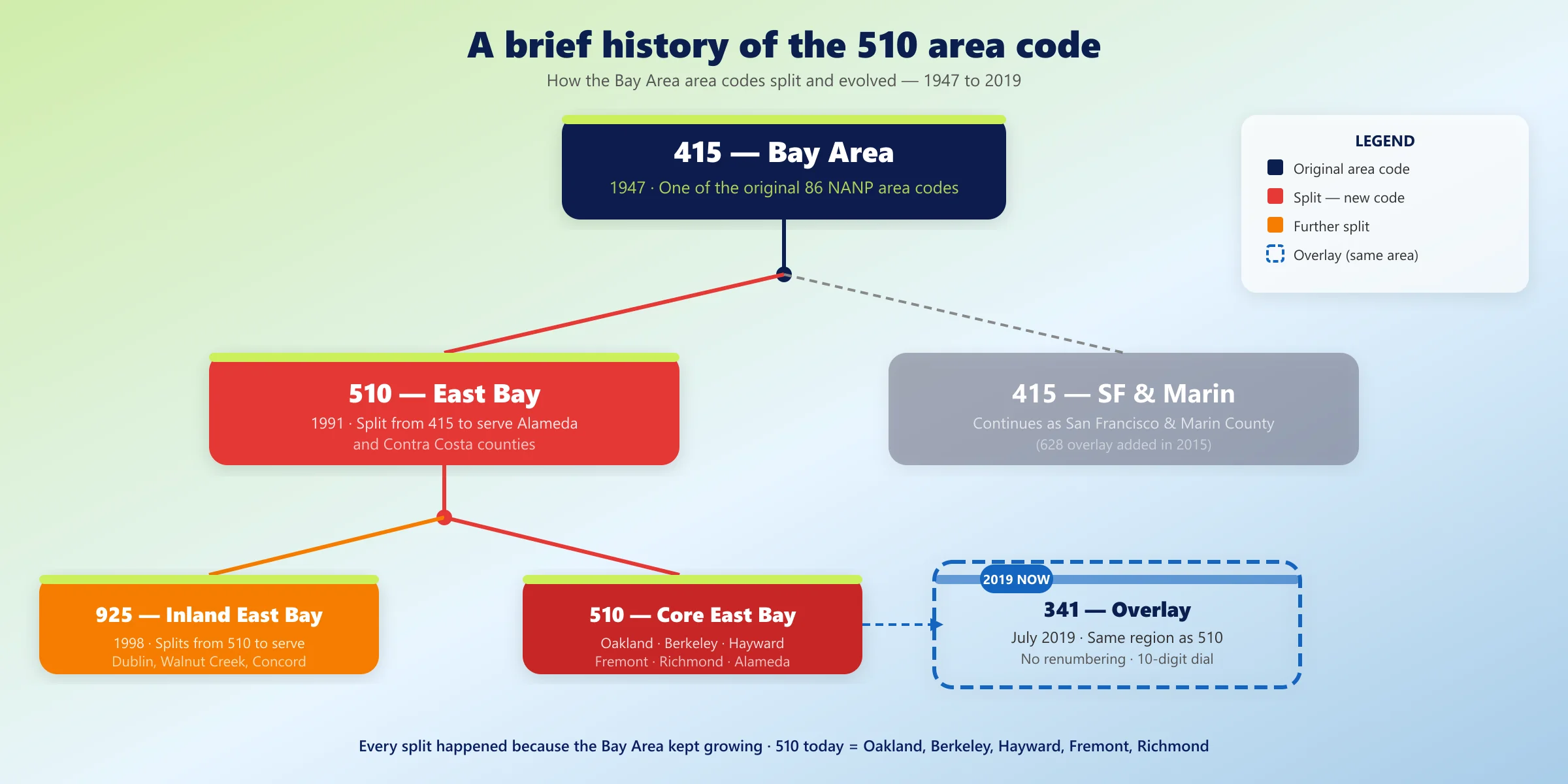
- 1947 — The Bay Area uses 415 alone as one of the original 86 NANP area codes.
- 1991 — 510 splits off from 415 to serve the East Bay.
- 1998 — 925 splits off from 510 to serve the inland East Bay east of the Berkeley Hills.
- 2019 — 341 added as an overlay on the 510 region.
What is the 341 overlay?
In July 2019, the 341 area code was activated as an overlay on the existing 510 region. An overlay adds a second area code to the same geographic footprint, rather than splitting the region into two new codes.
Three practical changes followed:
- Existing 510 numbers stay 510. Nothing was renumbered.
- New numbers may be 510 or 341. Carriers pull from whichever pool has current inventory.
- All local calls now require ten-digit dialing. Seven-digit was retired when the overlay activated.
Culturally, the 510 still carries the East Bay identity. The 341 is regulatorily identical but reads as "recently assigned." For businesses wanting maximum local credibility, 510 is preferred, though 341 numbers are now common in fresh inventory pools.
How to dial 510 numbers in 2026
Ten-digit dialing has been mandatory in the East Bay since 2019:
- Inside the region: 510-XXX-XXXX or 341-XXX-XXXX (ten digits)
- From elsewhere in the US: 1-510-XXX-XXXX
- From outside North America: +1-510-XXX-XXXX
- Toll-free: 1-800, 1-888, 1-877, 1-866, 1-855, 1-844, 1-833
- Emergency: 911, always
Older PBX configurations that strip leading digits will fail silently. Update them.
Why East Bay businesses still ask for the 510
A local area code is no longer a phone-book decision. For East Bay businesses, it is an identity decision that separates them from the SF default. A 510 caller ID lifts answer rates across Oakland, Berkeley, Hayward, Fremont, and the Contra Costa cities. Inbound, a 510 on a website or invoice signals participation in the working Bay Area economy, not a Silicon Valley call centre or an SF outsider.
The 510 robocall problem and how to defend against it
The Bay Area sits high in US robocall and spoofing volume because the region is wealthy, tech-savvy, and dense.
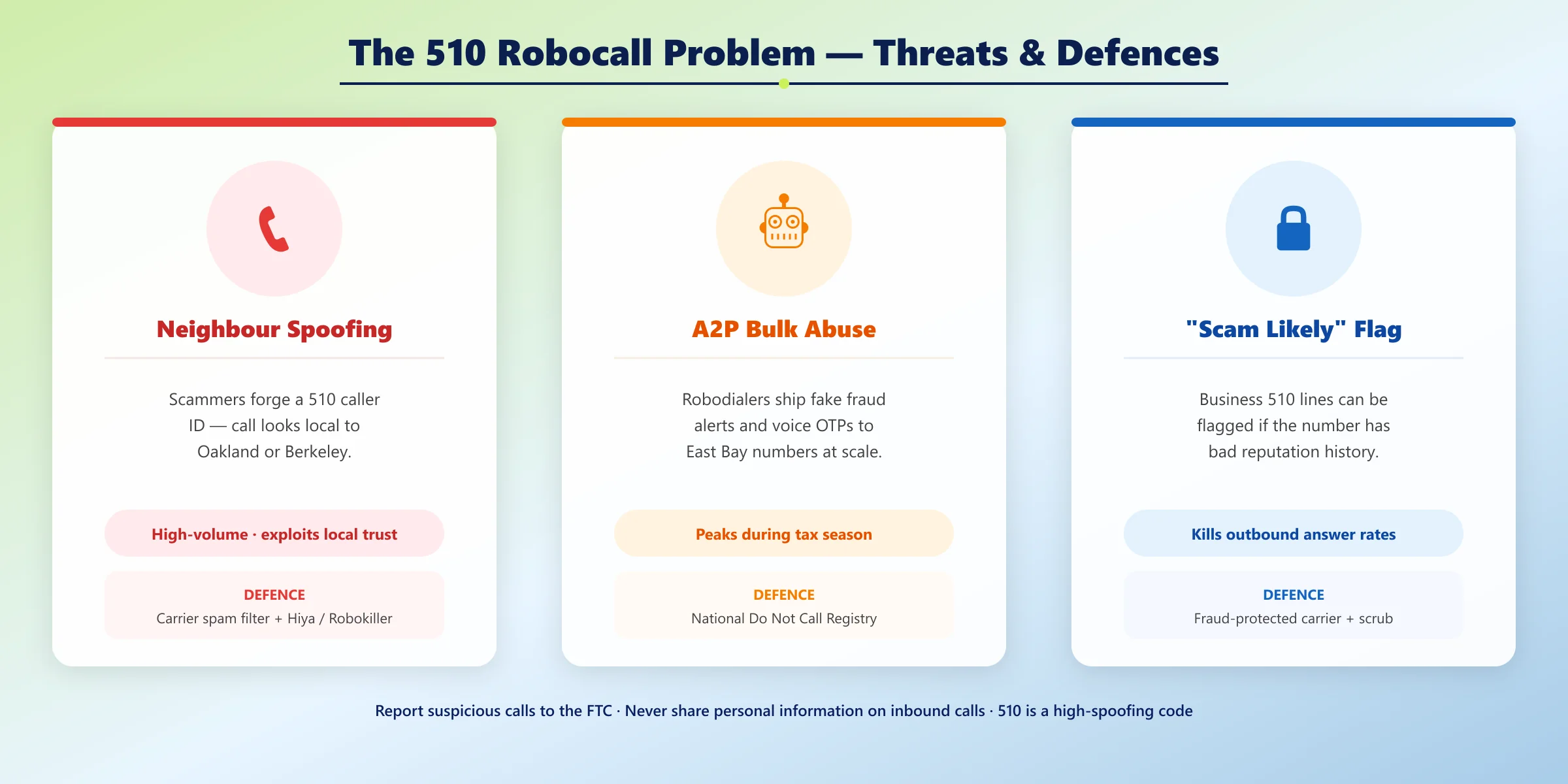
Three things are happening:
- Neighbour spoofing. Scammers forge a 510 caller ID so the call appears to come from Oakland or Berkeley.
- A2P abuse. Bulk dialers ship voice OTPs, fake fraud alerts, and impersonation scripts.
- Tech-support and IRS impersonation. The 510 prefix gets spoofed for higher-trust scams targeting tech-employed residents.
For individuals, defences work in layers: register with the National Do Not Call Registry, enable your mobile carrier's built-in spam filter, install a call-blocking app like Hiya or Robokiller, never share personal information on inbound calls, and report suspicious activity to the FTC. The FCC guide to stopping robocalls covers every consumer protection available.
For businesses, the picture is different. Outbound calls from a 510 line risk being flagged as Scam Likely if the number has reputation history with carrier spam databases. The fix is a wholesale VoIP provider that scrubs a number's reputation before activation.
East Bay industries the 510 hits hardest
Different sectors weight a 510 differently. Where it matters most:
- Logistics and shipping. Port of Oakland is one of the largest container ports on the US West Coast.
- Healthcare. Kaiser Permanente is headquartered in Oakland; Children's Hospital Oakland and Highland Hospital anchor the East Bay. Buyers favour vendors with HIPAA-compliant communication.
- Biotech and life sciences. The Berkeley—Emeryville corridor includes Bayer, Novartis, and a dense startup base.
- Education and research. UC Berkeley, Lawrence Berkeley National Lab.
- Technology and creative. Pixar (Emeryville) plus an East Bay startup ecosystem distinct from SF.
- Manufacturing. Tesla's Fremont factory and a supplier base across the East Bay.
For any company selling into these verticals, a 510 is part of the credibility stack alongside an East Bay address.
How to get a 510 area code number for your business
The modern path is short:
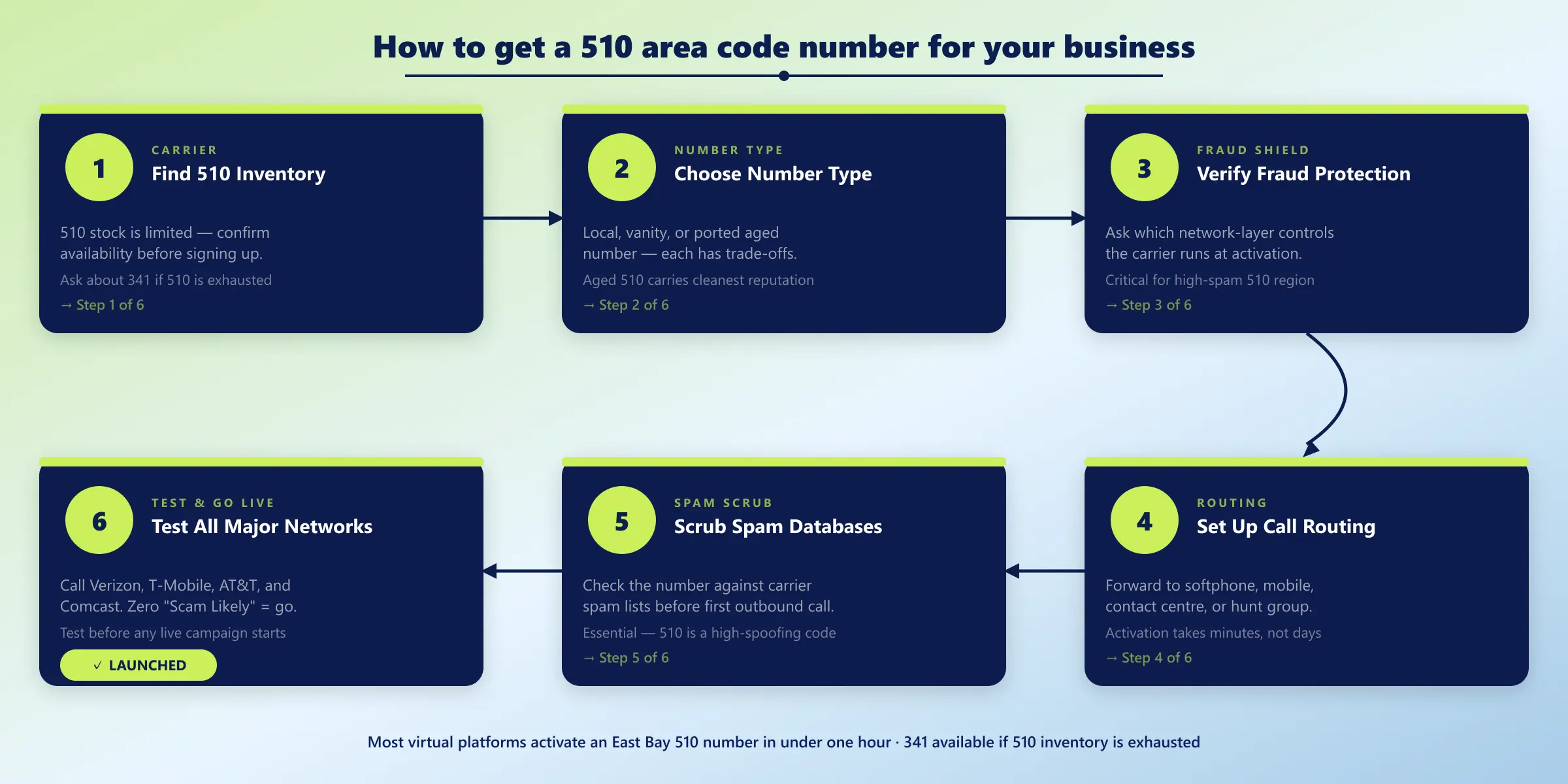
- Pick a wholesale voice carrier with current 510 inventory. Stock varies; ask before signing.
- Choose number type. Local, vanity, or a ported aged number. Aged numbers carry cleaner reputation history.
- Confirm fraud protection. Ask which controls the carrier runs at the network layer.
- Set up routing. Forward to a softphone, contact centre, mobile, or hunt group. Activation takes minutes.
- Scrub the number against scam lists before launch.
- Test outbound deliverability with calls to Verizon, T-Mobile, AT&T, and Comcast handsets to confirm no Scam Likely flags.
Modern virtual phone number platforms run this end-to-end in under an hour.
See also: 516 area code (Long Island).
Conclusion
The 510 is the working East Bay code — Oakland, Berkeley, Hayward, Fremont, Richmond — covering some of the most economically productive square miles in California outside the SF peninsula. The 1991 split from 415, the 1998 break with 925, and the 2019 addition of the 341 overlay shaped the current footprint. For businesses selling into the East Bay in 2026, a clean 510 line lifts answer rates and beats the SF-default assumption that costs East Bay-focused companies real connect-rate points. The follow-through — routing through a fraud-protected carrier and keeping the number's reputation clean — is where most businesses underinvest.
For more on US area codes and how carrier routing works, see our wholesale voice guide for East Bay carrier selection and call delivery fundamentals.
Frequently called from Oakland