Introduction
Every wholesale VoIP termination minute you buy is the sum of seven invisible decisions: which destination operator, which route type, how many transit hops, what compliance attestation, what fraud protection, what NOC response, and what carrier margin. The headline rate is just the visible output. The decisions underneath determine whether that rate holds up under volume or quietly inflates once the bill arrives.
This guide breaks down what wholesale VoIP termination rates actually cover — the components inside every per-minute price, why rates vary so wildly by destination, what the headline number hides, and how to read a termination rate sheet the way a carrier-economics analyst would. It's written for buyers who want to know exactly what they're paying for before they sign.
How Wholesale VoIP Termination Rates Work
Every outbound call passes through a chain of carriers. The originating provider hands the call to a wholesale VoIP termination provider. That provider routes it across one or more interconnects until the call lands on the destination operator — a mobile carrier in Lagos, a fixed-line in Manchester, a softswitch in São Paulo.
Each hop in that chain adds latency, adds margin, and adds a place where audio quality can break. The termination rate you pay covers that chain plus the carrier's margin. Two providers can quote the same rate to the same destination and run completely different routing tables underneath. The number is the same. The route isn't. Buyers benchmarking against wholesale VoIP rates often miss the routing-table difference entirely.
The Seven Components Inside Every Termination Rate
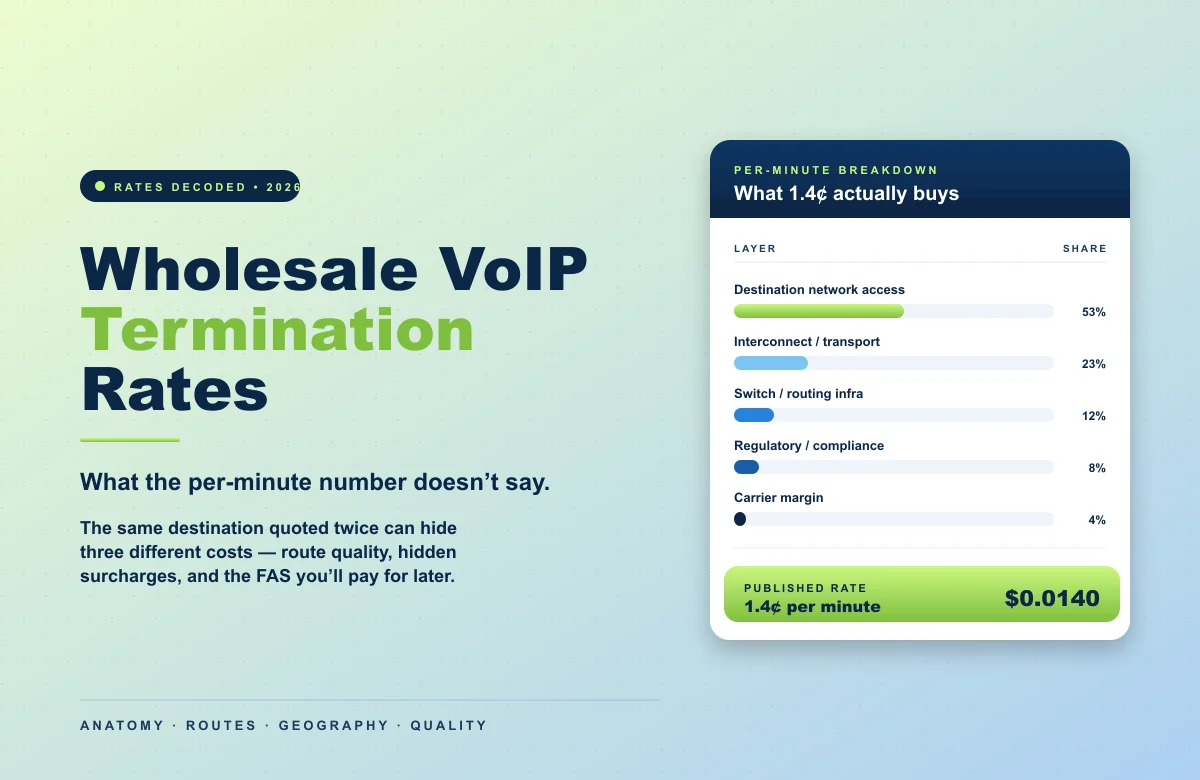
Behind every per-minute price are seven cost layers:
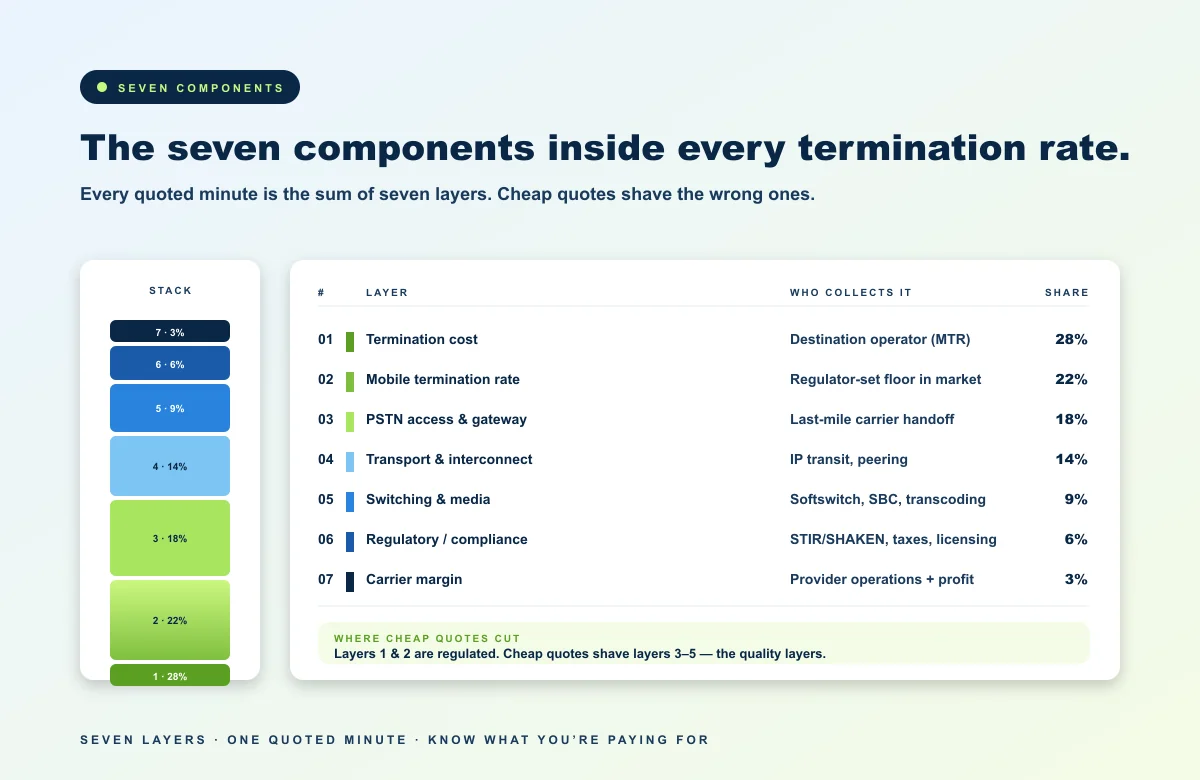
- Termination cost. What the carrier pays the destination operator to land the call. For mobile destinations, this is usually a regulated MTR. For fixed-line, it's negotiated.
- Transit margin. If the call passes through one or more intermediate carriers, each takes a margin. Direct interconnects skip this layer.
- Switching and signalling. The cost of running carrier-grade SIP infrastructure — softswitches, SBCs, monitoring, redundant capacity.
- Compliance overhead. FCC Guide-mandated STIR/SHAKEN attestation for US-bound calls, HIPAA-compliant routing for healthcare traffic, jurisdictional data handling.
- Fraud protection. IRSF detection, anomaly monitoring, dispute resolution. Skipping this layer cuts cost; it also cuts buyer protection.
- NOC and operations. 24/7 staffing, real-time CDR access, customer support, route-degradation response.
- Carrier margin. What a wholesale VoIP carrier keeps after costs.
A real wholesale VoIP termination rate covers all seven. A polished one skips two or three and shows up cheaper on the rate sheet. The skipped layers reappear later as billing disputes, fraud losses, and quality complaints.
How Route Type Changes the Termination Rate
The biggest visible driver of wholesale VoIP termination rates is route type. The four you'll see most:
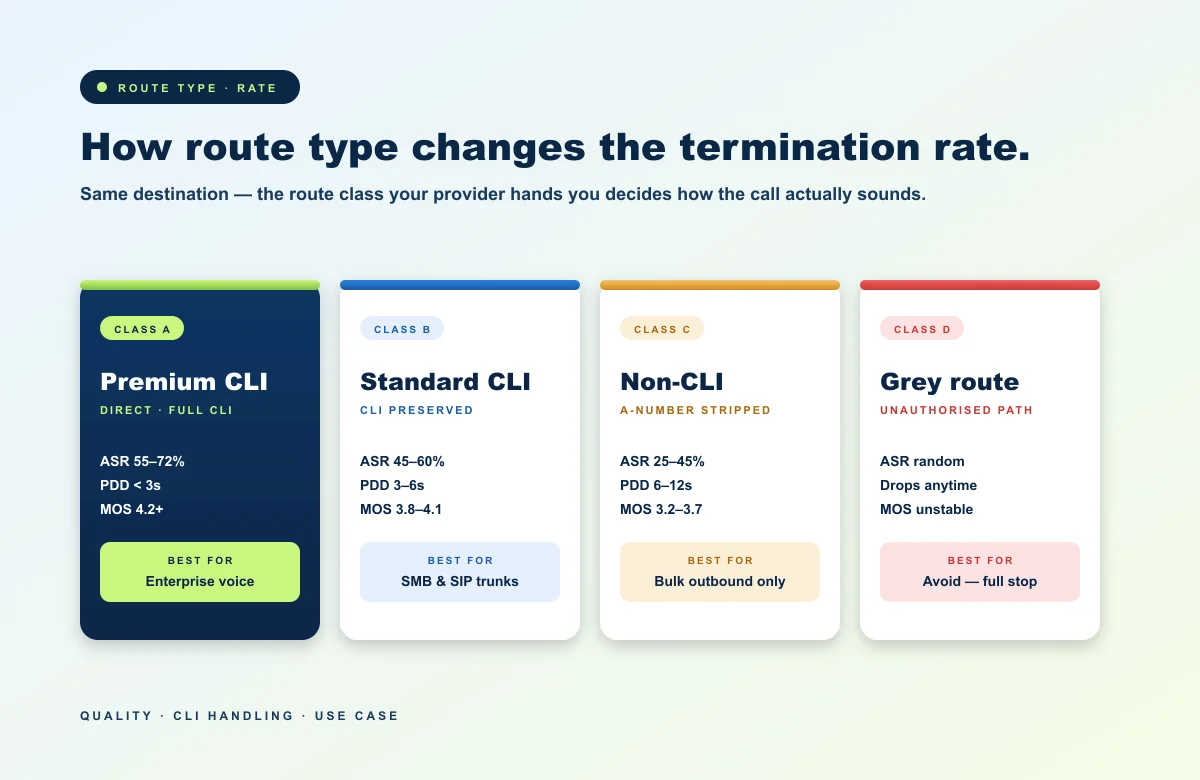
- Premium CLI — caller ID preserved, highest rate position. Best for sales and customer-service traffic.
- Standard CLI — caller ID preserved, mid-rate. Best for everyday business voice.
- Non-CLI — caller ID stripped, low rate. Best for notifications and low-stakes outbound.
- Grey — multi-hop, often blacklisted, lowest rate. Avoid.
Match the route type to the use case. A premium CLI rate for autodialer traffic burns money. A grey-route rate for healthcare or financial services calls destroys reputation.
How Geography Drives Termination Pricing
Country-level termination economics vary more than buyers expect. Three patterns:
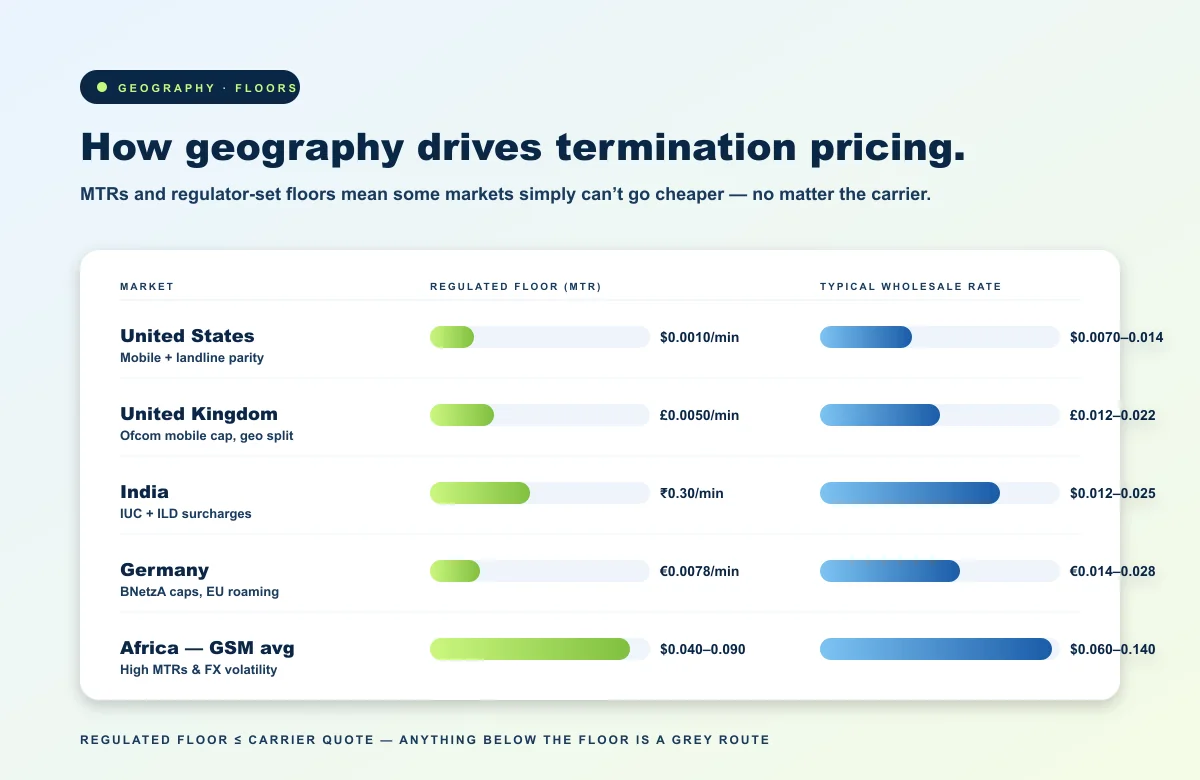
Mobile vs fixed-line. Mobile termination is almost always more expensive than fixed-line because of regulated MTRs, per GSMA mobile termination rate (MTR) data. Industry data on the wholesale voice market shows continued growth across emerging regions.
Regulated vs negotiated markets. Some markets (South African mobile, Nigerian mobile, Kenyan termination) have regulated MTRs that set a hard floor on pricing. A wholesale provider quoting below the regulated MTR is either burning cash or routing somewhere they shouldn't. Industry data on the wholesale voice market shows continued growth across emerging regions. Industry data on the wholesale voice market shows continued growth across emerging regions. GSMA tracking of the global telecom market shows wholesale voice volumes expanding through 2030.
Direct vs aggregated routes. Markets with scarce direct interconnects (most of Africa, parts of LATAM) carry a quality premium when bought from carriers with the relationships, and quality risk when bought through transit aggregators.
What the Headline Termination Rate Hides
Five things sit outside the per-minute number but show up on the bill:
- FAS inflation. False Answer Supervision routes bill you for connect tones, voicemail prompts, or ringing time as if they were live conversations. A route that looks like $0.005 per minute can effectively cost double once FAS is factored in.
- Setup and connection fees. Per-call charges added on top of per-minute pricing.
- Forex spread. Africa-bound traffic priced in USD adds volatility for buyers paying in ZAR or NGN.
- Fraud loss exposure. Carriers without active fraud detection pass IRSF and SIM-box losses to the buyer in many disputes.
- Quality penalties. Low ASR and high PDD reduce billable minutes per dial attempt — the rate is the same, but completion rates drop.
Always ask for an all-in cost projection that includes these layers, not just the per-minute headline.
How TKOS Builds Wholesale VoIP Termination Rates
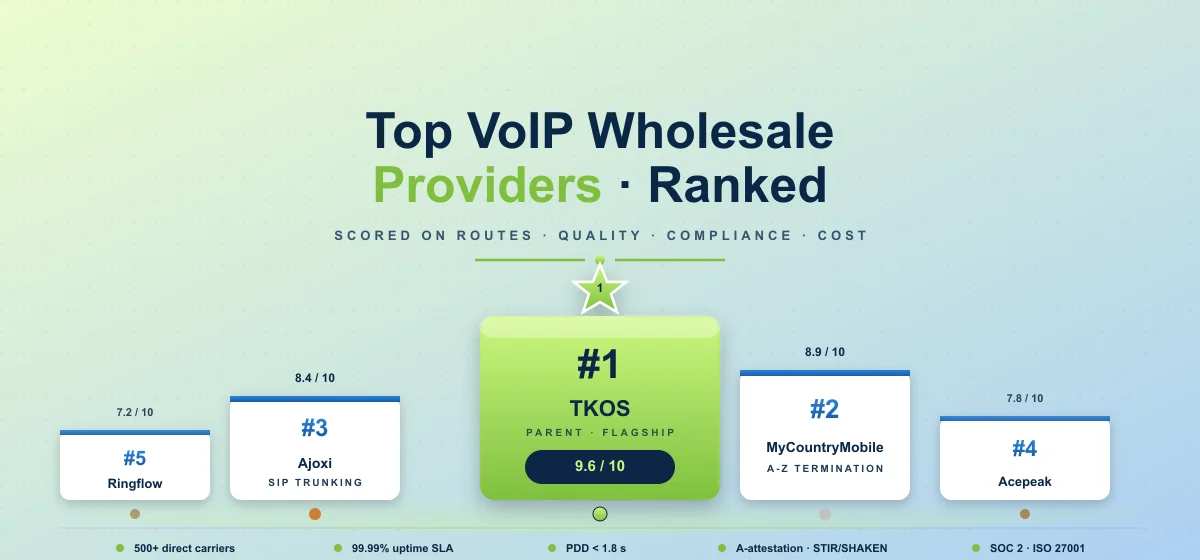
TKOS isn't the cheapest. We don't try to be. Our termination rates reflect what they actually cover:
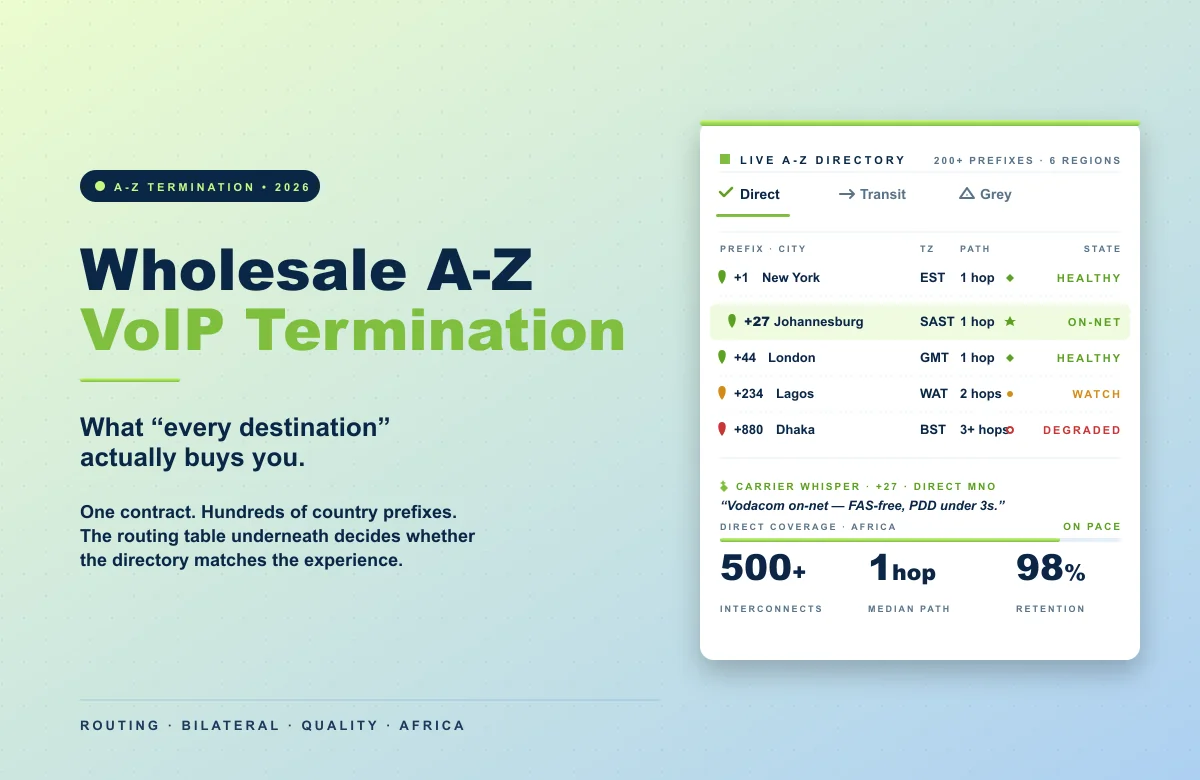
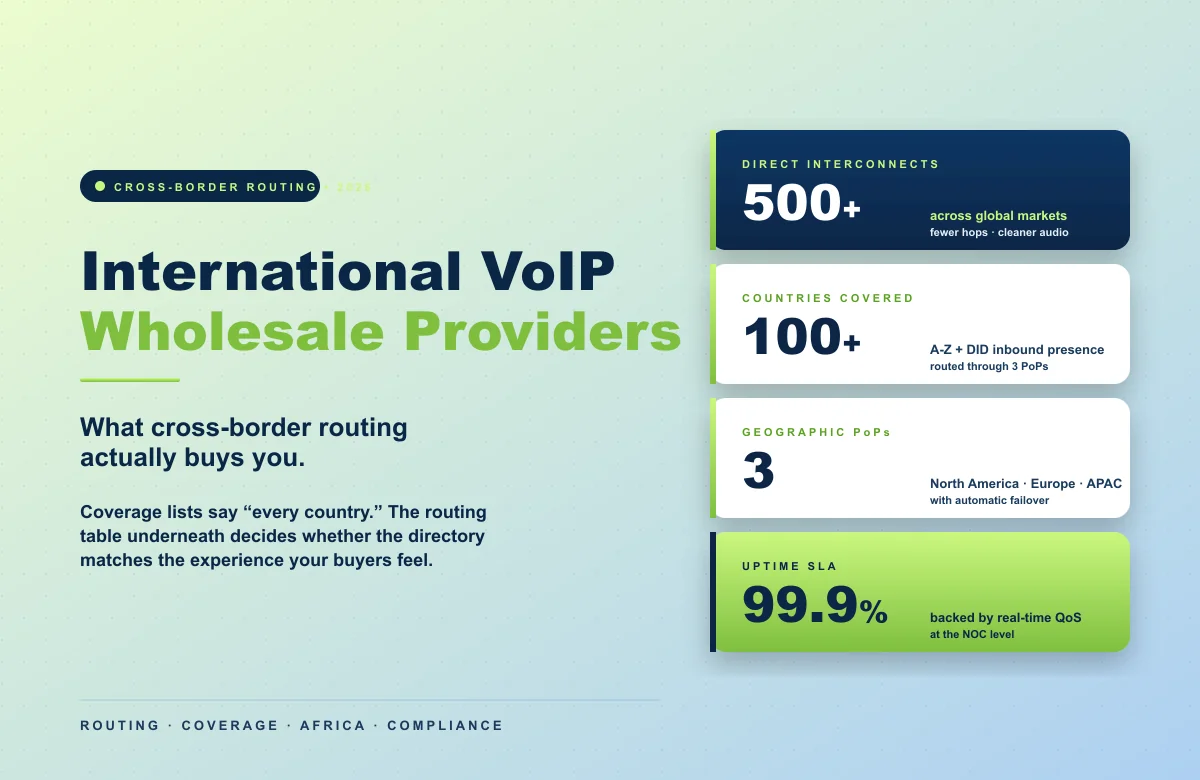
- 500+ direct carrier interconnects for fewer hops, lower latency, and superior audio clarity — especially across Africa.
- FAS-free routes as a contractual exclusion, not a sales line.
- Transparent route classification — CLI, Non-CLI, A-Z — picked per destination.
- STIR/SHAKEN active for US-bound traffic.
- HIPAA-compliant voice for healthcare clients.
- Geographically redundant architecture with PoPs in North America, Europe, and Asia.
- 99.9% uptime SLA backed by real-time QoS monitoring.
- 24/7/365 NOC with tier-3 engineers.
A decade of carrier relationships across Africa and 98% partner retention across 500+ active partners isn't a marketing claim. It's the lagging indicator that the rate sheet matches the actual bill.
How Quality Metrics Convert Termination Rates Into Real Cost
The headline wholesale VoIP termination rate is what you pay per minute terminated. The real cost is what you pay per minute of actual conversation. Four metrics translate one into the other:
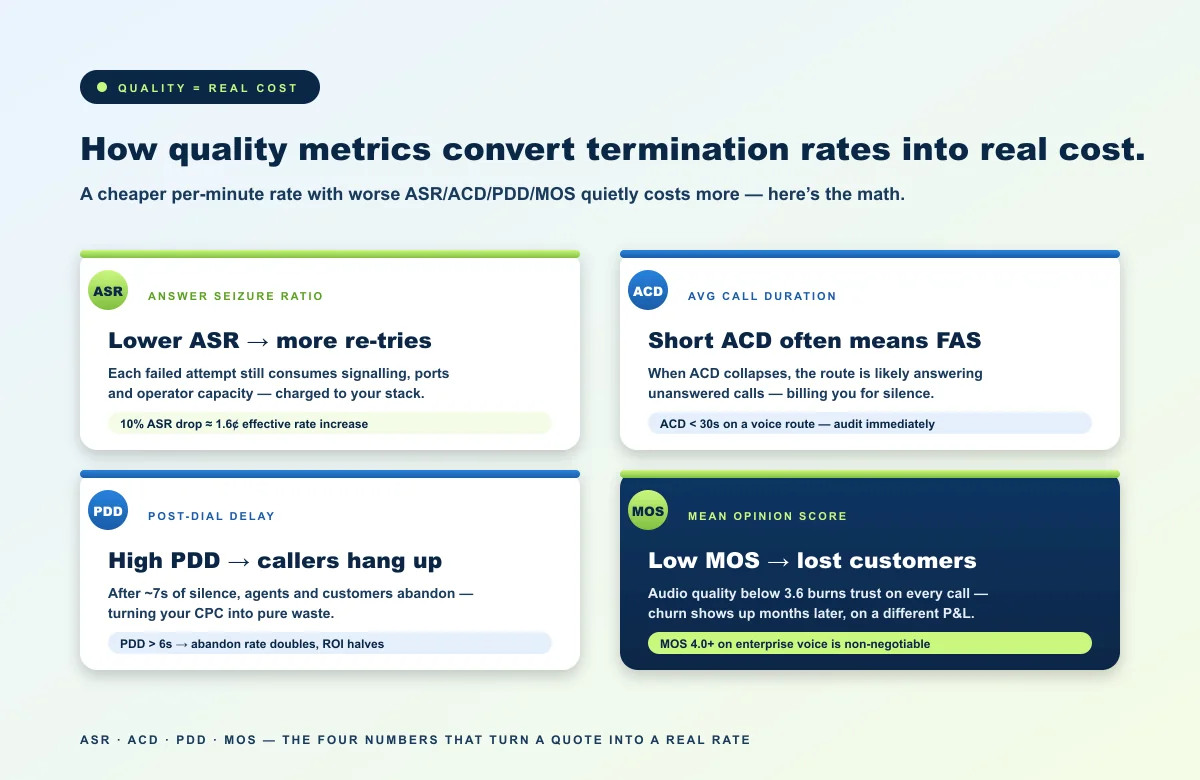
- ASR (Answer Seizure Ratio). Percentage of dial attempts that result in answered calls. Higher ASR means more billable conversations per dial. ASR below 35% on developed-market mobile is a flag.
- ACD (Average Call Duration). How long answered calls last. Lower ACD on a route can signal call-quality issues causing early hang-ups.
- PDD (Post-Dial Delay). Time between dial completion and ringback. PDD above 4 seconds kills answer rates. Buyers don't see PDD on the rate sheet but feel it in completion data.
- MOS (Mean Opinion Score). Audio quality measure. MOS below 3.5 produces customer complaints. Top wholesale VoIP termination providers monitor and publish per-route MOS; resellers usually don't.
A termination rate of $0.005 per minute on a route with 30% ASR and 4.2-second PDD costs more in real terms than $0.007 on a route with 45% ASR and 2.1-second PDD. The headline is just the visible layer.
How to Validate a Wholesale VoIP Termination Rate
Once you have a rate quote, validate it before signing. Ask the provider for the last 30 days of per-route ASR, ACD, and PDD on your top destinations. Run a structured test pilot — 500—1,000 dial attempts spread across your traffic mix — and reconcile the test billing against the quoted rate. Confirm FAS-free routing in the contract, not just in conversation. Verify that test minutes are honoured at quoted rates, not at full inflated test pricing. The wholesale VoIP termination rate that survives this validation is the rate that will actually appear on your monthly bill.
Conclusion
Wholesale VoIP termination rates only make sense when you read them as the sum of seven cost layers — termination, transit, switching, compliance, fraud protection, NOC, and margin. The rate sheet shows the visible output. The economics underneath decide whether your wholesale VoIP termination rates hold up under volume or quietly inflate once the bill arrives. Buyers who validate wholesale VoIP termination rates against quality metrics and contractual FAS-free language sign with confidence.
Getting Started
Don't pick a wholesale VoIP termination provider on the headline rate. Ask for the cost stack. Ask for the FAS policy in writing. Run test minutes and verify the rate against actual billing across your top destinations. Then sign.