Introduction
Every wholesale carrier on the planet sells some form of wholesale A-Z VoIP termination. The label means "we can complete calls to every destination from country A through country Z." In practice, the routing underneath varies more than the label suggests. The same A-Z quote can sit on top of 50 direct interconnects or 200 transit hops — and the buyer's experience is wildly different depending on which one is delivering each call.
This guide breaks down what A-Z termination actually buys you, how route quality varies inside the same A-Z service, what separates a real provider from an aggregator with a bigger directory, and what to look for when picking a partner. It's written for MSPs, contact centres, CPaaS platforms, and resellers terminating into many destinations and tired of guessing which routes will hold up under volume.
What is wholesale A-Z VoIP termination?
Wholesale A-Z VoIP termination is a single-relationship service that routes outbound calls to every destination from country A through country Z, billed per minute. One contract covers global reach across hundreds of country prefixes mapped to active routes. The opposite is bilateral termination, which covers only specific country pairs and requires a separate agreement for every destination.
How A-Z Termination Actually Works
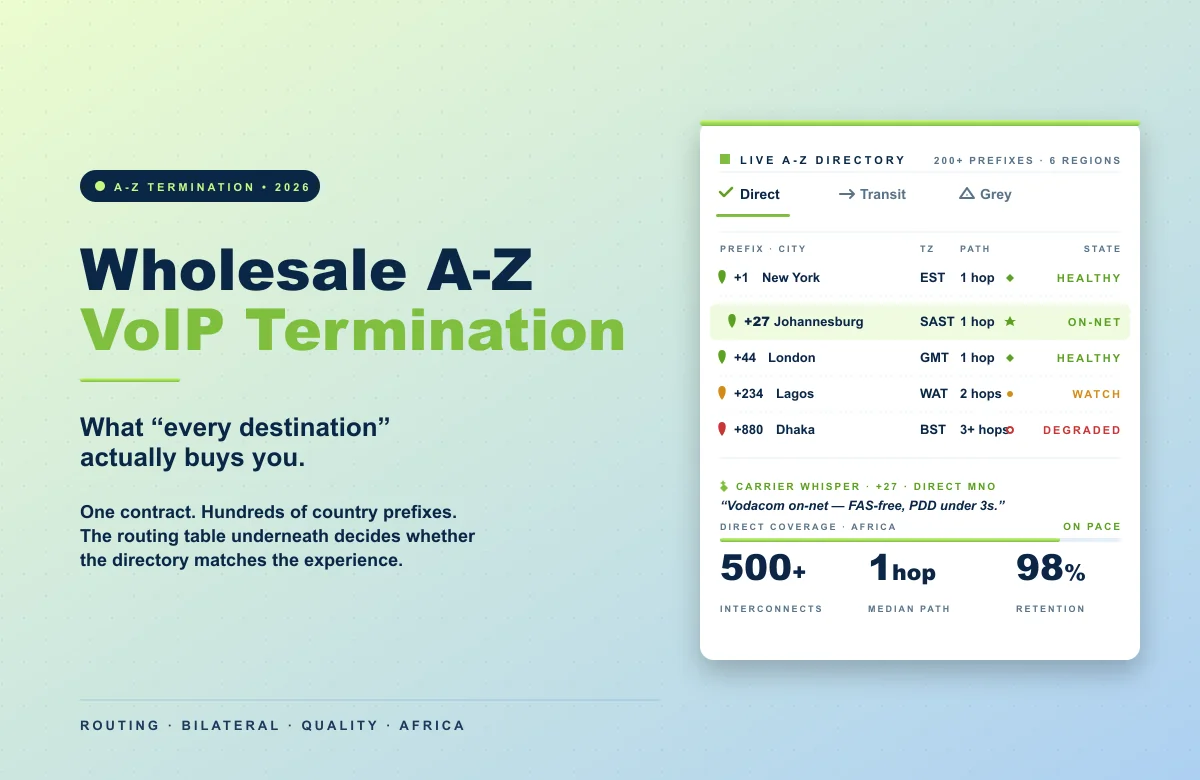
Behind every A-Z termination quote is a routing table. The carrier maintains a list of country prefixes, and each prefix points to one or more upstream relationships that can land calls on the destination network. When you send a call, the carrier's switch picks a route in real time based on cost, quality, and availability.
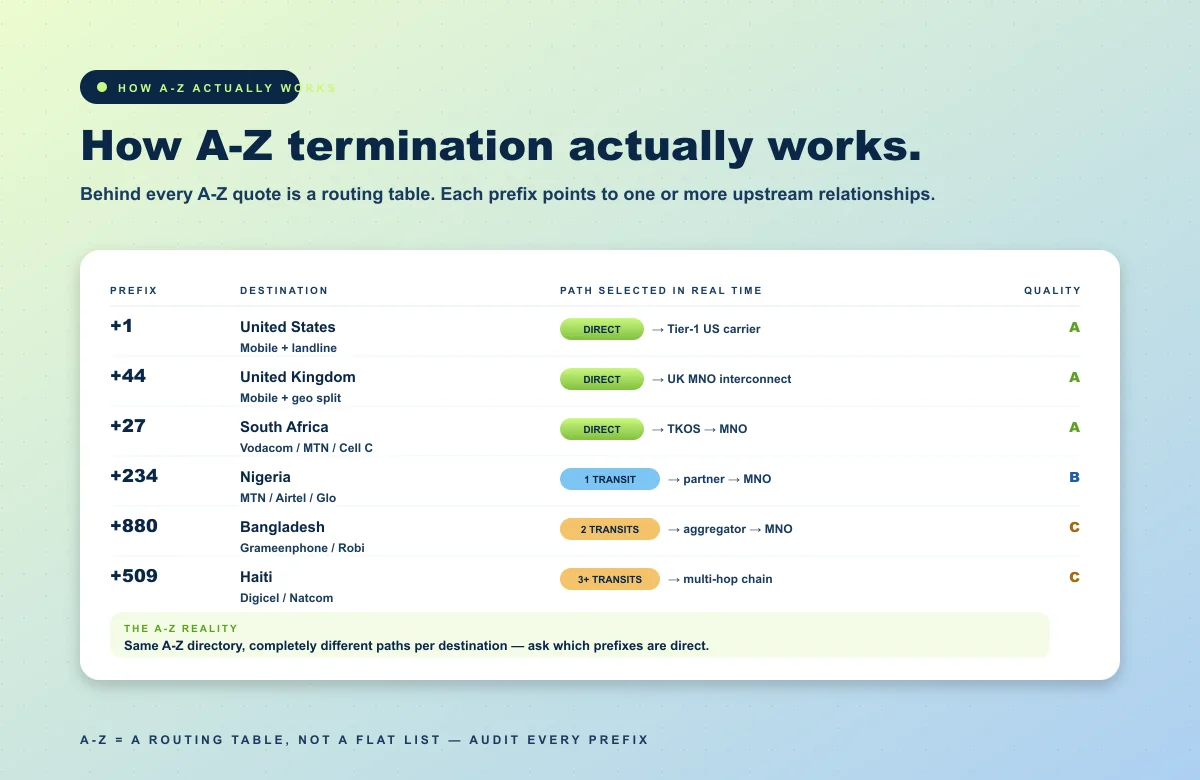
That sounds straightforward. The reality: not every prefix in the routing table points to a direct interconnect. Some prefixes route through a single transit partner. Others route through three. The A-Z label says nothing about which destinations are direct and which are aggregated. Two carriers can publish the same A-Z coverage list and run completely different infrastructure underneath it.
A-Z vs Bilateral Termination — When Each Makes Sense
Wholesale A-Z VoIP termination is the default for most VoIP platforms because the alternative — bilateral termination — doesn't scale to many destinations. Bilateral termination means one contract per country pair. A contact centre making outbound calls into 30 markets would need 30 separate carrier relationships, 30 sets of test minutes, and 30 ongoing reconciliations.
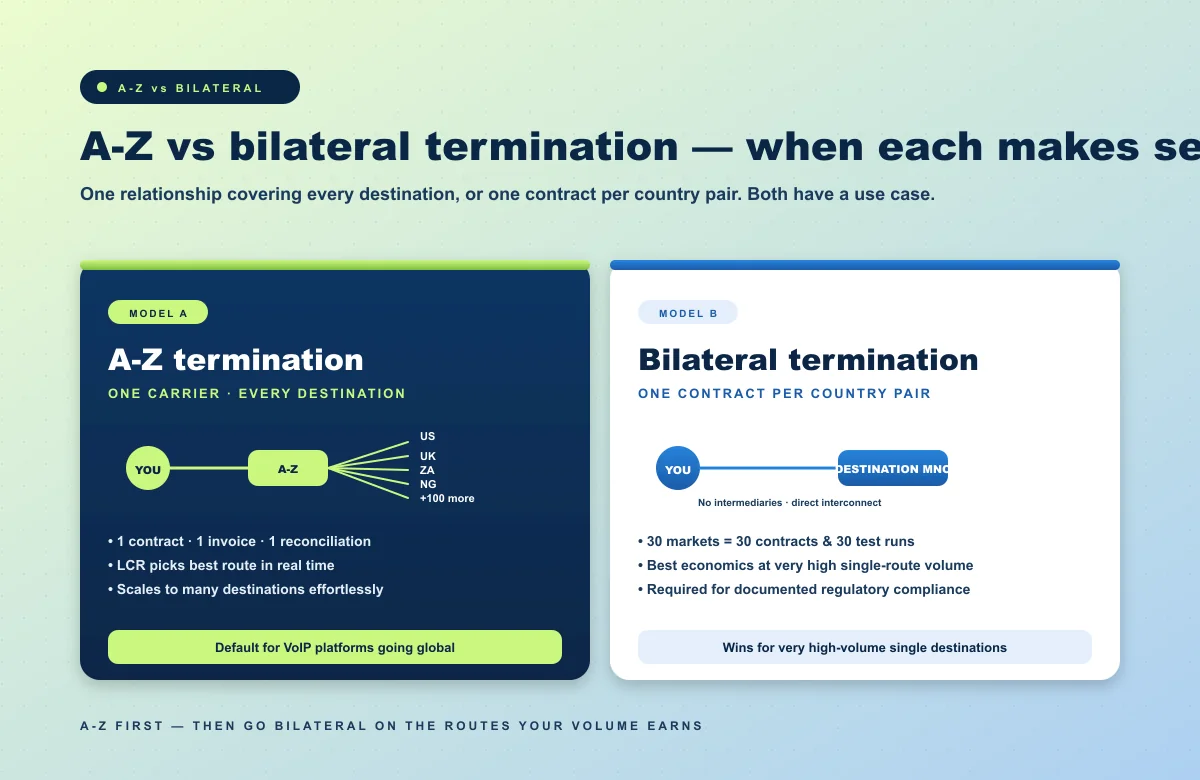
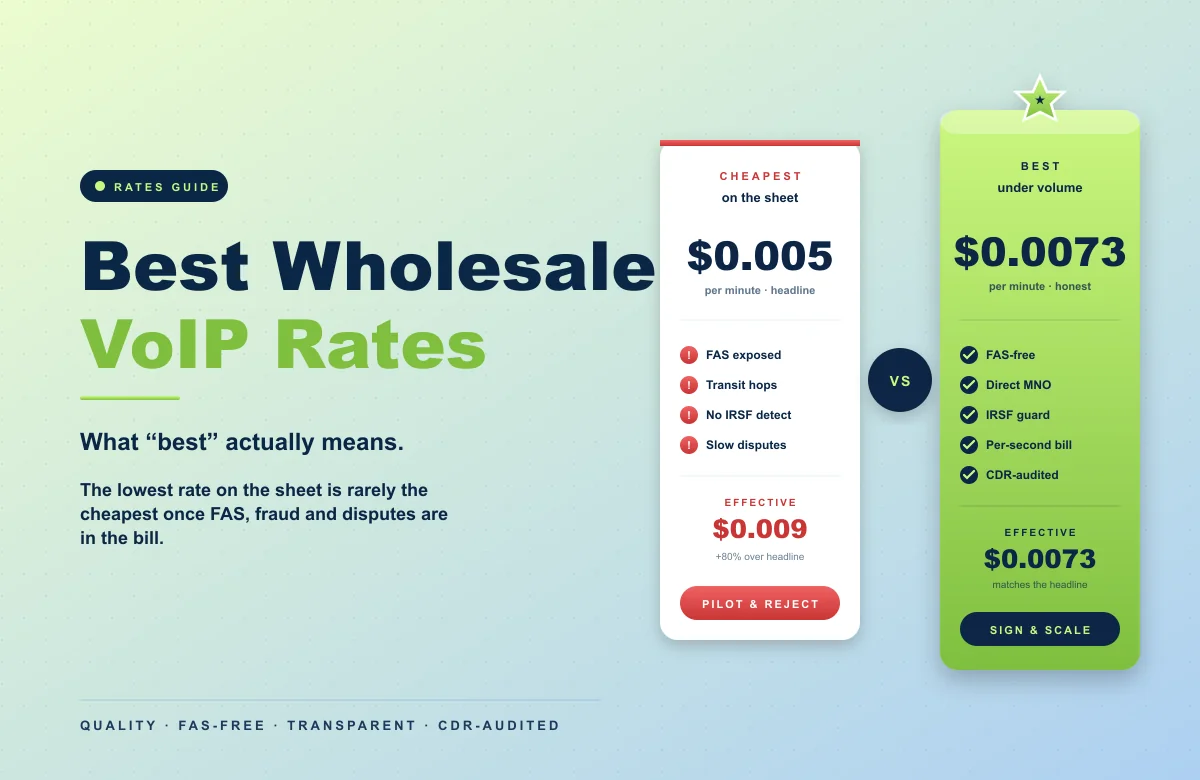
Bilateral termination still wins in two cases. First, very high volume into a single destination — direct bilateral interconnect with the destination operator unlocks better economics than buying that route through an A-Z provider. Second, regulated markets where the originating carrier needs documented compliance with destination-country rules. For everyone else, A-Z termination is the right starting point. Buyers comparing options against wholesale VoIP termination rates often find the A-Z model cheaper to operate even when per-minute pricing looks similar.
Quality Variations Inside the Same A-Z Service
The most overlooked truth about A-Z termination is that the label says nothing about route quality on any specific destination. Three patterns recur:
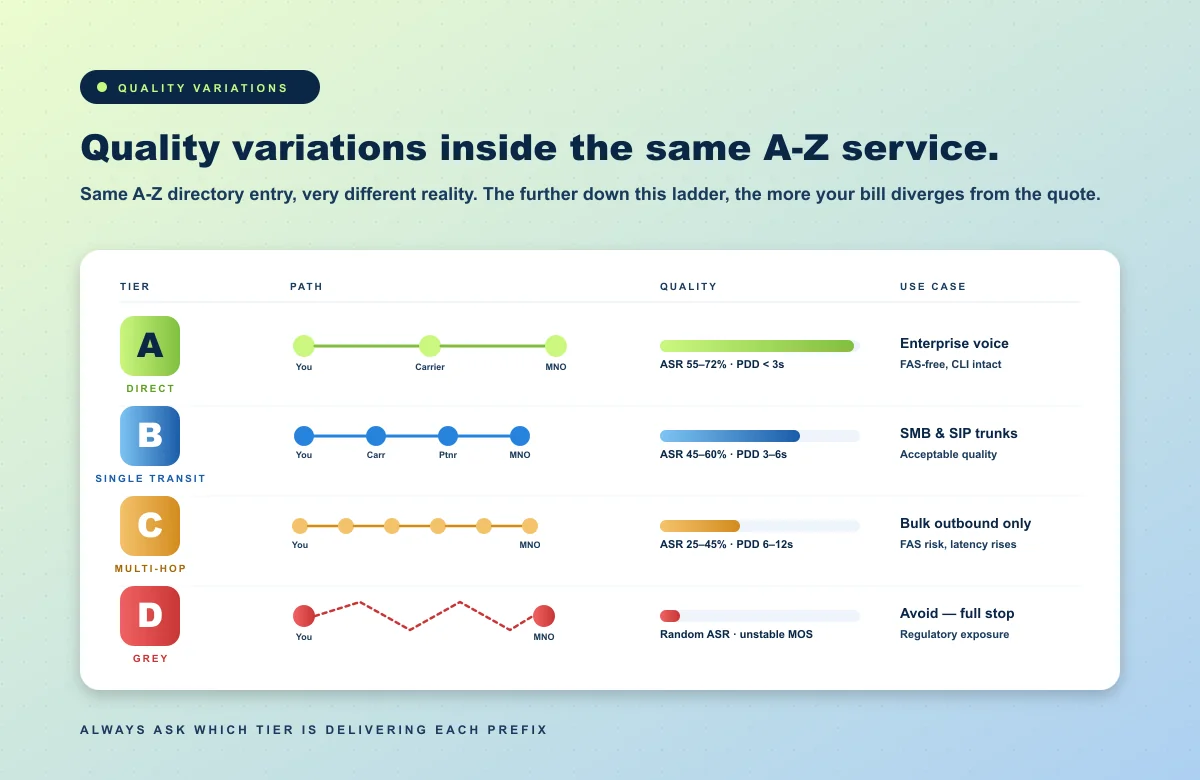
- Direct interconnect — carrier holds direct relationship with destination operator. Best ASR, lowest PDD, FAS-free.
- Single transit — call routes through one intermediate wholesale carrier. Acceptable quality, mid-range margin.
- Multi-hop transit — call routes through 2-4 intermediate carriers. Higher latency, more FAS exposure.
- Grey route — aggregated path bypassing destination's premium termination. Lowest cost, highest fraud-flag risk.
A real A-Z quote breaks the routing down by destination. A polished quote shows you the per-minute rate column and stops there. Always ask which destinations are direct, which are transit, and how many hops in each transit path.
How to Evaluate an A-Z Termination Provider
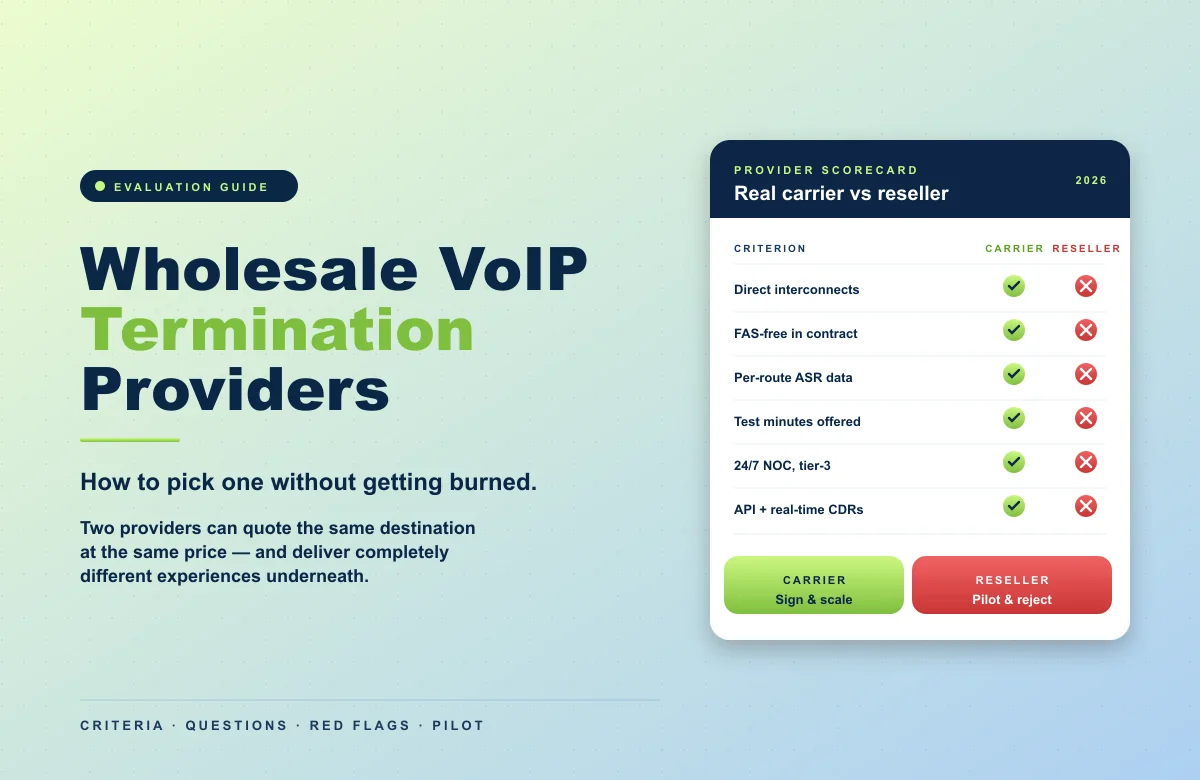
A real evaluation goes well past coverage size. The provider with 200 country prefixes isn't automatically better than the one with 150 — what matters is which destinations match your traffic mix and how the routes underneath actually perform. Insist on: Operators benchmark wholesale voice termination rates before committing to long-term volume.
- Direct vs transit breakdown by destination — not just "we cover that country."
- Per-route ASR and ACD over the last 30 days for your top destinations.
- PDD targets under 4 seconds on developed-market mobile.
- FAS-free policy as a contractual exclusion, not a sales line.
- Test minutes on real traffic before any commitment.
- FCC Guide-mandated STIR/SHAKEN attestation for any US-bound traffic in your A-Z mix.
- NOC response time when a route degrades — hours, not days.
- API access for real-time CDRs and routing changes.
Anything missing is a flag. The A-Z service is a black box without these answers.
Why African Destinations Make A-Z Termination Harder
Most global A-Z termination providers handle developed-market destinations cleanly. Africa is where the label breaks down. Most US and European wholesalers don't hold direct interconnects with major African MNOs (Vodacom, MTN, Cell C, Telkom, Safaricom), according to GSMA wholesale telecom market data. They route African traffic through one or two transit partners — three or four hops minimum on most routes.
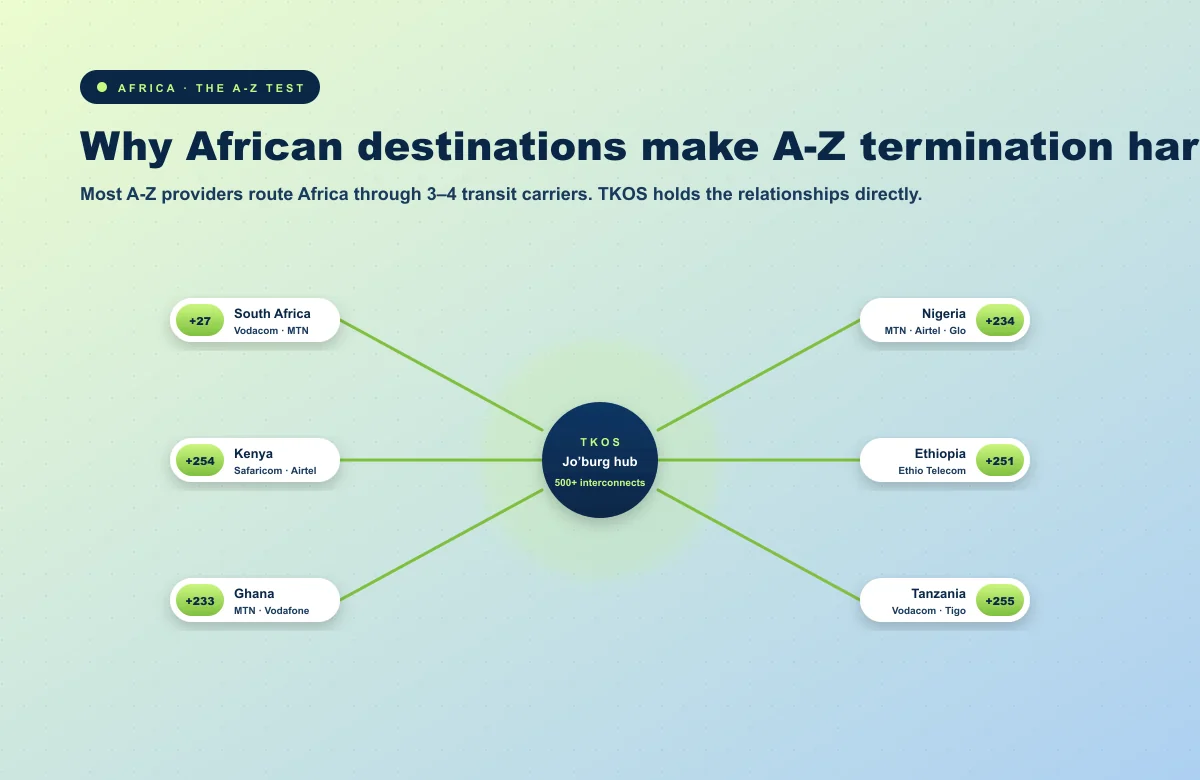
That's where latency creeps in and FAS slips through. Regulated MTRs in some African markets (South African mobile, Nigerian mobile, Kenyan termination) also set hard floors on pricing. An A-Z provider quoting below those floors is either burning cash or routing somewhere they shouldn't. For any platform with material African traffic, the right wholesale A-Z VoIP termination partner has direct African interconnects, not just an A-Z directory entry.
STIR/SHAKEN and the Compliance Layer
US-bound calls inside a wholesale A-Z VoIP termination service have to carry STIR/SHAKEN attestation. Without it, calls get flagged, blocked, or shown as "Spam Likely" on the recipient's screen. A carrier whose A-Z service doesn't include STIR/SHAKEN attestation can't deliver quality US termination.
For non-US markets, the fraud layer is different — IRSF, wangiri callbacks, SIM-box bypass, and route hijacking. Your A-Z termination partner should have visible fraud monitoring at the NOC level, not after-the-fact CDR audits.
What TKOS Delivers in Wholesale A-Z VoIP Termination
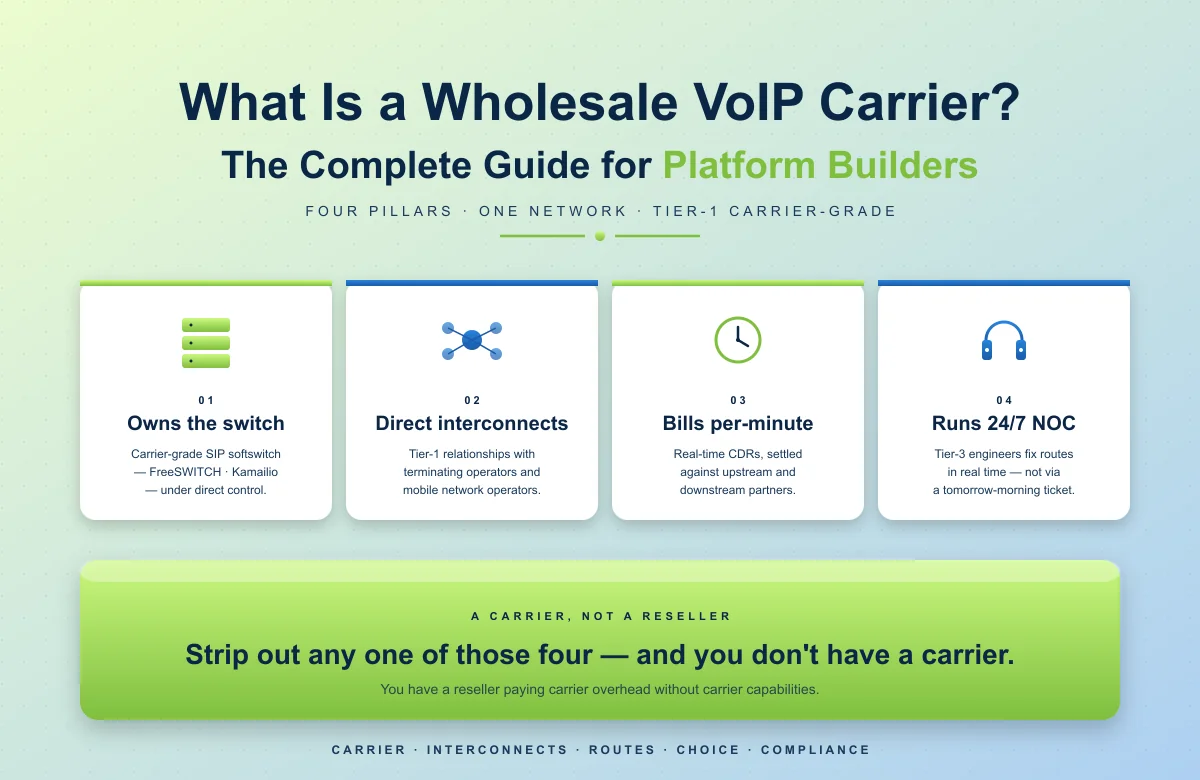
TKOS isn't trying to be the cheapest wholesale A-Z VoIP termination provider. We're the carrier built for African voice traffic from a Johannesburg-anchored network, extended into 100+ countries with PoPs in North America, Europe, and Asia. What we deliver:
- 500+ direct carrier interconnects for fewer hops and superior audio clarity.
- Full route transparency — direct vs transit breakdown by destination.
- CLI, Non-CLI, and A-Z routes — FAS-free as a baseline.
- STIR/SHAKEN active for US-bound traffic in your A-Z mix.
- HIPAA-compliant voice for healthcare clients.
- Geographically redundant architecture with automatic failover.
- 99.9% uptime SLA backed by real-time QoS monitoring.
- 24/7/365 NOC with tier-3 engineers — issues resolved on the first call.
A decade of carrier relationships across Africa and 98% partner retention across 500+ active partners reflect what wholesale A-Z VoIP termination looks like when the routing underneath actually matches the directory.
Conclusion
Wholesale A-Z VoIP termination promises every destination. Real A-Z termination delivers transparent routing on every destination — direct vs transit, FAS-free or not, STIR/SHAKEN-attested or not, monitored at the NOC or not. The carriers that publish per-route quality data and treat their A-Z directory as a living document — updated as interconnects change — are the ones whose A-Z service holds up under volume.
Carriers that publish a static directory and treat the A-Z label as marketing copy are the ones whose buyers end up reconciling complaints against routes they can no longer audit. Buyers who treat the A-Z label as the start of the conversation rather than the end pick partners whose routing matches the directory. The rest end up reconciling quality complaints against a coverage list that promised more than the network underneath could deliver.
Getting Started
Don't pick a wholesale A-Z VoIP termination provider on coverage size alone. Ask for the routing breakdown, the FAS policy, the per-route quality data, and the NOC response time in writing. Run test minutes across your top destinations and verify before signing.