Introduction
The best wholesale VoIP rates aren't the lowest ones. They're the rates that match what you actually need — high call-completion on the destinations that drive your revenue, FAS-free billing on every route, transparent CDRs that match your invoices, and a NOC that responds in minutes when something breaks. The lowest per-minute price on the market often costs more once FAS inflation, fraud exposure, and quality complaints are factored in.
This guide breaks down what the best wholesale VoIP rates actually look like — how to spot quality routes hiding behind reasonable pricing, how to score rate sheets against your real traffic mix, why headline rates lie, and what to ask before signing. It's written for MSPs, contact centres, CPaaS builders, and resellers tired of chasing the cheapest number on the rate sheet only to watch margins disappear in disputes.
What are the best wholesale VoIP rates?
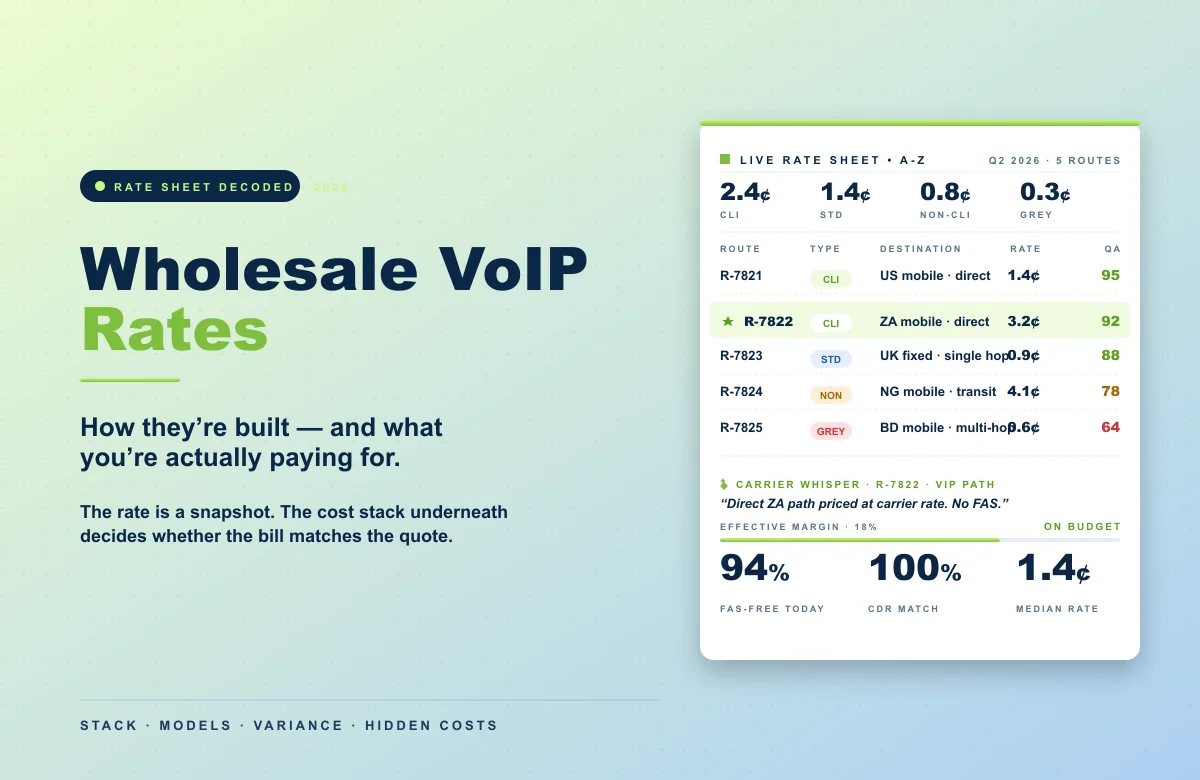
The best wholesale VoIP rates are per-minute prices that combine competitive cost, FAS-free billing, transparent direct-vs-transit routing, fraud protection, and contractual quality SLAs across the destinations a buyer actually terminates to. "Best" is segment-specific — the best wholesale VoIP rates for African mobile traffic differ from the best rates for US toll-free, and no single provider leads on every destination. Layered against published wholesale VoIP rates sheets, the structure of "best" becomes easier to read.
Why the Lowest Rates Aren't the Best Wholesale VoIP Rates
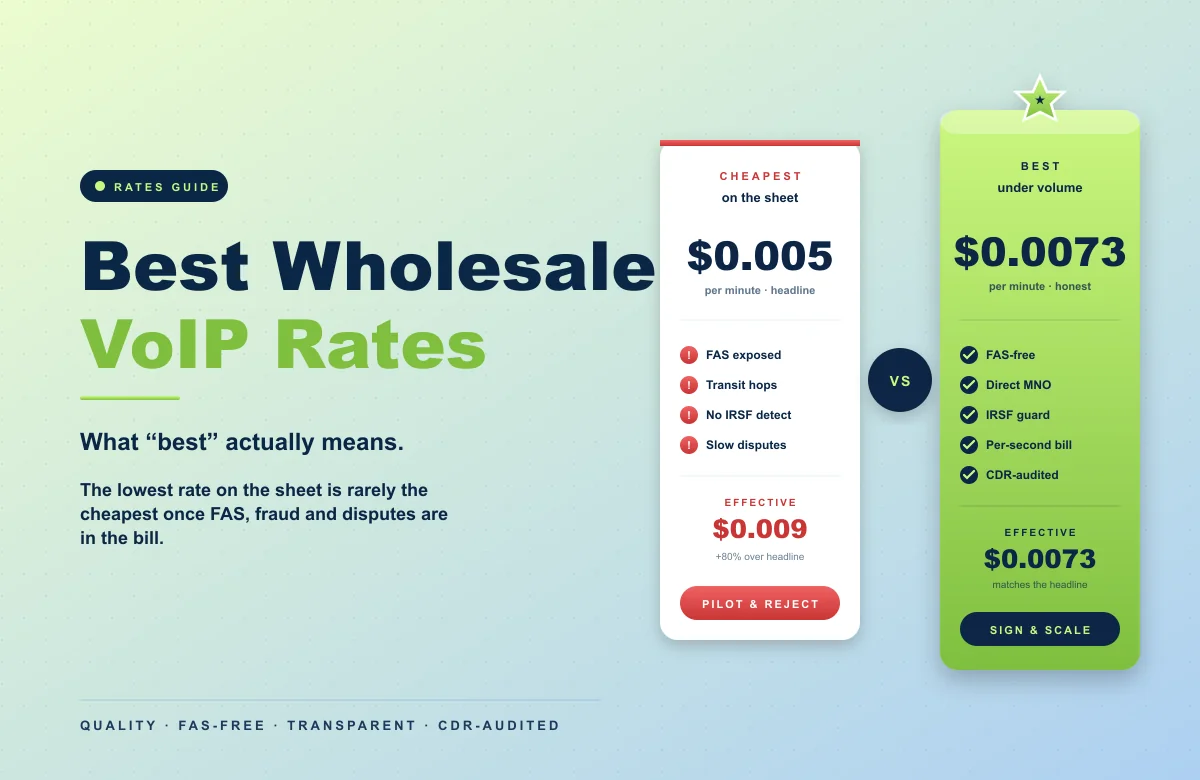
A wholesale rate 30% below the market median almost always reflects a quality compromise. To undercut market pricing, the carrier has to skip somewhere — direct interconnects, fraud filtering, NOC investment, or FAS protection. The headline number looks good. The bill three months later doesn't.
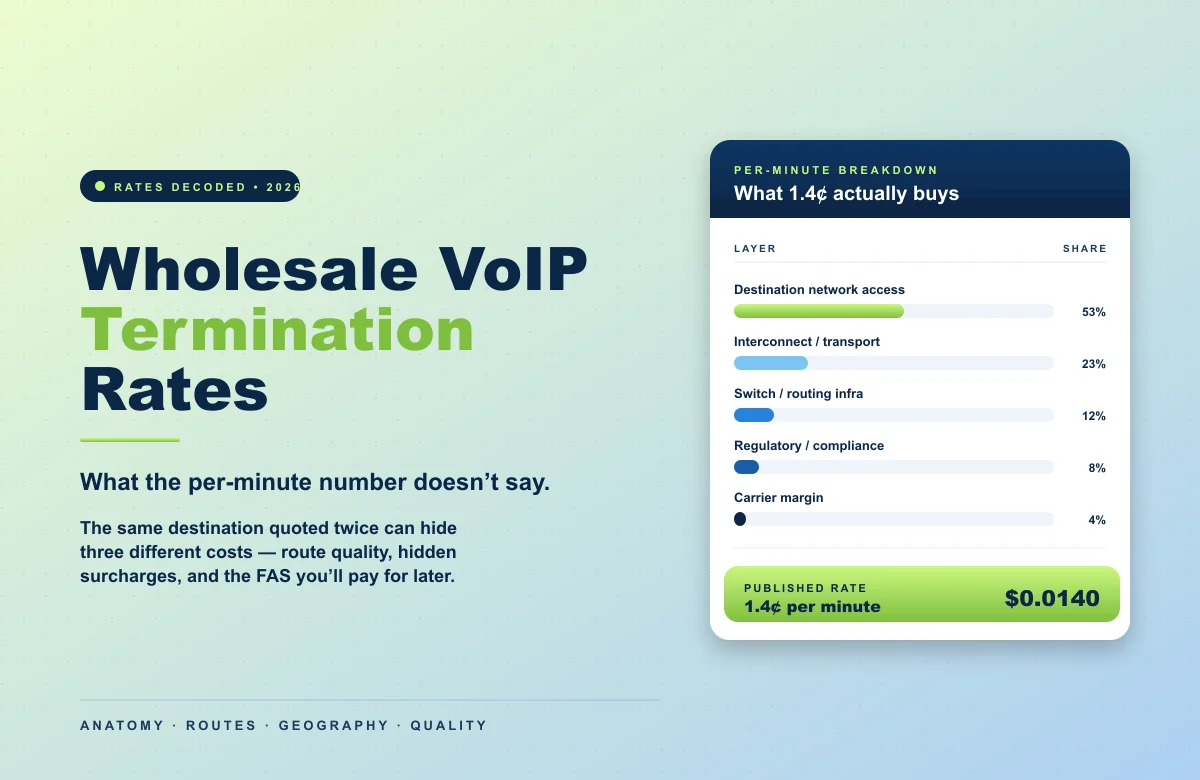
Buyers chasing the lowest rate often discover three things at once: ASR drops on key destinations, ACD numbers stop matching their CDRs, and dispute resolution times stretch from days to weeks. The best wholesale VoIP rates are priced to cover what they actually deliver — interconnect costs, switching infrastructure, fraud protection, NOC operations, and a sustainable carrier margin. The same logic governs wholesale VoIP termination rates, where the per-route economics expose every shortcut.
What "Best" Actually Means by Use Case
The right pricing depends entirely on what you're terminating. Four common use cases, four different definitions of "best":
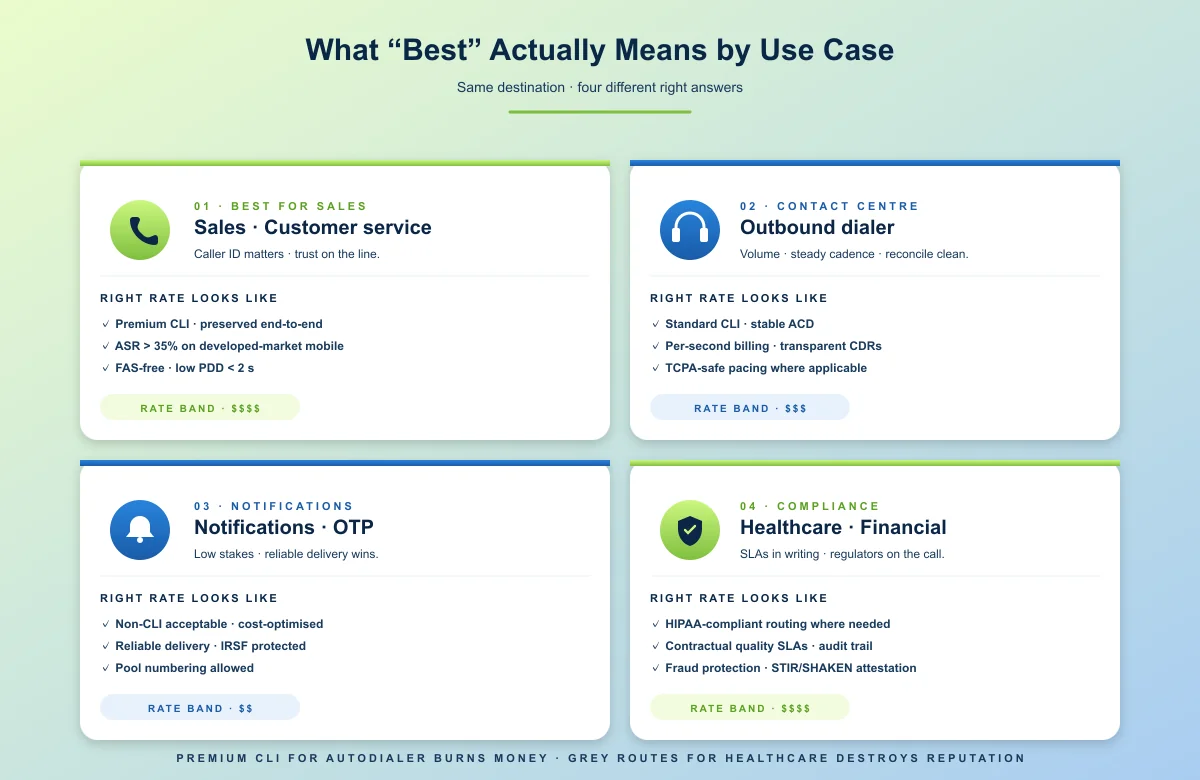
- Sales / customer service — premium CLI routes with ASR > 35%, FAS-free, low PDD.
- Contact centre outbound — standard CLI with consistent ACD, transparent CDRs.
- Notifications / OTP — cost-optimised routes with reliable delivery, lower CLI requirement.
- Healthcare / financial — HIPAA-compliant where relevant, contractual SLAs, fraud protection.
A premium CLI rate for autodialer traffic burns money. A grey-route rate for healthcare calls destroys reputation. The right pricing is what's priced for the use case in front of you, not the cheapest column on a generic sheet.
How to Compare Rates Across Providers
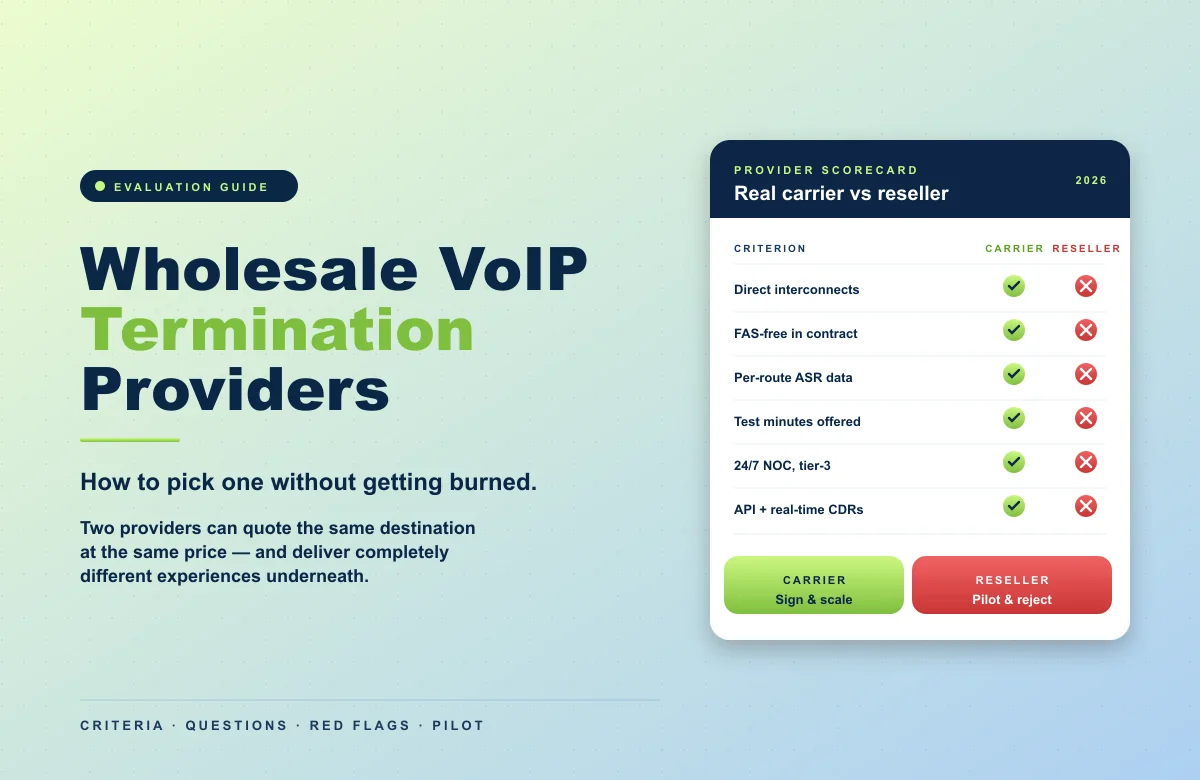
A real comparison of wholesale rates goes well past the headline price. Score every candidate against these criteria:
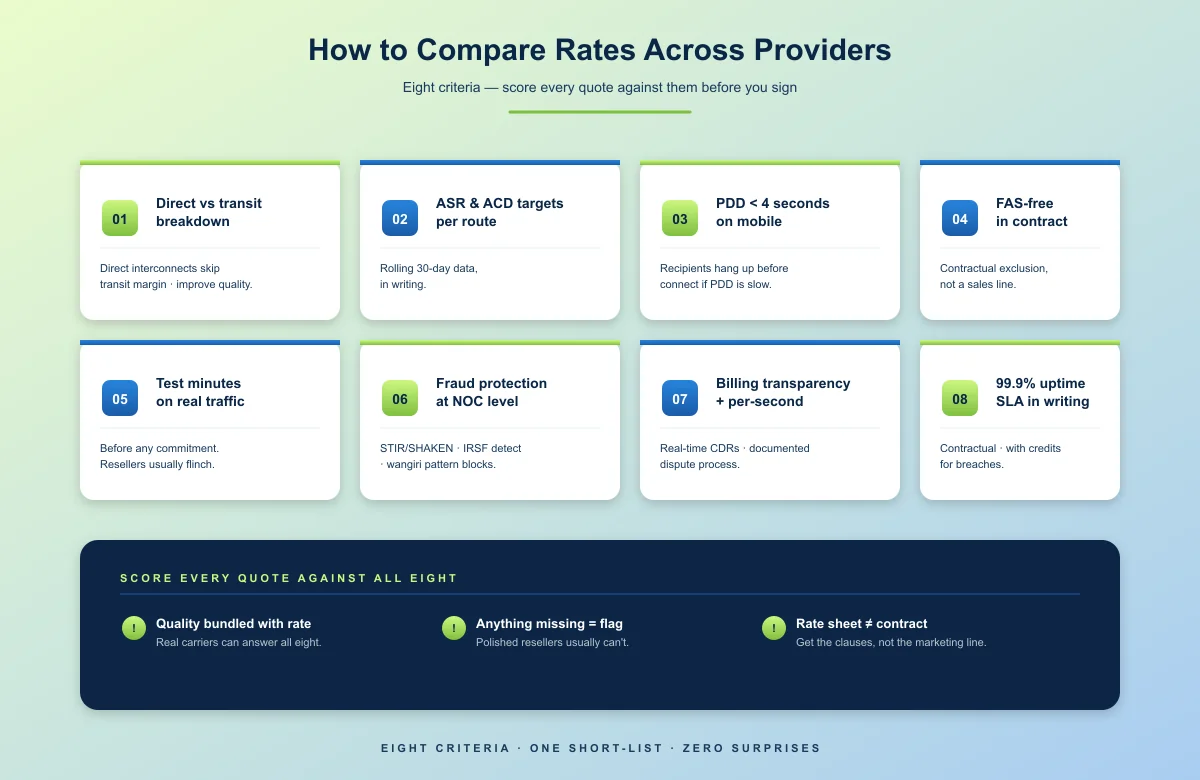
- Direct vs transit breakdown by destination — direct interconnects skip transit margin and improve quality.
- ASR and ACD targets per route, ideally with rolling 30-day data.
- PDD commitment under 4 seconds on developed-market mobile.
- FAS-free policy as a contractual exclusion in writing.
- Test minutes on real traffic before any commitment.
- Fraud protection — FCC Guide-mandated STIR/SHAKEN attestation, IRSF detection, NOC-level monitoring.
- Billing transparency — real-time CDRs, per-second increments, documented dispute process.
- Contractual uptime SLA 99.9% or better.
Anything missing is a flag. Quality rates from a real carrier come bundled with answers to all of these. Polished resellers usually can't produce them.
Hidden Costs That Make "Cheap" Rates Expensive
Five costs sit outside the headline number and inflate effective price:
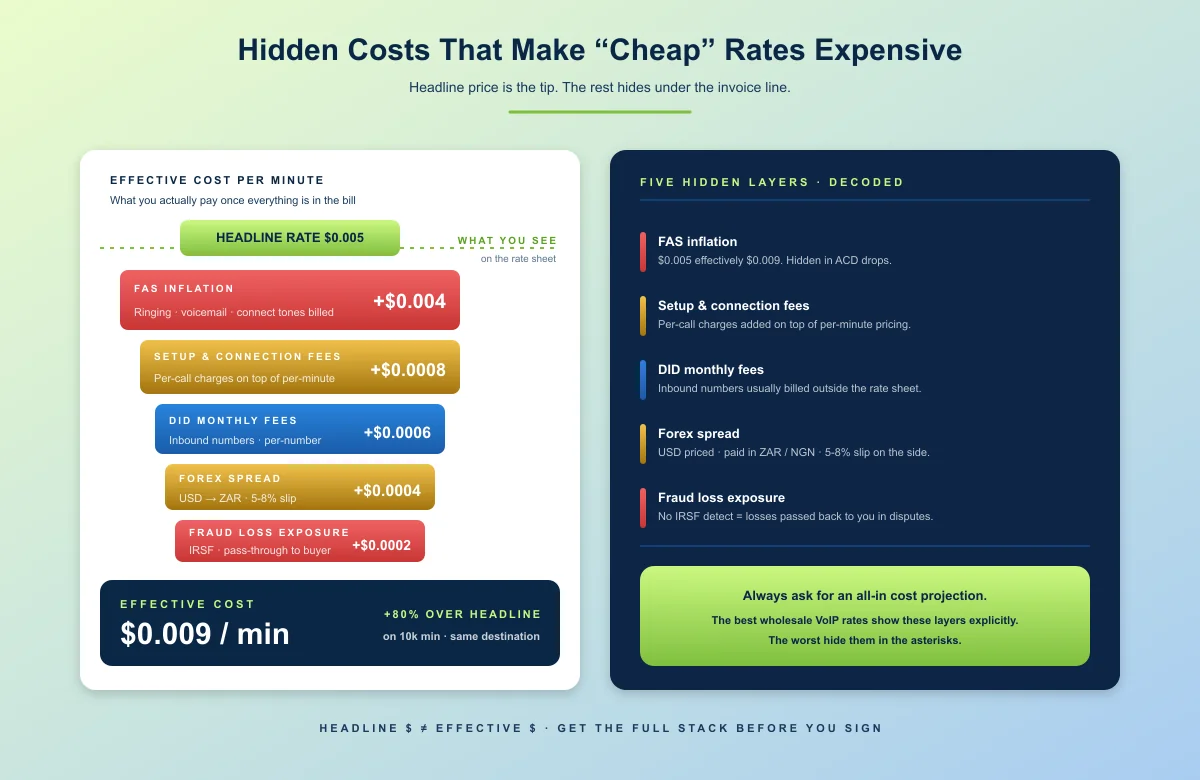
- FAS inflation. Routes billing for connect tones, voicemail, or ringing as if they were live conversations. A $0.005 rate can effectively cost $0.009.
- Setup and connection fees. Per-call charges added on top of per-minute pricing.
- DID monthly fees. Inbound numbers usually carry separate per-number fees outside the rate sheet.
- Forex spread. USD-priced traffic billed against ZAR or NGN can shift effective cost 5—8%.
- Fraud loss exposure. Carriers without active IRSF detection often pass the loss through in disputes.
Always ask for an all-in cost projection. The best wholesale VoIP rates show these layers explicitly. The worst hide them in the asterisks. Industry data on the wholesale voice market shows continued growth across emerging regions.
Volume Tiers and Rate Discounts
Most rate sheets reserve their better pricing for committed volume tiers. The structure typically looks like:
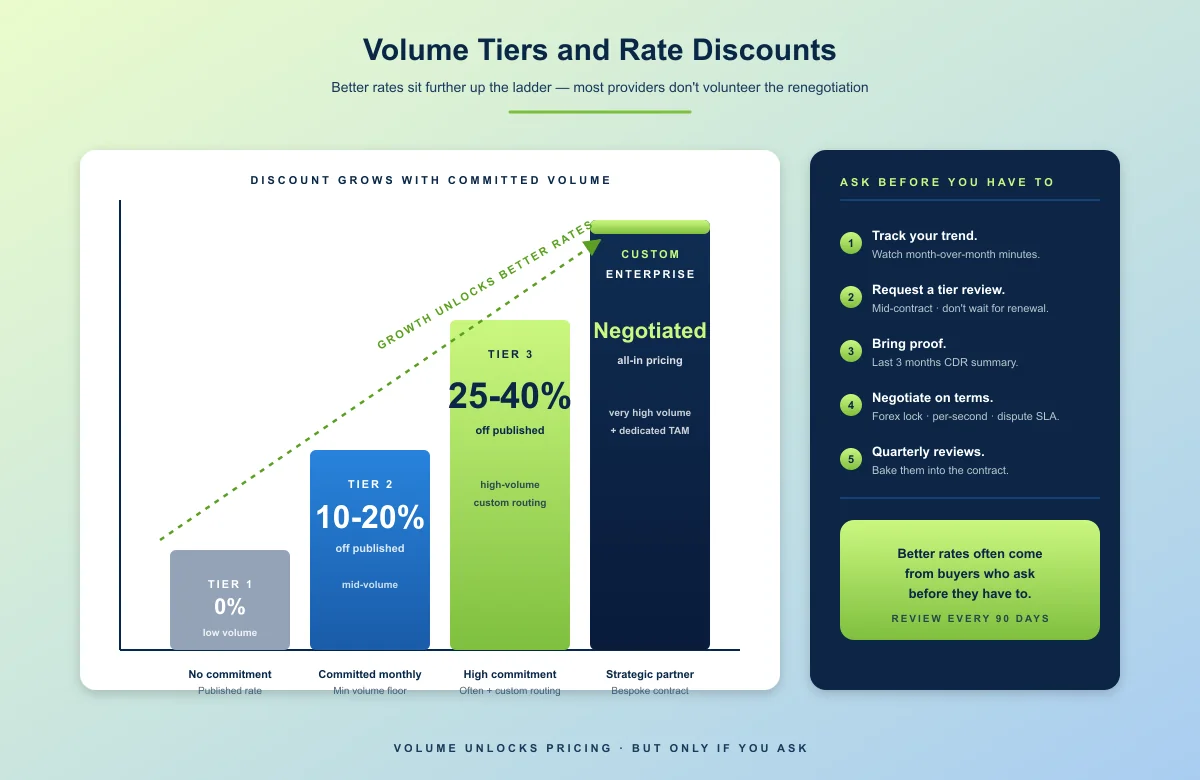
- Tier 1 (low volume): published rate, no commitment.
- Tier 2 (mid volume): 10—20% discount on committed monthly minutes.
- Tier 3 (high volume): 25—40% discount, often with custom routing.
- Custom enterprise tiers: negotiated for very high-volume buyers.
If your monthly minutes have been growing, ask for a tier review mid-contract. Most providers don't volunteer the renegotiation until renewal — but the better rates often come from buyers who ask before they have to.
Wholesale Rates for African Voice Traffic
African voice traffic is where headline pricing breaks down most predictably. Most US and European providers don't hold direct interconnects with major African MNOs (Vodacom, MTN, Cell C, Telkom, Safaricom), according to GSMA mobile termination rate data. They route African traffic through one or two transit partners — three or four hops minimum on most routes.
Quality pricing for African destinations comes from carriers with direct relationships in those markets. Direct interconnects deliver fewer hops, lower latency, and clearer audio. Regulated MTRs in some African markets (South African mobile, Nigerian mobile, Kenyan termination) also set hard floors on pricing — a carrier quoting below the regulated MTR is either burning cash or routing somewhere they shouldn't.
How TKOS Delivers the Best Wholesale VoIP Rates
TKOS isn't trying to be the cheapest. We're trying to be the carrier whose rates match what we actually deliver:
- 500+ direct carrier interconnects for fewer hops and superior audio clarity, especially across Africa.
- FAS-free routes as a contractual exclusion.
- CLI, Non-CLI, and A-Z routes priced per use case.
- STIR/SHAKEN active for US-bound traffic.
- HIPAA-compliant voice for healthcare clients.
- Real-time CDRs through API and self-service portal.
- 99.9% uptime SLA backed by real-time QoS monitoring.
- 24/7/365 NOC with tier-3 engineers.
98% partner retention across 500+ active partners reflects what the best wholesale VoIP rates look like when the rate sheet matches the actual bill every cycle.
How to Validate a Rate Quote Before Signing
Once you have a rate quote in hand, validate it before any commitment. A useful pilot runs in three phases. First, generate 500 dial attempts spread across your top destinations and compare the carrier's CDRs against your own. Second, mirror 5—10% of real traffic to the new provider for two weeks and watch ASR, ACD, and FAS exposure side by side with your incumbent. Third, ramp in 25% increments while monitoring billing accuracy and dispute response time at each step. Carriers comfortable with structured testing tend to be the ones whose rates hold up. The rest usually flinch.
Conclusion
The best wholesale VoIP rates aren't found by sorting rate sheets cheapest-first. They're found by matching destinations to use cases, scoring providers on quality and transparency, and signing with carriers whose rate covers the operations behind it. Buyers who reframe the search from "lowest price" to "price that holds up under volume" stop reconciling complaints and start forecasting margin. That's what real carrier-grade pricing actually delivers.
Getting Started
Don't pick a provider on the headline rate. Ask for the route breakdown, the FAS policy, the test-minute access, and the dispute process. Run real test traffic and reconcile the resulting invoice against your own CDRs before committing. The carriers that walk you through every layer of pricing transparently are the ones whose rates hold up under volume — and the ones whose partners don't end up writing complaint emails six months in.