Introduction
New York City uses more area codes than any other US metro — eight active prefixes spread across five boroughs, with overlays still being added. Open any New Yorker's phone and three patterns dominate the outer-borough contacts: 718s passed down from the paper phone-book era, 347s that arrived with the early cell-phone boom, and 929s, the newest and fastest-growing of the three.
The 929 has been live since 2011, but only in the last few years have buyers in Brooklyn, Queens, the Bronx, and Staten Island stopped reading it as "not real NYC." It is now a fully credible local code, with plentiful inventory.
What is the 929 area code?
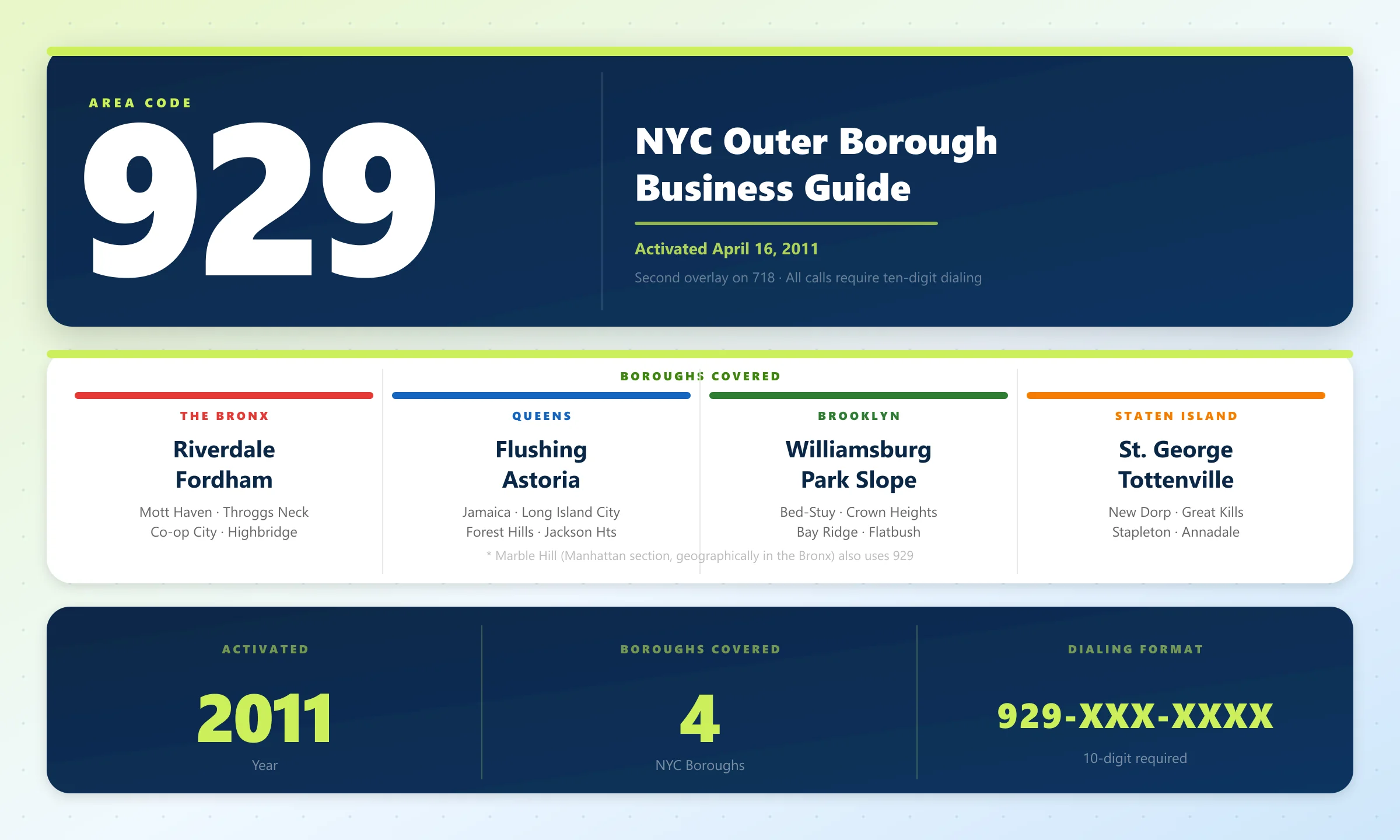
The 929 area code is a North American Numbering Plan code overlaying the 718 numbering plan area in New York City. It serves the boroughs of Brooklyn, Queens, the Bronx, Staten Island, and the Marble Hill section of Manhattan. Activated on April 16, 2011, it joined 347 (1999) and 718 (1984) as the third code carrying the outer-borough traffic.
Which cities does the 929 area code cover?
The 929 covers all of the same geography as 718 and 347. The footprint includes:
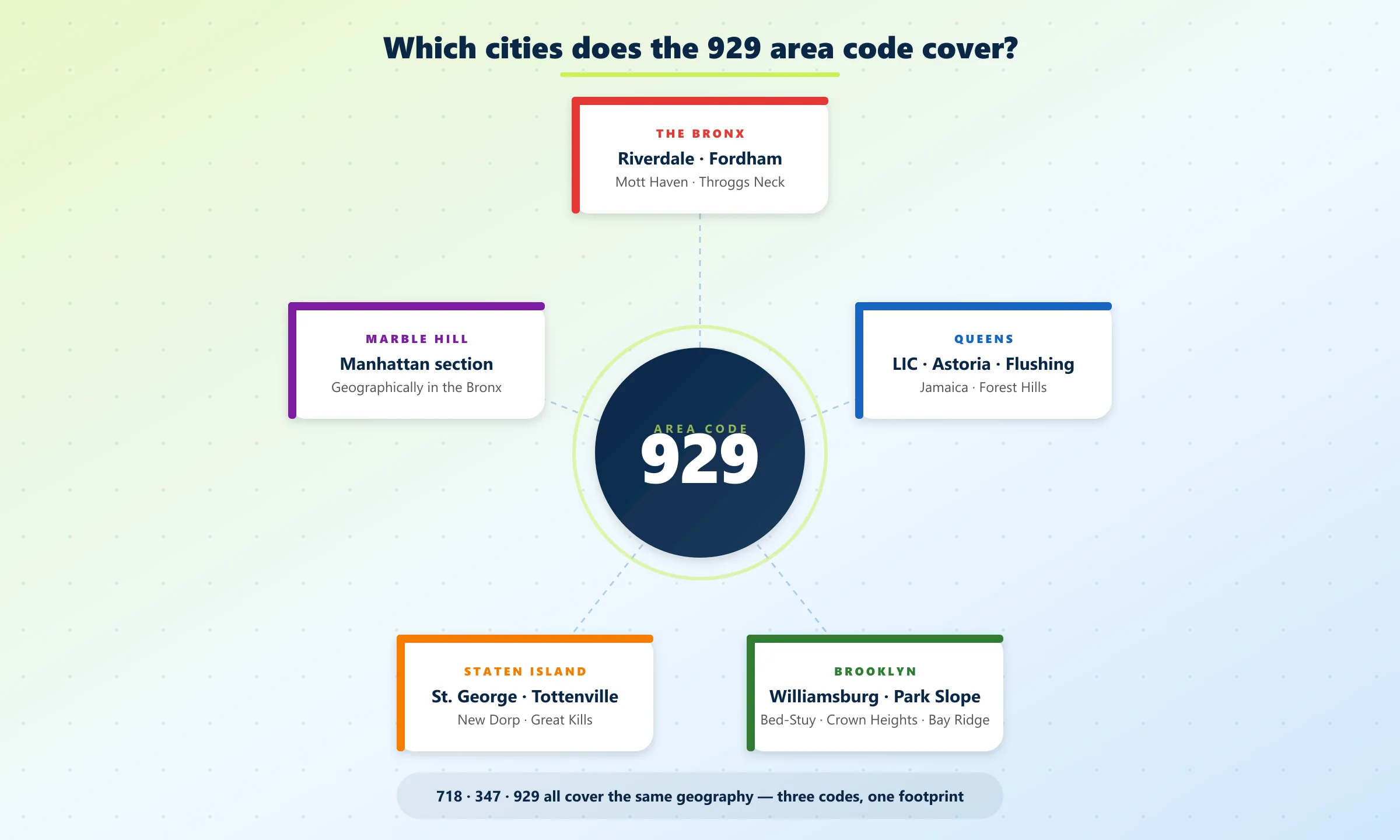
- Brooklyn — Williamsburg, Park Slope, Bedford-Stuyvesant, Crown Heights, Bay Ridge
- Queens — Long Island City, Astoria, Flushing, Jamaica, Forest Hills
- The Bronx — Riverdale, Fordham, Mott Haven, Throggs Neck
- Staten Island — St. George, Tottenville, New Dorp
- Marble Hill — the Manhattan section attached geographically to the Bronx
Manhattan proper uses 212, 646, and 332. Long Island uses 516 area code and 631. Westchester uses 914. The 929 footprint is strictly the four outer boroughs plus Marble Hill.
A brief history of NYC's outer-borough codes
The story is one of repeated exhaustion:
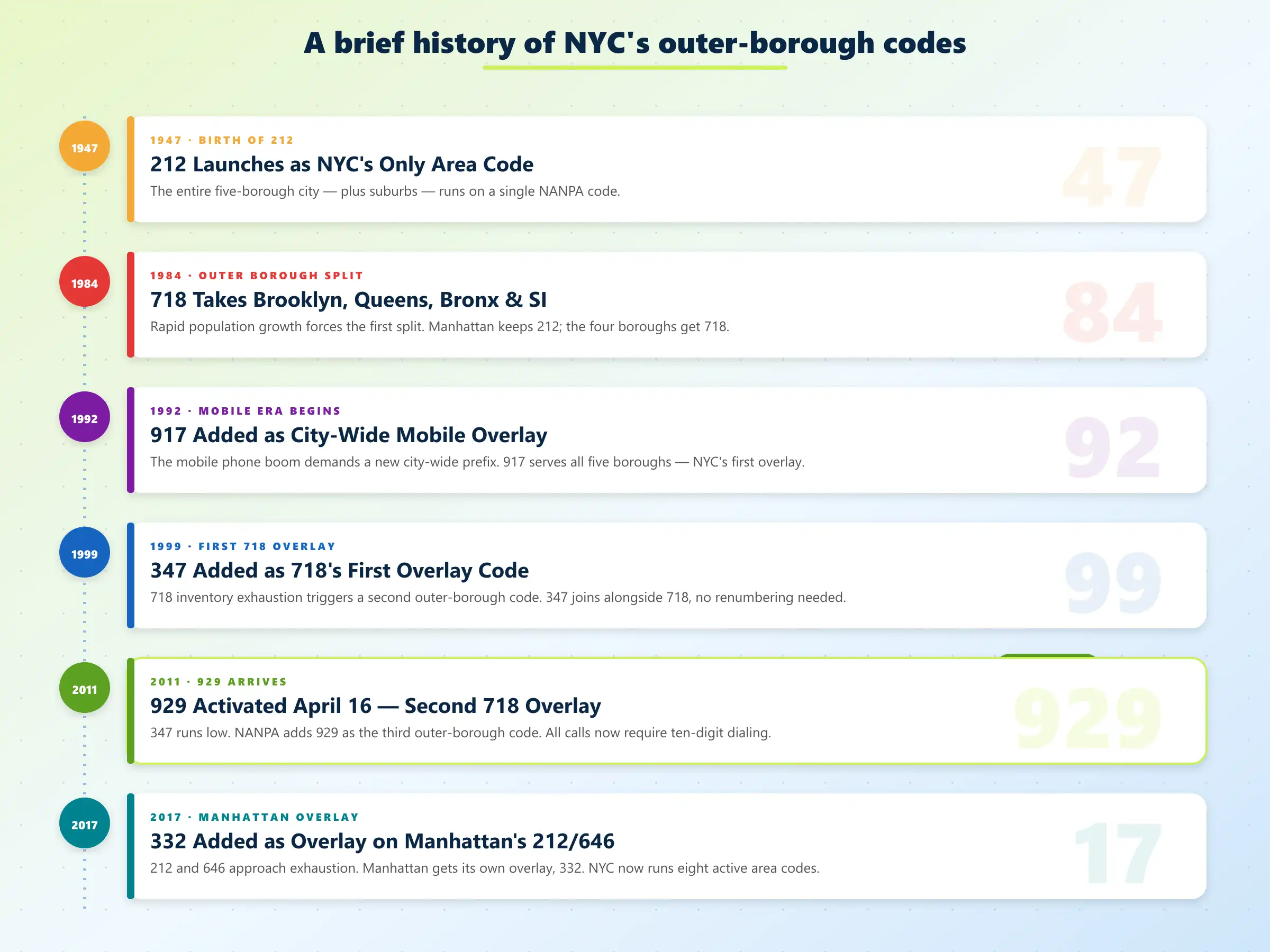
- 1947 — 212 launches as NYC's single area code.
- 1984 — 718 splits off to serve Brooklyn, Queens, the Bronx, and Staten Island.
- 1992 — 917 added as a city-wide mobile overlay.
- 1999 — 347 added as an overlay on the 718 region.
- 2011 — 929 added as the second overlay on the 718 region.
- 2017 — 332 added as an overlay on Manhattan's 212/646.
Why does the 929 exist?
By 2010, both 718 and 347 were running out of available combinations. Rather than split the boroughs again, the NANPA chose the overlay path — adding a third area code, 929, to the same geographic footprint.
Three practical realities followed:
- Existing 718 and 347 numbers stayed unchanged. Nothing was renumbered.
- New activations could be 718, 347, or 929 depending on which pool had inventory. In 2026, fresh 718 inventory is essentially exhausted, 347 is thin, and 929 is the most available.
- All local calls require ten-digit dialing. Seven-digit was retired when the overlays multiplied.
Culturally, 718 reads as "established New Yorker," 347 as "moved to NYC in the 2000s," and 929 as "moved here recently" — increasingly fine given how many businesses launched after 2015.
How to dial 929 numbers in 2026
NYC's overlay structure means ten-digit dialing has been mandatory for years:
- Inside NYC: 929-XXX-XXXX or 718-XXX-XXXX or 347-XXX-XXXX (ten digits)
- From elsewhere in the US: 1-929-XXX-XXXX
- From outside North America: +1-929-XXX-XXXX
- Toll-free: 1-800, 1-888, 1-877, 1-866, 1-855, 1-844, 1-833
- Emergency: 911, always
Older PBX configurations that strip leading digits will fail silently. Update them.
Why outer-borough businesses still ask for the 929
A local area code is no longer a phone-book decision. It is a brand decision and a connect-rate decision — the same logic behind demand for 305 numbers in Miami.
A 929 caller ID lifts answer rates with prospects in Brooklyn, Queens, the Bronx, and Staten Island. People answer numbers they recognise, and 929 reads as familiar to anyone who has lived in the outer boroughs for the last decade. Inbound, a 929 on a website or invoice signals participation in the borough economy, not a call centre two time zones away. Businesses headquartered elsewhere buy 929 numbers as part of their NYC go-to-market and route them anywhere via cloud telephony.
The 929 robocall problem and how to defend against it
NYC area codes are among the most spoofed in the country because the city is a high-income, high-trust market with global brand recognition. The 929 sits inside that pattern.
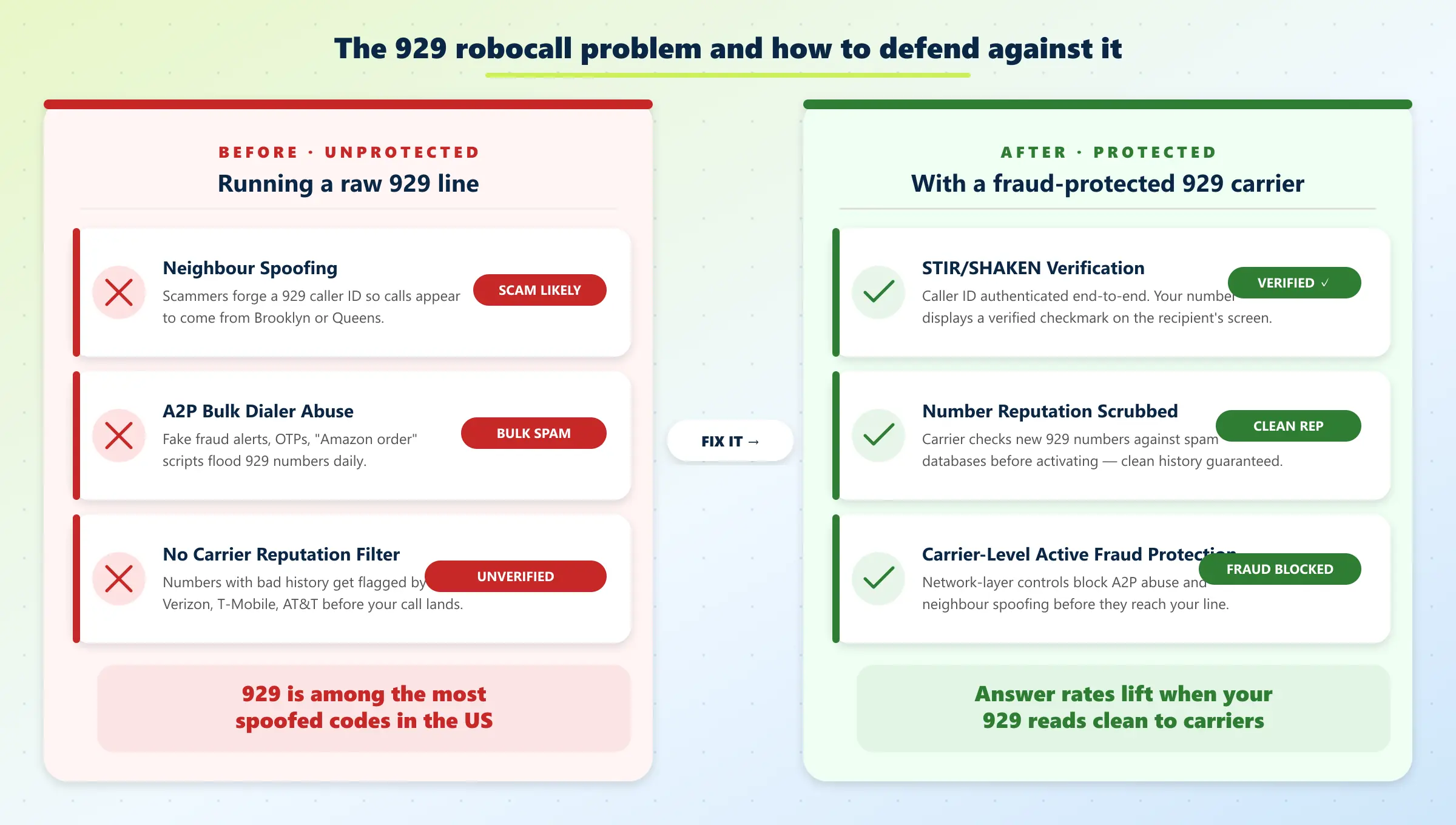
Three things are happening:
- Neighbour spoofing. Scammers forge a 929 caller ID so the call appears to come from a Brooklyn or Queens line.
- A2P abuse. Bulk dialers ship voice OTPs, fake fraud alerts, and "your Amazon order" scripts.
- Tech-support and IRS impersonation. The 929 prefix gets disproportionately spoofed because NYC reads as wealthy and reachable.
For individuals, the practical defences work in layers: register with the National Do Not Call Registry, enable your mobile carrier's built-in spam filter, install a call-blocking app like Hiya or Robokiller, never share personal information on inbound calls, and report suspicious activity to the FTC at reportfraud.ftc.gov. The FCC's robocall guide covers every consumer protection available.
For businesses, the picture is different. Outbound calls from a 929 line risk being flagged as "Scam Likely" if the number has reputation history with carrier spam databases. The fix is a carrier that offers wholesale VoIP with active fraud protection and number scrubbing built in.
NYC industries the 929 hits hardest
Different sectors weight the 929 differently. Where it matters most:
- Finance and fintech. Wall Street uses 212; the outer-borough fintechs and back-office operations sit on 718/347/929.
- Healthcare. NYU Langone, Mount Sinai, NewYork-Presbyterian operate across all five boroughs. Buyers favour vendors with HIPAA-compliant communication.
- Media and creative. Brooklyn's creative industries, Queens production hubs, and Bronx-based content shops.
- Logistics and e-commerce. Last-mile delivery, warehousing, and DTC fulfilment cluster in Queens and the Bronx.
- Real estate. Brooklyn and Queens are among the highest-velocity residential markets in the US.
For any company selling into these verticals, a 929 (or aged 718) is part of the credibility stack. Routing it through a wholesale voice carrier ensures clean delivery across NYC networks.
How to get a 929 area code number for your business
The modern path is short:
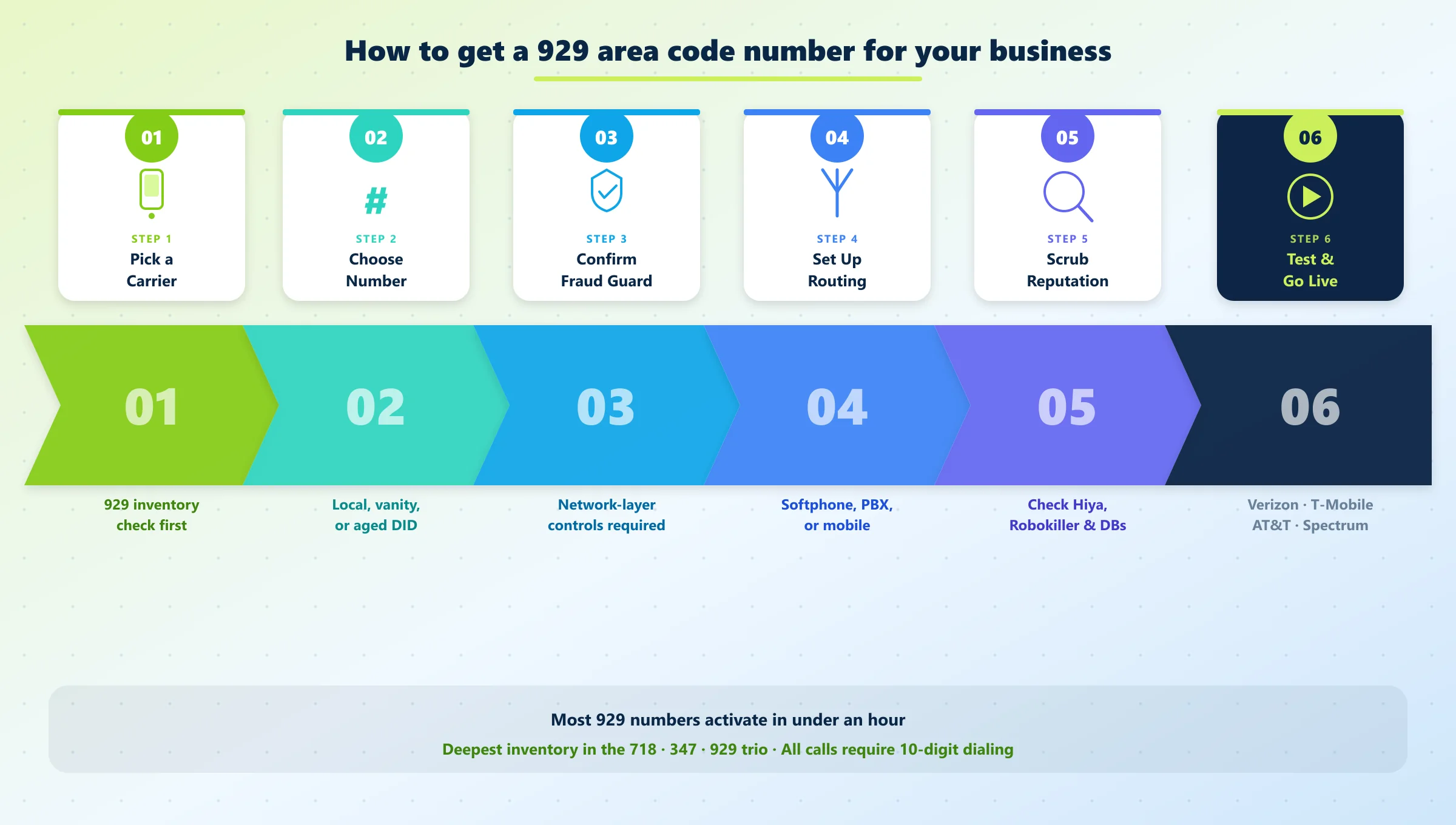
- Pick a carrier with current 929 inventory. Stock is plentiful but varies; ask before signing.
- Choose number type. Local, vanity, or a ported aged number. Aged numbers carry cleaner reputation history.
- Confirm fraud protection. Ask which controls the carrier runs at the network layer.
- Set up routing. Forward to a softphone, contact centre, mobile, or hunt group. Activation takes minutes.
- Scrub the number against scam lists before launch.
- Test outbound deliverability with calls to Verizon, T-Mobile, AT&T, and Spectrum handsets to confirm no "Scam Likely" flags.
Modern virtual phone number platforms run this end-to-end in under an hour.
See also: 909 area code (Inland Empire).
Conclusion
The 929 is no longer the new kid. It is a fully active outer-borough code with the deepest available inventory of the 718/347/929 trio, used daily by Brooklyn startups, Queens healthcare operations, Bronx logistics firms, and Staten Island services. For businesses selling into the four non-Manhattan boroughs in 2026, a clean 929 line lifts answer rates and beats the wait for scarce 718 inventory. Keeping the number's reputation clean and routing it through a fraud-protected carrier is where the work lies.
Frequently called from New York