Introduction
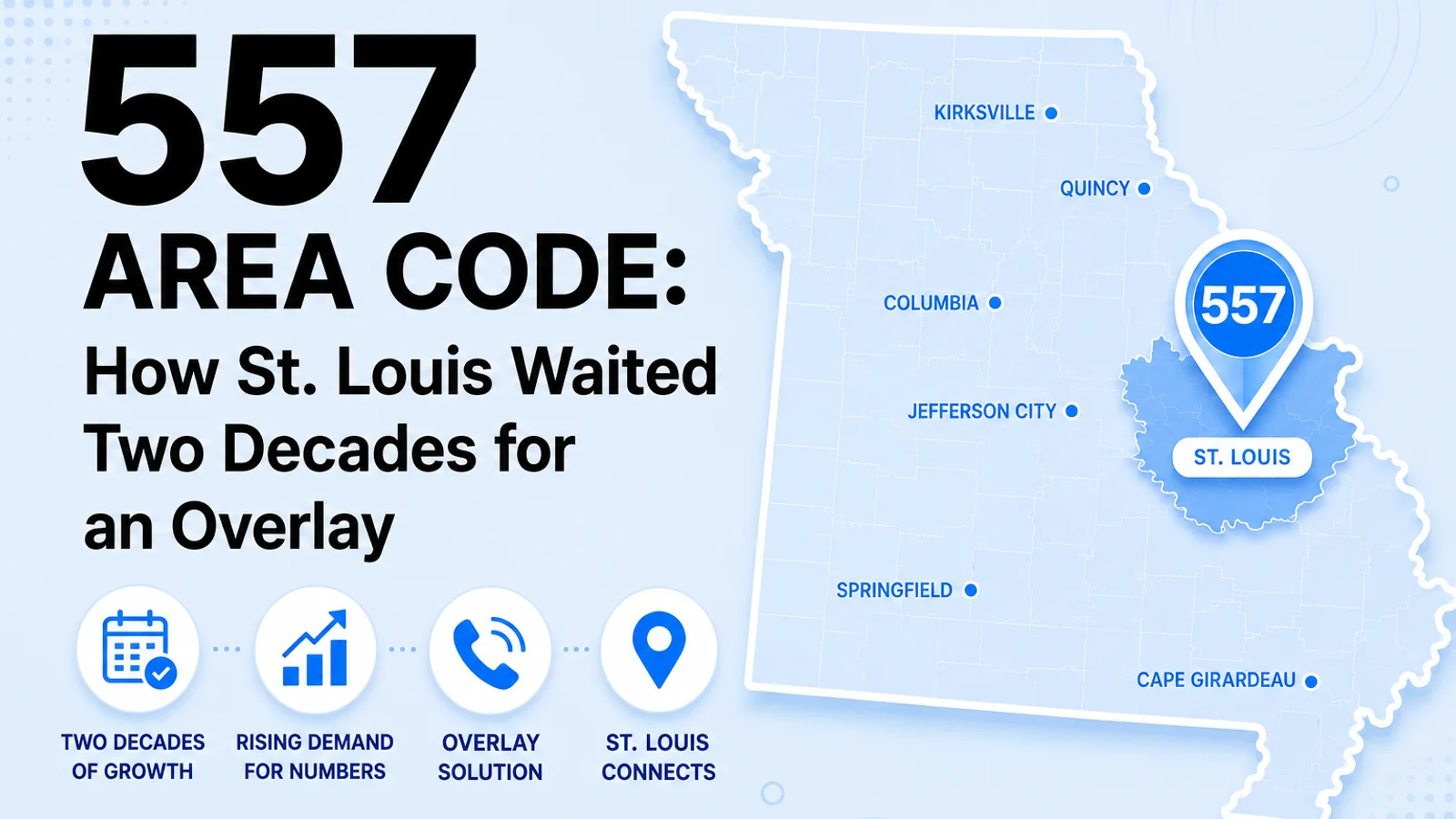
In October 2000, Missouri regulators announced a second area code for St. Louis and set a launch date: May 5, 2002. Eight months before that date arrived, the plan was shelved indefinitely, and the region kept dialing 314 alone for another twenty years. The 557 area code finally went into service on August 12, 2022, not because regulators changed their minds, but because the numbers running out finally caught up with the original warning. This guide covers where 557 reaches, why its launch took so much longer than planned, and a detail almost no other guide mentions: 10-digit dialing arrived in St. Louis for a reason that had nothing to do with 557 at all.
None of that history changes how a 557 number works today. It dials, rings, and bills exactly like any other St. Louis number, and a caller can't tell 557 from 314 by sound alone. What matters more is the mechanics: which suburbs actually fall inside the overlay, why the region moved to 10-digit dialing before 557 numbers even existed, and how a business anywhere can pick one up. Every date and figure below comes from Missouri Public Service Commission filings and NANPA's own numbering records, not repeated from another local directory page.
Mapping the 557 Overlay: St. Louis City and County
557 covers the same ground as 314: the independent city of St. Louis and most of St. Louis County, the inner-ring suburbs pressed right up against the city line. Florissant, Ferguson, Webster Groves, Kirkwood, University City, Clayton, Creve Coeur, and Bridgeton all sit inside the boundary.
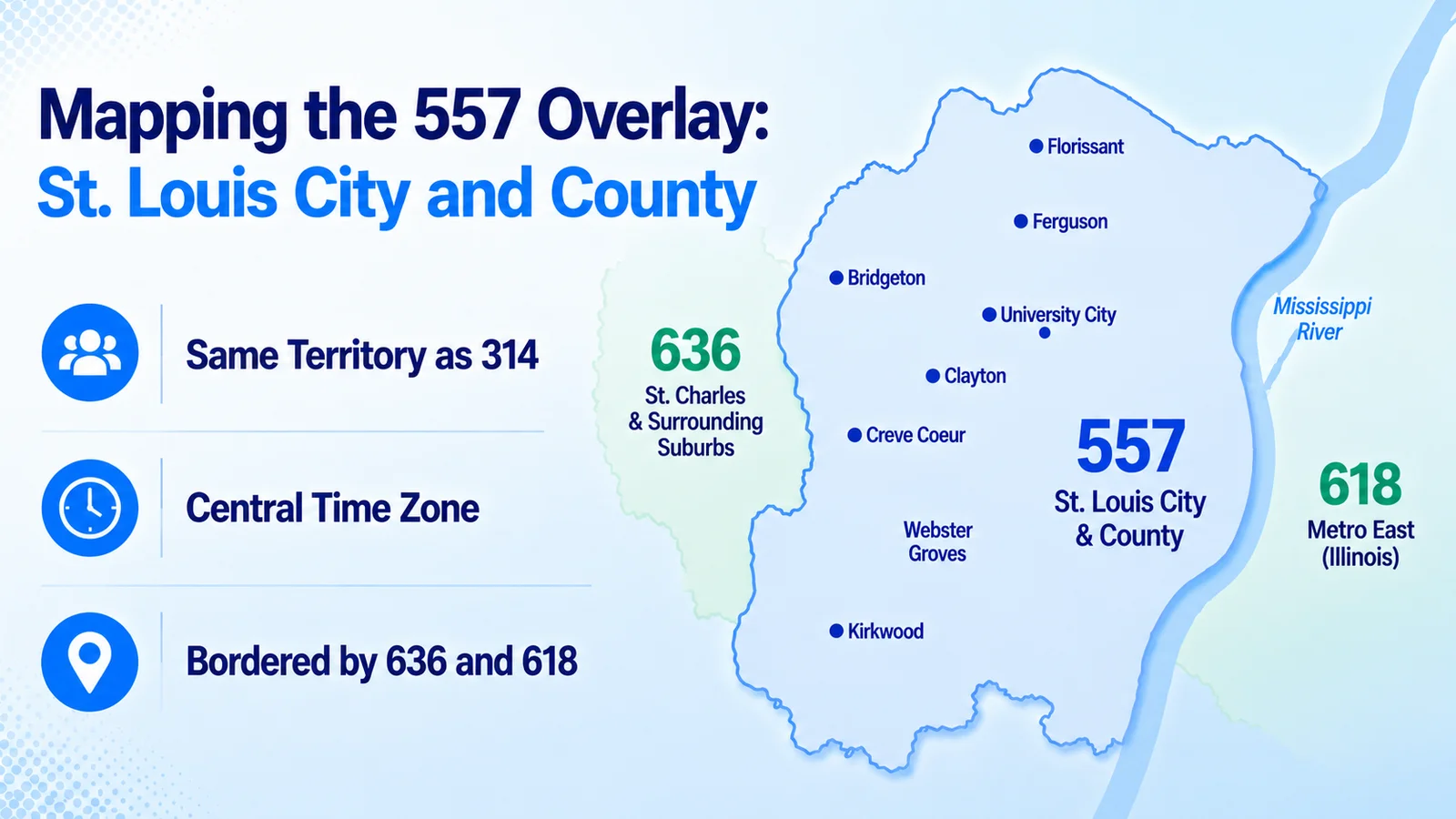
Together, the footprint holds more than 1.3 million people across both area codes combined, sitting in the Central time zone. Two area codes border the territory directly: 636 wraps around it to the west, south, and north, while 618 picks up across the Mississippi River to the east, serving the Metro East communities.
Why Has St. Louis Changed Area Codes Three Times Since 1947?
Missouri has never been a single-area-code state. When the national numbering plan launched in 1947, the state split into two codes: 816 for Kansas City in the west and 314 for the eastern half, where St. Louis anchored the region as its largest city by far.
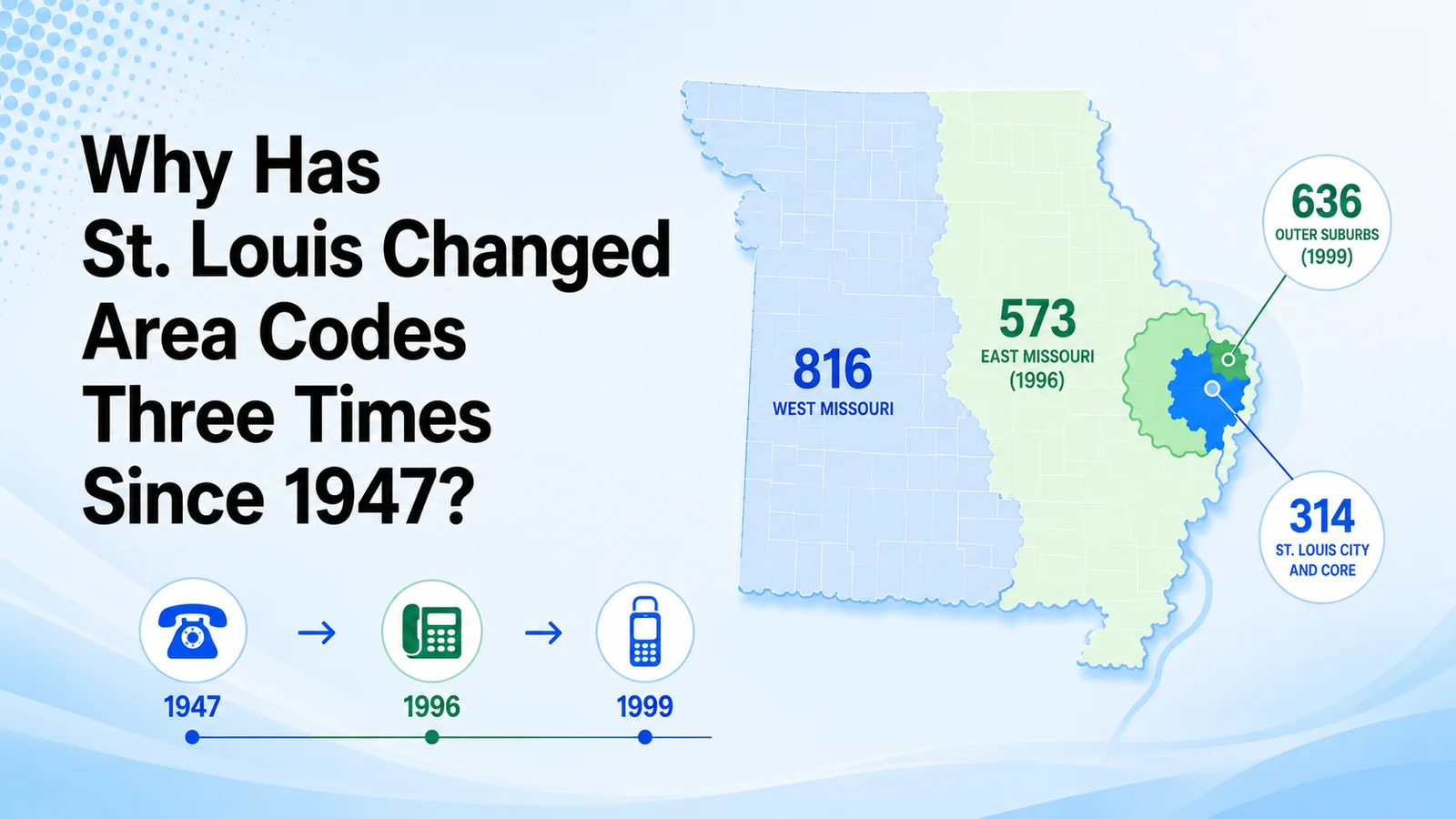
By 1995, subscriber growth had pushed 314 toward exhaustion, and regulators split the area code for the first time: everything outside the St. Louis metro area became 573, effective January 7, 1996. That should have solved the problem for a generation — it didn't.
Cell phones, fax lines, and pagers ate through the remaining numbers so quickly that within two years 314 needed relief again. It shrank a second time on May 22, 1999, when the outer suburbs split off into area code 636, leaving 314 with only the dense inner core it still covers today.
What Happened to the Overlay Missouri Announced in 2000?
Two splits in four years should have been the end of it, but regulators saw another shortage coming almost immediately. On October 24, 2000, the Missouri Public Service Commission announced a second area code for the 314 region, an overlay this time rather than a third split, with an implementation date set for May 5, 2002.
That date never arrived. On September 25, 2001, eight months before the scheduled launch, the commission postponed it indefinitely. Number pooling, a conservation technique assigning numbers in smaller blocks, had stretched 314's remaining supply further than anyone expected.
The overlay wasn't canceled, exactly. It just had nowhere to go for the next two decades, while 314 kept absorbing new lines on its own. Tampa Bay followed a nearly identical path: the 656 area code was proposed as an overlay in 1999, rejected in favor of a geographic split, and finally activated as the planned overlay in 2022 — the same year St. Louis's own delayed plan finally went live. Denver reached the same milestone weeks later when the 983 area code launched as a second overlay on 303 and 720 in June 2022.
By the early 2020s, conservation alone wasn't enough anymore, and the shelved 2000 plan finally became necessary. But before 557 itself arrived, something else forced St. Louis to change how it dialed the phone.
Why Did 10-Digit Dialing Arrive in St. Louis Before 557 Did?
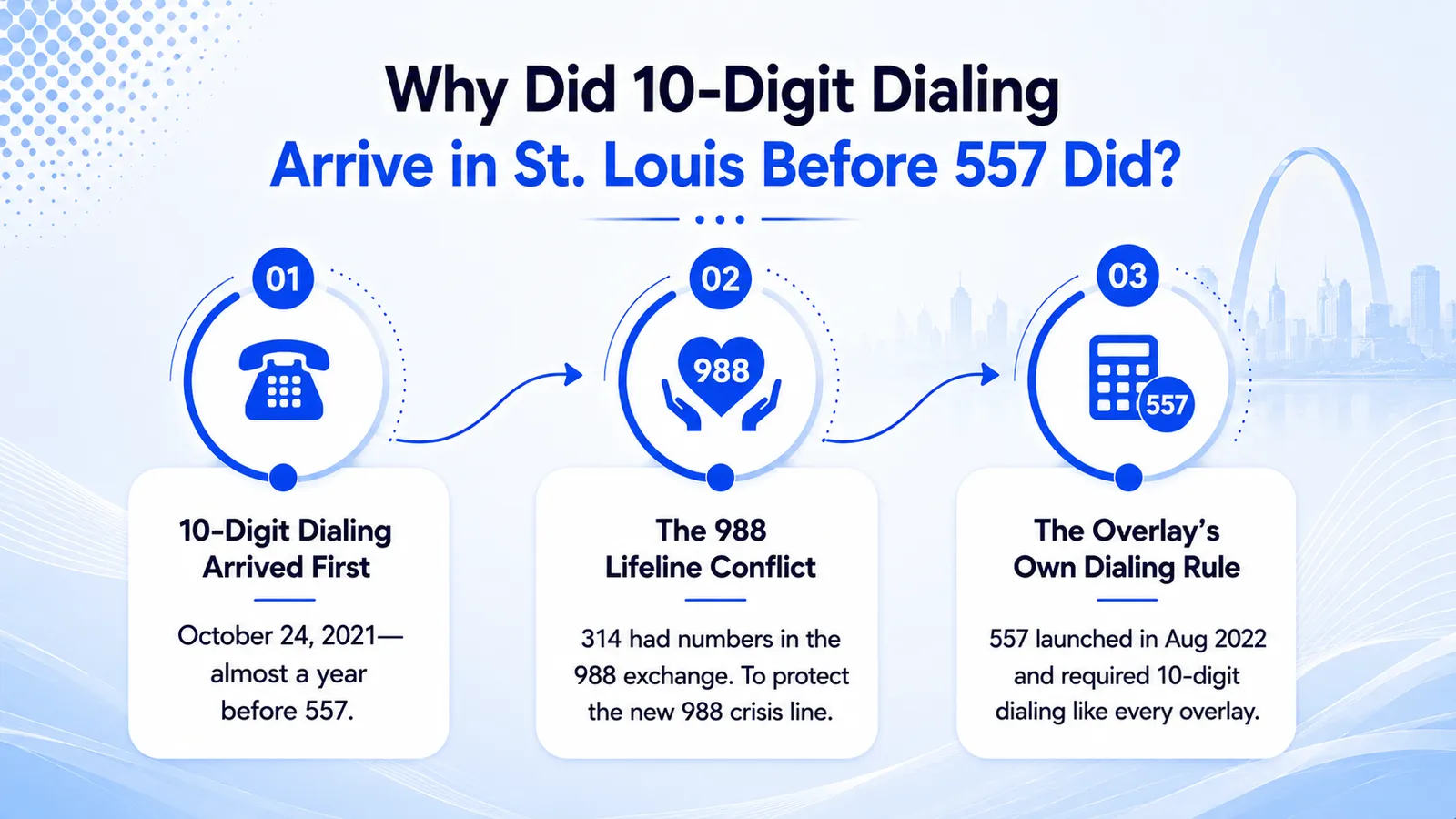
Ten-digit dialing came to the St. Louis area on October 24, 2021, nearly a full year before a single 557 number existed. It was a separate, unrelated fix coordinated through the FCC-overseen North American Numbering Plan Administrator.
The 988 Lifeline Conflict
In 2020, regulators designated 988 as the new nationwide three-digit number for the Suicide & Crisis Lifeline, the same way 911 works for emergencies. St. Louis had a problem: 314 already had numbers assigned to the exchange 988, so some residents' seven-digit numbers began with the same three digits as the new crisis line.
Dialing seven digits locally could no longer safely coexist with a three-digit shortcut to 988, so NANPA scheduled the entire 314 region to move to mandatory 10-digit dialing by October 24, 2021, specifically to clear that conflict.
The Overlay's Own Dialing Rule
557's activation in August 2022 required 10-digit dialing too, as every overlay does, but by then the switch had already happened for an unrelated reason nearly a year earlier. Anyone who assumes 10-digit dialing in St. Louis is purely a 557 side effect is missing that it arrived in two separate waves: one tied to the national 988 rollout, one tied to the overlay.
How Does 557 Actually Differ From 314?
On paper, 557 and 314 are nearly indistinguishable, and the table below shows exactly how little separates them. The one meaningful gap is adoption: of the 800 possible prefixes available to 557, only a sliver have been assigned so far, so most new numbers still land on 314.
| Detail | 314 | 557 |
|---|---|---|
| First assigned | 1947, original NANP code | August 12, 2022, overlay |
| Geographic coverage | St. Louis city + inner St. Louis County | Identical to 314 |
| Dialing format | 10 digits, mandatory | 10 digits, mandatory |
| Prefixes in active use | Majority of assigned numbers | Small and growing minority |
| Carrier support | Universal | Universal |
For most residents, that gap won't matter for years. Existing 314 numbers keep working as they always have, with no reassignment or change to what counts as a local call.
How to Get a 557 Area Code Number
Getting a St. Louis number doesn't require a Missouri address or a trip downtown. A wholesale VoIP platform can provision one in minutes and route its calls and texts to whatever device or team already handles customer contact.
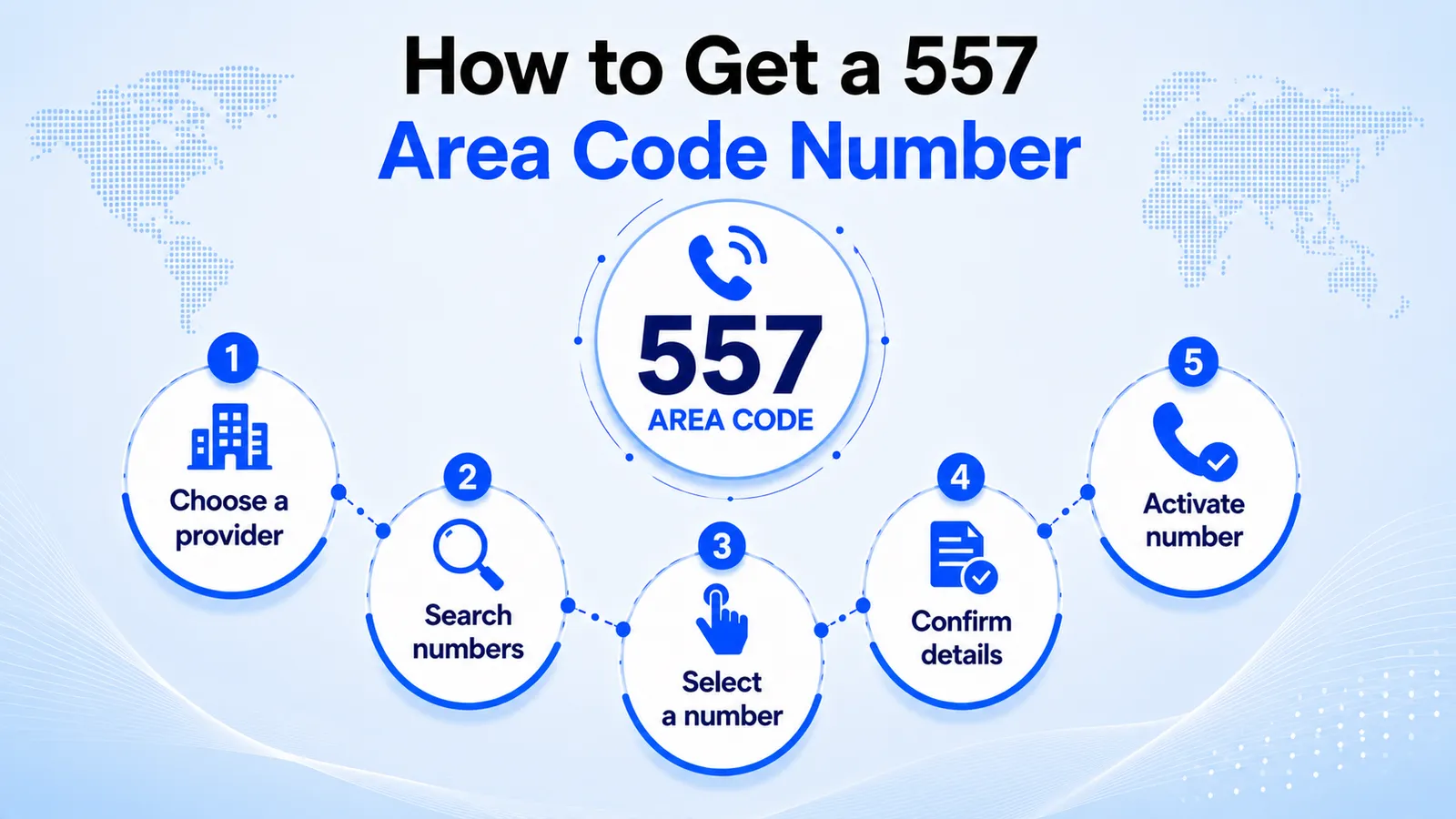
- Choose a business phone provider, such as TKOS, that offers Missouri area codes.
- Search the available number list and note whether a 314 or 557 number comes up.
- Select a specific number from the results shown.
- Confirm billing and business details; a physical Missouri address is not required.
- Activate the number and connect it to existing call routing, voicemail, and team extensions.
Businesses that already hold a 314 number can keep it and add a 557 number alongside it, useful for separating departments or campaigns without giving up a recognized number. Porting an existing number in typically finishes within about a week.
Why Local Numbers Still Matter in a Fortune 500 Town
St. Louis carries more Fortune 500 headquarters than its size would suggest, from Edward Jones and Stifel Financial to Centene and Bayer Crop Science. A local area code still signals something in a market like that: familiarity, a business reachable at a real St. Louis number, not an anonymous toll-free line.
That signal works the same whether the number reads 314 or 557, since neither carries more or less legitimacy on its own. What actually protects answer rates is carrier-level caller ID authentication, not which three digits come first.
For teams outside Missouri, a 557 or 314 number solves the local-presence problem without a lease, a hire, or a Missouri business license. A cloud phone system routes calls to wherever the team is based, so a St. Louis number answered from Lagos or London carries the same local familiarity as one sitting on a desk in Clayton.
Conclusion
557 exists because a warning issued in 2000 eventually came true two decades later than planned. St. Louis split its area code twice in the 1990s, then had a third relief plan ready to go in 2002, only to shelve it for twenty years once number pooling bought enough breathing room. When the numbers finally ran short again, the shelved plan activated almost exactly as originally designed, just decades behind schedule. Along the way, the 988 crisis line forced 10-digit dialing on the region nearly a year before 557 even existed.
None of that history changes how a 557 number functions for a business today. Ten-digit dialing is mandatory across the whole 314/557 region now, and a 557 number carries exactly the same local credibility as a 314 one for a St. Louis customer. Businesses expanding into the area, or already there and adding lines, can set up a 557 number through TKOS in minutes, without waiting on physical installation or losing an existing 314 number in the process. Get the history straight, and the rest of the setup is the easy part.
Popular international calling destinations