Introduction
Metro Atlanta has added a new area code roughly every decade since 1995 — 770, then 678, then 470, then 943 — not because the city kept changing its mind, but because it kept growing. Each overlay arrived for the same reason: the previous codes ran short of available combinations.
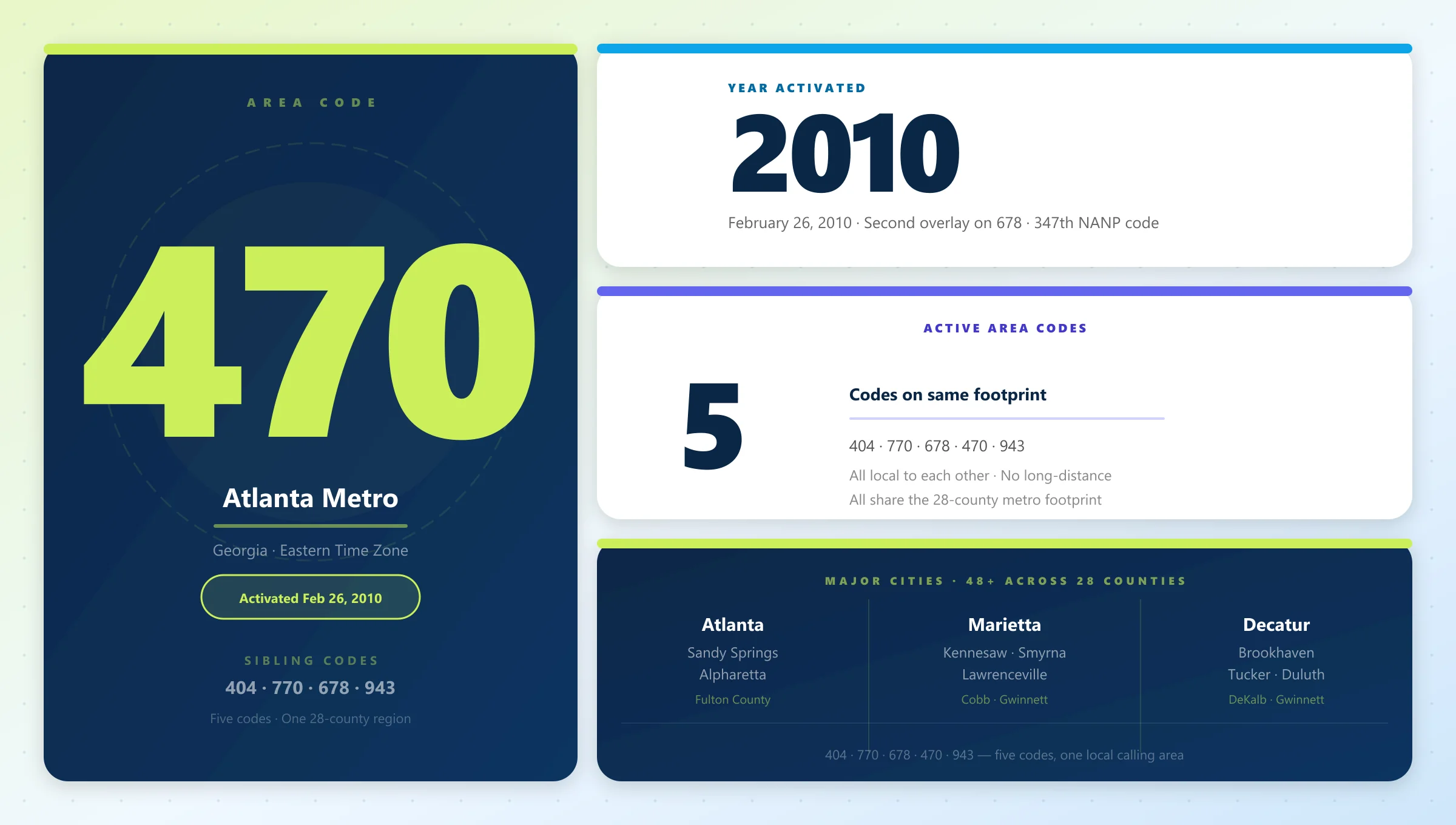
The 470 has been live since February 26, 2010, and it is now one of the most commercially available codes in the Atlanta market. Inventory is plentiful where 404 is almost extinct. For businesses entering the Atlanta metro today, 470 is often the most practical starting point.
What is the 470 area code?
The 470 area code is a North American Numbering Plan code covering all 28 counties of metro Atlanta, Georgia. Activated on February 26, 2010, it was the 347th NANP area code to go live and the second overlay on the 678 region. It shares its entire footprint with 404, 770, 678, and the newest addition, 943.
In metro Atlanta, 404 reads as the original city code — deep roots, scarce inventory. 678 reads as suburban-era. 470 reads as modern and available, the same way 929 reads in Brooklyn or 786 reads in South Florida.
Which cities does the 470 area code cover?
The 470 footprint matches every other Atlanta-region code exactly. It covers all 28 counties of the metro area:
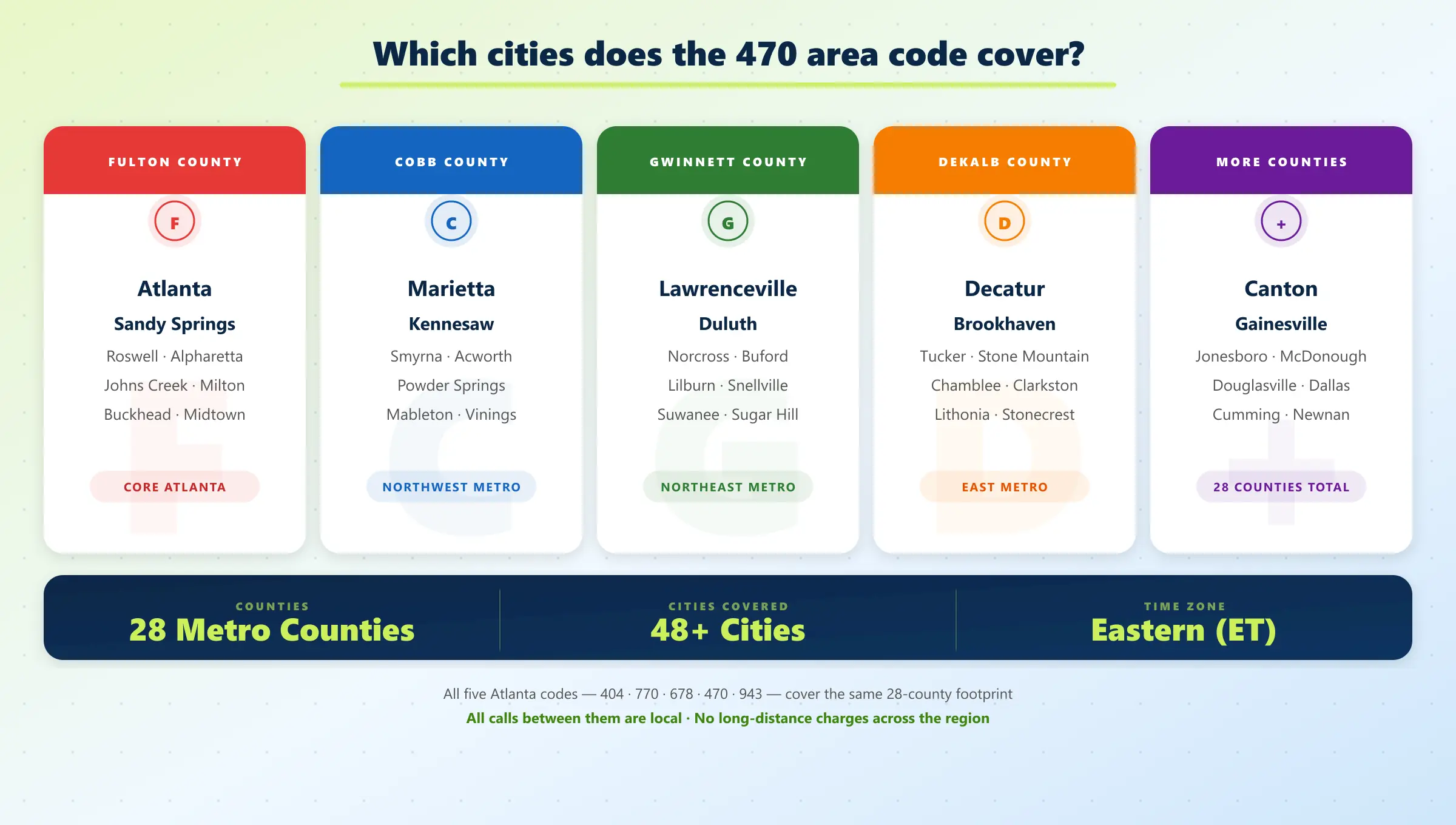
- Fulton County — Atlanta, Sandy Springs, Roswell, Alpharetta, Buckhead, Midtown
- Cobb County — Marietta, Kennesaw, Smyrna, Acworth, Powder Springs
- Gwinnett County — Lawrenceville, Duluth, Norcross, Buford, Snellville
- DeKalb County — Decatur, Brookhaven, Tucker, Stone Mountain, Chamblee
- North metro — Canton, Gainesville, Cumming (Cherokee and Forsyth counties)
- South metro — Jonesboro, McDonough, Stockbridge (Clayton and Henry counties)
- West metro — Douglasville, Newnan, Villa Rica (Douglas, Paulding, Carroll counties)
All calls between 404, 770, 678, 470, and 943 numbers within this footprint are local — no long-distance charges apply regardless of which code you call.
A brief history of the 470 and its sibling codes
Atlanta's prefix history is a short course in what happens when a metro area grows faster than its phone-number supply:
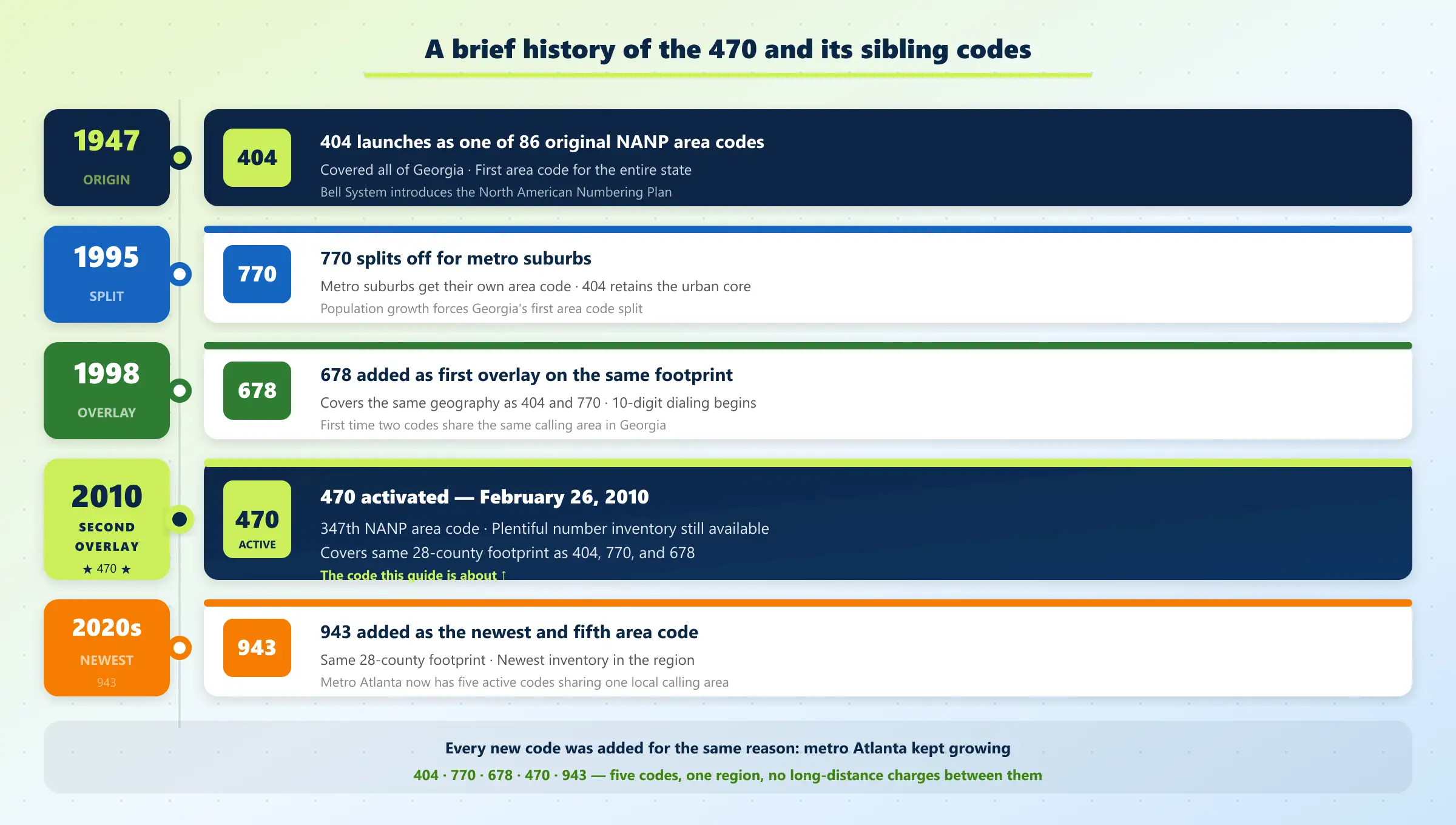
- 1947 — 404 launches as one of the 86 original NANP codes, covering all of Georgia.
- 1995 — 770 splits off for metro suburbs. Atlanta's urban core keeps 404.
- 1998 — 678 added as the first overlay on both 404 and 770. Ten-digit dialing becomes mandatory.
- 2010 — 470 activated February 26 as the second overlay. The 347th NANP code.
- 2020s — 943 added as the fifth active code on the same 28-county footprint.
Every addition was driven by the same force: more people and more devices per person. The 28-county metro now carries five area codes that are legally and technically identical in coverage.
Why does the 470 area code have overlay codes?
When a region exhausts available number combinations, regulators have two options: split the geography or add an overlay. Atlanta chose overlays after the 1995 split, and each subsequent code — 678, 470, 943 — was layered on top of the same territory.
Three practical effects followed each overlay addition:
- Existing numbers stayed unchanged. No one was renumbered when 678, 470, or 943 arrived.
- New activations pull from whichever code has inventory. In 2026, fresh 404 is nearly exhausted, 678 is thin, and 470 carries the deepest available stock.
- All local calls require ten-digit dialing, mandatory since 1998 when the first overlay arrived.
Culturally, the hierarchy still carries weight. A 404 signals deep Atlanta roots. A 470 signals a business that came of age in the modern era — which describes most of Atlanta's current growth.
Why Atlanta businesses still ask for 470 numbers
A local area code is no longer a phone-book decision. It is a brand decision and a connect-rate decision — the same principle driving demand for 305 numbers in Miami.
A 470 caller ID lifts answer rates with local prospects. People answer numbers they recognise as Atlanta, and 470 reads as metro to anyone in the region. Inbound, a 470 on a website or invoice signals local economy participation rather than a call centre in a different time zone.
Companies headquartered elsewhere routinely buy 470 numbers as part of their Atlanta go-to-market kit, then route those calls to wherever their teams sit. Cloud telephony makes the number live anywhere in the world.
The 470 robocall problem and how to defend against it
Atlanta sits high on US neighbour-spoofing lists. The 470 shares this exposure with 404 and 678 — scammers forge Atlanta caller IDs because the metro reads as high-income and high-trust.
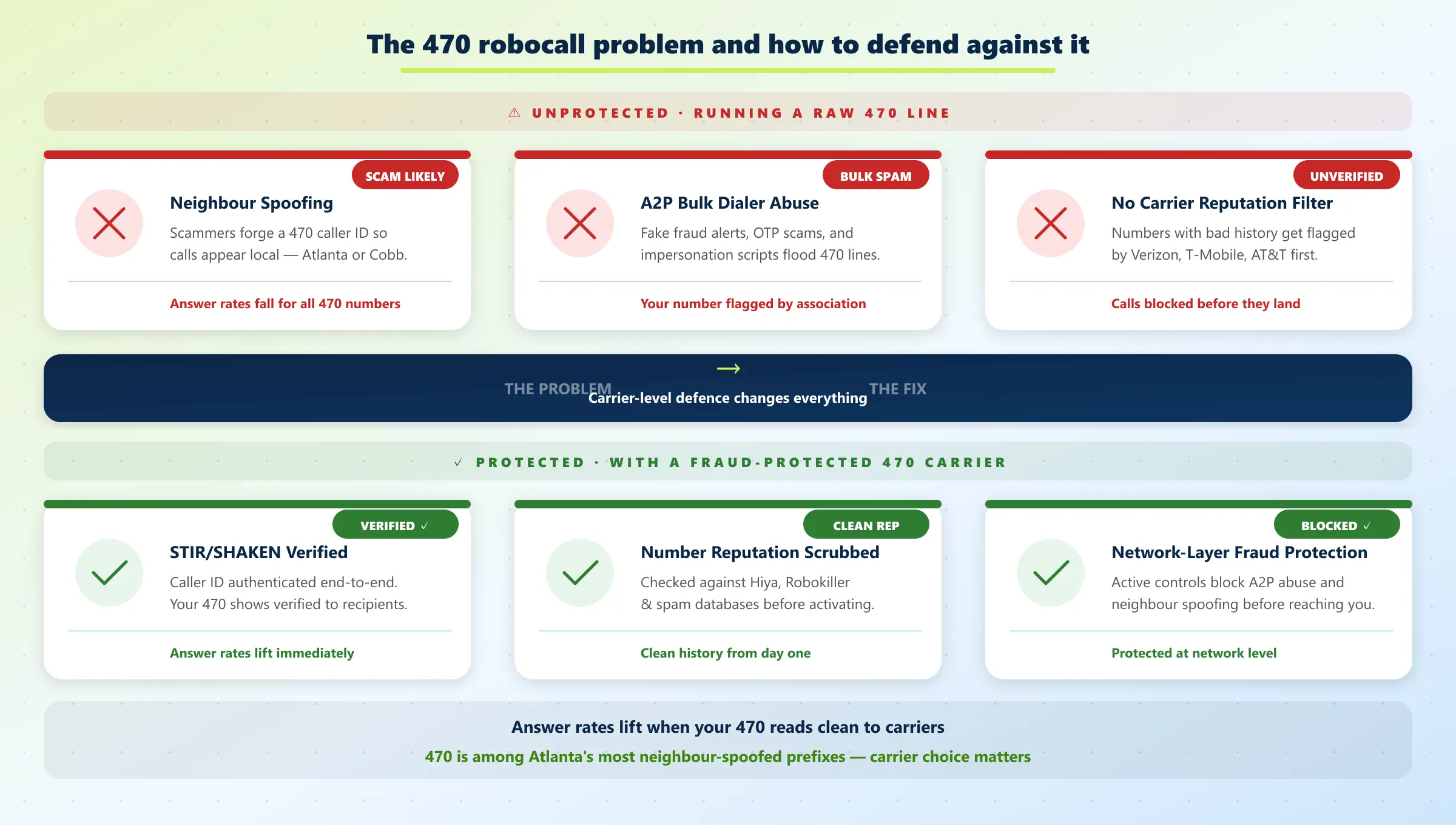
Three threats concentrate on Atlanta-prefix numbers:
- Neighbour spoofing. Scammers forge a 470 or 404 caller ID so the call appears to come from Cobb County or Buckhead.
- A2P bulk dialer abuse. Fake fraud alerts, OTP impersonation, and automated sales scripts flood Atlanta numbers daily.
- Carrier reputation flags. Numbers with any spam history get pre-flagged by Verizon, T-Mobile, and AT&T before calls even land.
For individuals, layered defences work: register with the National Do Not Call Registry, enable your carrier's built-in spam filter, install a call-blocking app like Hiya or Robokiller, and report suspicious activity to the FTC at reportfraud.ftc.gov. The FCC's robocall guide covers every consumer protection available.
For businesses, the stakes are higher. Outbound calls from a 470 line can be flagged as Scam Likely if the number carries reputation history in carrier databases. The fix is a carrier that provides wholesale VoIP with STIR/SHAKEN attestation and active fraud protection built in.
Atlanta industries where 470 matters most
Different sectors weight a local Atlanta number differently. Where the 470 moves the needle most:
- Technology and fintech. Atlanta is the US payments-technology capital, home to NCR Voyix, Global Payments, and a deep VC-backed startup bench.
- Healthcare and medical. Emory Healthcare, Piedmont Health, WellStar, and Children's Healthcare of Atlanta mean buyers expect HIPAA-compliant communication.
- Media and entertainment. Home of CNN, Tyler Perry Studios, and a rapidly growing film-production industry.
- Logistics and supply chain. Hartsfield-Jackson is the world's busiest airport; logistics companies serving the South-East want a local Atlanta presence.
- Real estate. One of the US's most active residential and commercial markets, where agent identity is tied to local credibility.
For any company selling into these verticals, a 470 is part of the credibility stack. Routing it through a wholesale voice carrier ensures clean delivery and optimal pricing on outbound minutes.
How to get a 470 area code number for your business
The modern path is short:
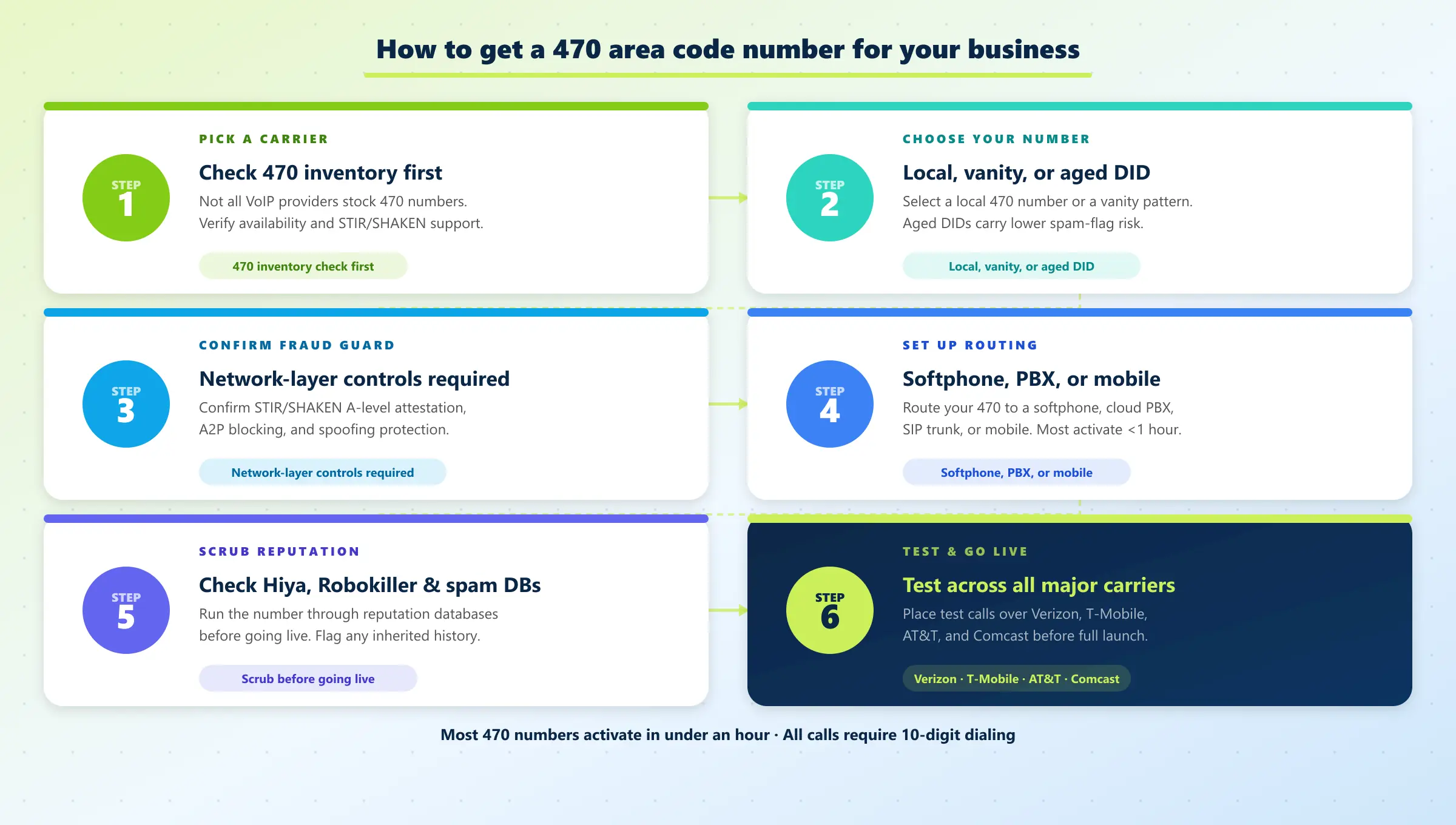
- Pick a carrier with current 470 inventory. Stock is plentiful, but ask about STIR/SHAKEN and fraud controls before signing.
- Choose number type. Local, vanity, or a ported aged DID. Aged numbers carry cleaner reputation history.
- Confirm fraud protection. Ask which STIR/SHAKEN attestation level and A2P blocking the carrier runs at the network layer.
- Set up routing. Forward to a softphone, contact centre, mobile device, or hunt group. Activation typically completes in under an hour.
- Scrub the number against Hiya, Robokiller, and carrier spam databases before launch.
- Test outbound deliverability with calls to Verizon, T-Mobile, AT&T, and Comcast handsets to confirm no Scam Likely flags.
Most 470 numbers activate in under an hour. The follow-through — keeping the number's reputation clean and routing it through a fraud-protected carrier — is where most businesses underinvest.
TKOS customers expanding into other Southeastern markets often also set up numbers in the 659 area code, giving a growing business a Birmingham, Alabama presence alongside its new Atlanta line — all managed from the same TKOS dashboard.
See also: 464 area code (Illinois).
Conclusion
The 470 area code is more than a recent addition to Atlanta's prefix stack. It is the most available, most practical entry point into a 28-county metro that has added nearly a million residents since 2010. For businesses selling into Atlanta's tech, healthcare, media, logistics, and real estate verticals, a clean 470 line is one of the fastest ways to signal local presence, lift answer rates, and compete inside a market that reads local credibility into everything from a caller ID to a business card.
Frequently called from Atlanta