Introduction
A call to a business two miles away can fail for one reason: the caller dialed seven digits instead of ten. That's everyday life across Sacramento's 916 and 279 codes, where two area codes now share identical territory. Dial it wrong and the call doesn't reach a stranger, it just stops, replaced by a recording telling the caller to hang up and retry. For a business waiting on that call, a wrong assumption about 279 costs a customer, not just a minute.
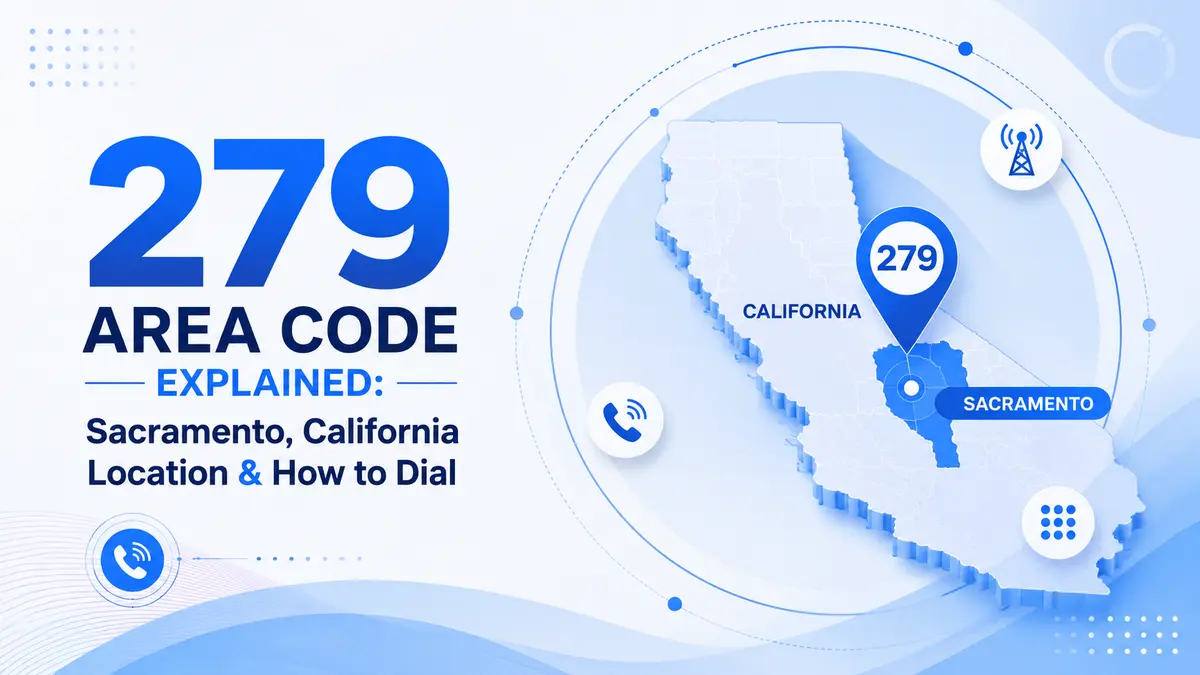
279 is a California prefix covering Sacramento and its suburbs, added in 2018 as an overlay on the existing 916 area code rather than a replacement for it. It shares 916's exact footprint, and every call inside it now needs a full ten digits, local or not. Six counties sit inside the boundary, each following the same rule. What follows covers where that boundary sits, why the dialing rule exists, and how to get a 279 number, wherever you're calling from.
What Is the 279 Area Code?
279 is a geographic area code under the North American Numbering Plan, assigned to the greater Sacramento region of California. It isn't a separate calling region: it's an overlay, layered on top of the existing 916 numbering area rather than carved out of it. A 279 number rings, bills, and behaves exactly like a 916 number from the same street.
The California Public Utilities Commission approved the overlay in Decision 17-02-010 on February 9, 2017, and it went live on March 10, 2018. The trigger was arithmetic, not abstract growth: regulators projected 916's available central office codes would run out by the end of 2018. An overlay let the region keep issuing new numbers without renumbering a single existing customer.
Where Is the 279 Area Code Located?
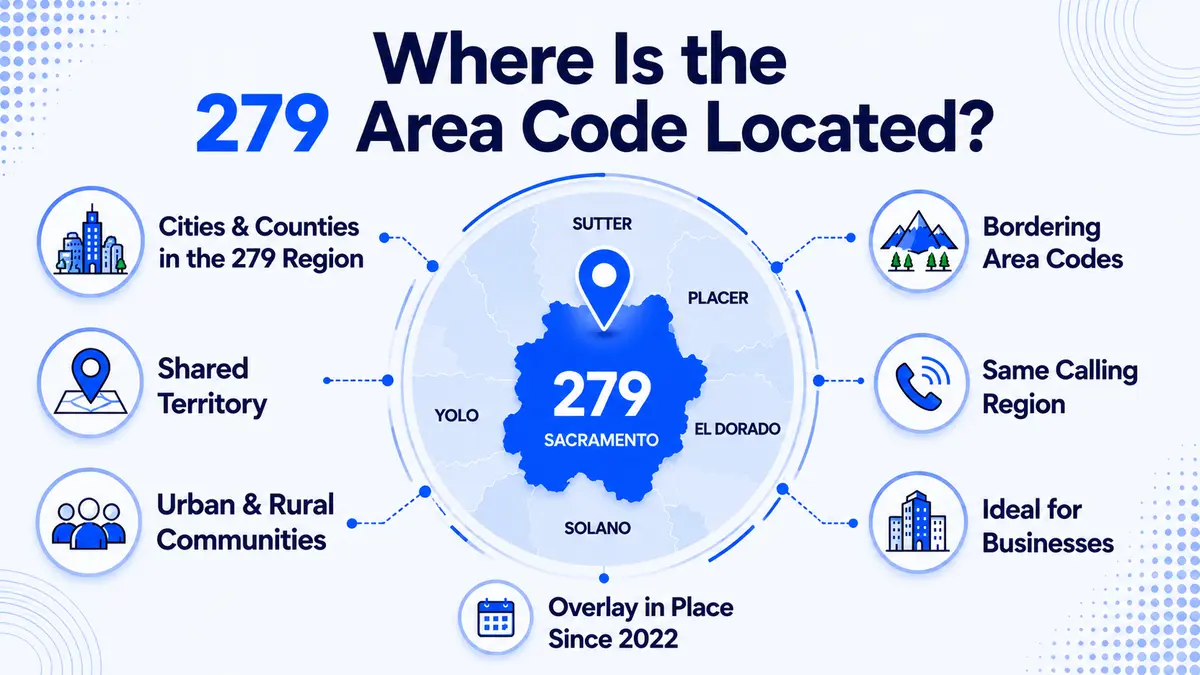
279 sits entirely within Northern California's Sacramento Valley, layered over ground 916 has covered since the 1990s. That shared territory spans six counties and dozens of communities, urban and rural alike.
Cities and Counties in the 279 Region
The CPUC names Sacramento, Citrus Heights, Elk Grove, Folsom, Rancho Cordova, and Isleton in Sacramento County; Lincoln, Loomis, Rocklin, and Roseville in Placer County; and West Sacramento in Yolo County, plus reach into El Dorado, Sutter, and Solano counties. Providers often add Davis and Woodland too, since those towns share the same rate center.
Bordering Area Codes
279 and 916 border three codes: 530 toward the Sierra foothills, 707 along the North Bay, and 925 and 209 toward the East Bay. None overlap 279's territory, so a business targeting Sacramento has no reason to consider them.
Is 279 New, or an Overlay of 916?
It helps to separate two things people lump together: a split and an overlay. A split redraws the map, so one part keeps its old area code while another gets a new one, changing existing numbers on the new side. 916 has been through that twice, split in 1959 to create 707 and again in 1997 to create 530, per the CPUC's own history.
279 works differently: nobody's existing 916 number moved or needs replacing. The same area now carries two codes at once, and which one a line gets depends on when it was issued. Numbers activated before March 10, 2018 kept 916; nearly everything since comes out of the 279 block as 916 capacity runs low. The same overlay logic plays out across the US — in Cincinnati, where the 283 area code stacks alongside 513 under identical rules.
279 vs. 916: What Actually Changes
The practical differences are narrower than most expect. The table below lines up what changes against what stays identical.
| Aspect | 916 (original) | 279 (overlay) |
|---|---|---|
| Coverage area | Greater Sacramento region | Identical to 916 |
| First issued | 1947 | March 10, 2018 |
| Assigned to | Existing lines, unchanged | New lines issued after March 2018 |
| Dialing format | 1 + area code + 7 digits | 1 + area code + 7 digits |
| Local call cost | Unaffected | Unaffected |
| Customer can request it? | Yes, if capacity allows | Assigned automatically |
Cost is the detail that surprises people most: neither code changes what a call costs or whether it counts as long distance. A call that was local before the overlay stays local after it, no matter which code either party dials from.
Why Does 279 Require 10-Digit Dialing?
Before the overlay, a Sacramento caller dialed seven digits for a local call and reached the right line, since only one area code existed there. Once 279 and 916 began sharing that ground, seven digits stopped telling the network which code a number belonged to.
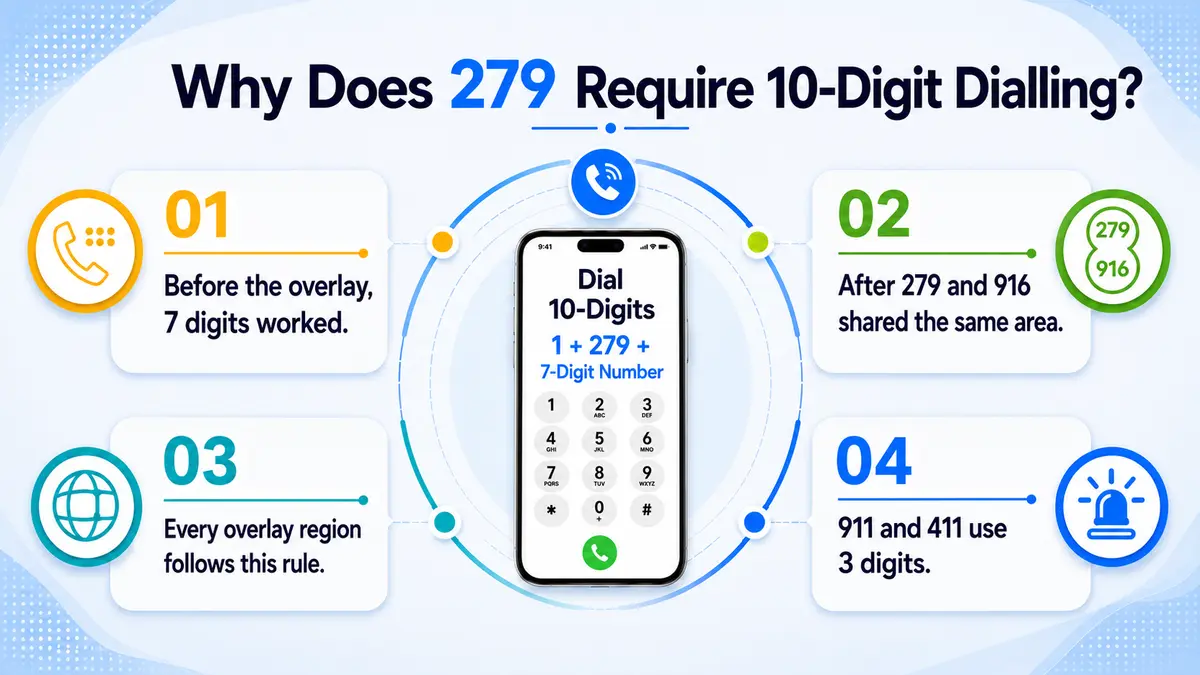
Every call now needs the leading 1, the area code, and the seven-digit number, no exceptions. This isn't unique to Sacramento. Every overlay region adopts the same rule, since it's the only reliable way to route calls correctly when two codes share one footprint. Three-digit numbers like 911 and 411 are the sole exception.
What Time Zone Does the 279 Area Code Use?
Every 279 number sits in the Pacific Time Zone, the same zone covering Los Angeles, San Francisco, and Seattle. Standard time runs eight hours behind UTC; during daylight saving time, roughly March through November, that narrows to seven hours behind.
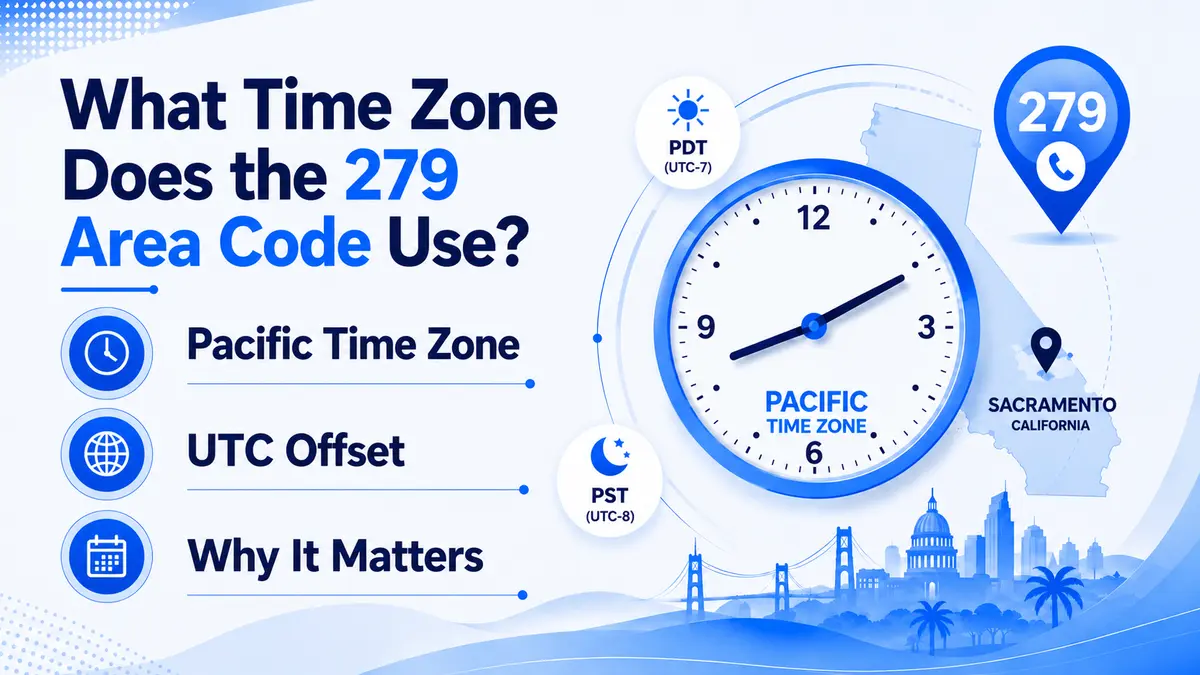
For a business outside California, that detail matters more than it sounds. A call center running a 9-to-5 Eastern schedule will find its 279 lines unanswered for the first few hours of its own day, since it's still before dawn in Sacramento. Scheduling routing and staffing around Pacific time, not the caller's home zone, avoids that mismatch entirely.
Will a New 279 Number Get Flagged as Spam?
Newly activated numbers, in any area code, sometimes get flagged as "Scam Likely" simply because they haven't built call history yet, and unrelated bad actors have occasionally cycled through a number block before a business claimed one. 279 isn't especially prone to this next to other overlay codes, but the risk isn't zero.
The industry-wide fix is STIR/SHAKEN, the caller ID authentication framework the FCC guide explains in detail. The originating carrier cryptographically signs a call to confirm the caller ID hasn't been spoofed, and that attestation follows it to the receiving carrier. A provider signing at full attestation gives a new 279 number real trust from day one, rather than building a reputation slowly through months of unflagged calls.
How to Get a 279 Area Code Number
No Sacramento address, business license, or state residency is required to activate a 279 number. Individuals and companies with no California presence can provision one, typically through a VoIP or virtual number provider.
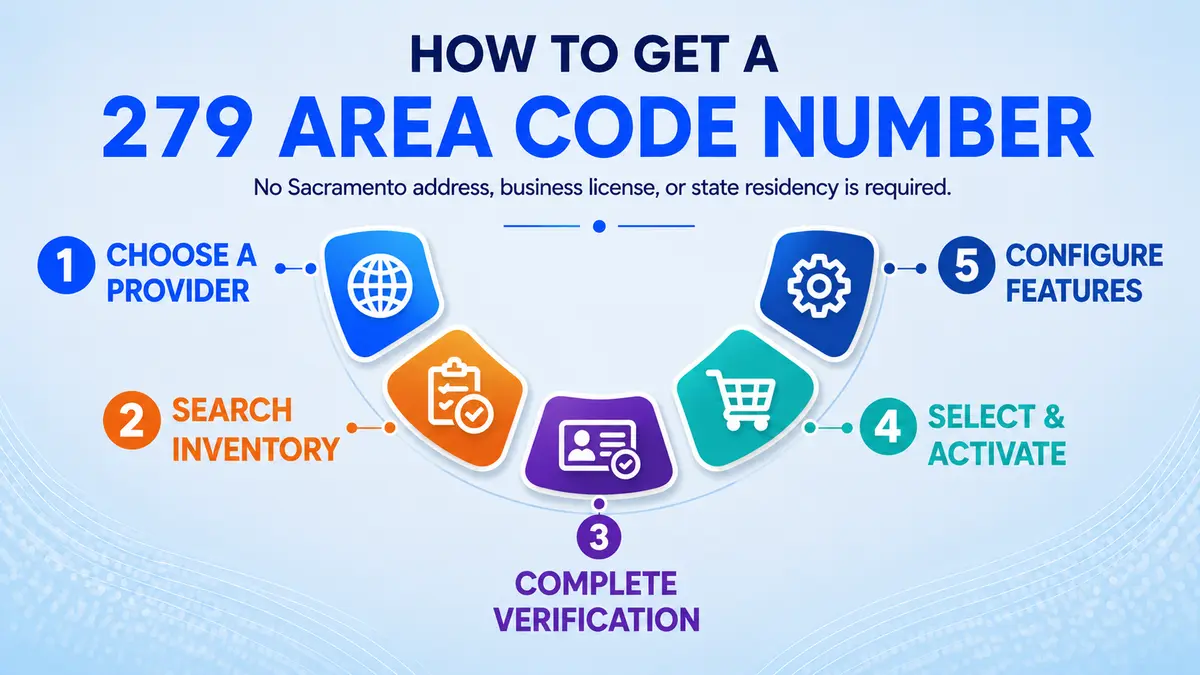
- Choose a provider that lists 279 as an available area code for new virtual or VoIP numbers.
- Search that provider's inventory by area code or by city inside the Sacramento footprint.
- Complete any identity or business verification the provider requires before issuing a number.
- Select and activate the specific 279 number from the available list.
- Configure call forwarding, voicemail, and routing before publishing the number anywhere public.
Anyone holding a 916 or 279 number elsewhere can typically port it in for free, and most providers let a business keep an older number active alongside the new one while it ramps up. None of this needs a Sacramento mailing address — a properly built system routes a California number through real wholesale VoIP infrastructure to a laptop, mobile app, or desk phone anywhere in the world.
Why Businesses Choose a Local 279 Number
A local area code still changes how a call gets answered. Recipients are measurably more likely to pick up a number matching their own region than one that looks unfamiliar or long-distance, which is the whole reason a 279 number is worth having for a business serving Sacramento customers without sitting inside city limits.
The bigger shift is who's buying these numbers now. A decade ago, a local number implied a local office. Today, a support team in Manila or a founder three time zones away can activate a 279 line and sound like they're calling from Midtown. That gap between where a business sits and where its number appears is no longer a workaround; for a growing share of buyers, it's simply the default.
Conclusion
916 and 279 cover identical ground; 279 exists because 916 ran short on numbers, not because the region changed. Both codes take all ten digits on every call, both bill the same, and neither is replacing the other. The one habit worth keeping is dialing all ten digits, no exceptions. That single rule accounts for nearly every dropped call tied to the overlay.
Getting a 279 number doesn't require living in Sacramento, or in the United States at all. Providers such as TKOS route these numbers across 500+ carrier interconnects on a 99.9% uptime SLA. That network can issue a 279 line to a business anywhere and have it live within minutes. The number's origin changes; the ten-digit habit that keeps it ringing correctly does not.
Popular international calling destinations