Introduction
Every phone call begins with a three-digit area code that tells the network where to send it. Washington, D.C. carried a single code, 202, for eight decades. That changed with 771, a new overlay stacked on top of 202. With nearly eight decades as the District's only prefix, 202 became one of the most recognizable area codes in the country.
Area codes carry more than geography. Some ranges serve toll-free lines, some emergency service, some future growth. 771 is an overlay, not a split — it doesn't carve new zones. It builds on 202, in place since 1947. Anyone dialing into or out of the District now uses ten digits regardless of which prefix their number carries.
What Is the 771 Area Code?
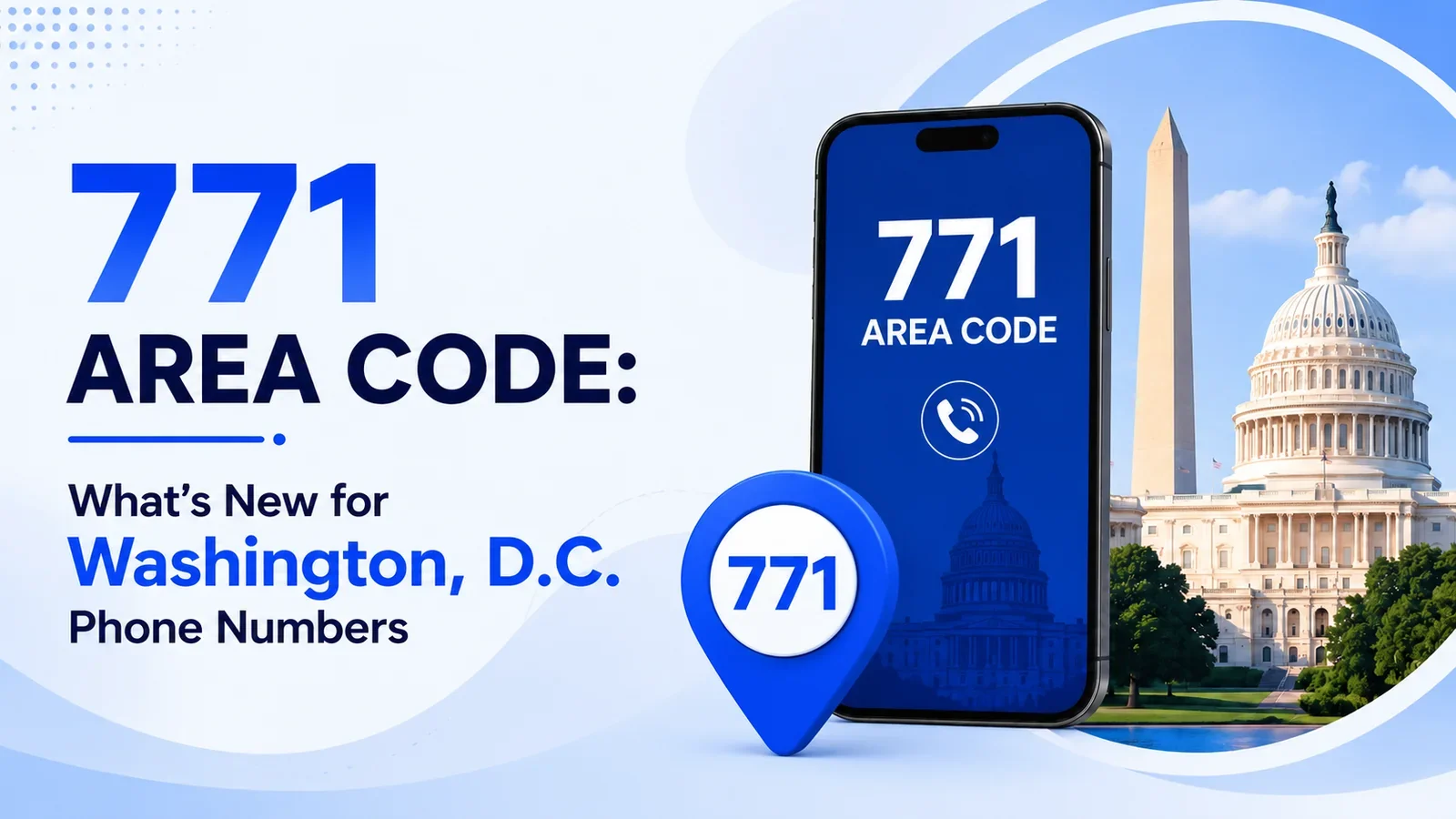
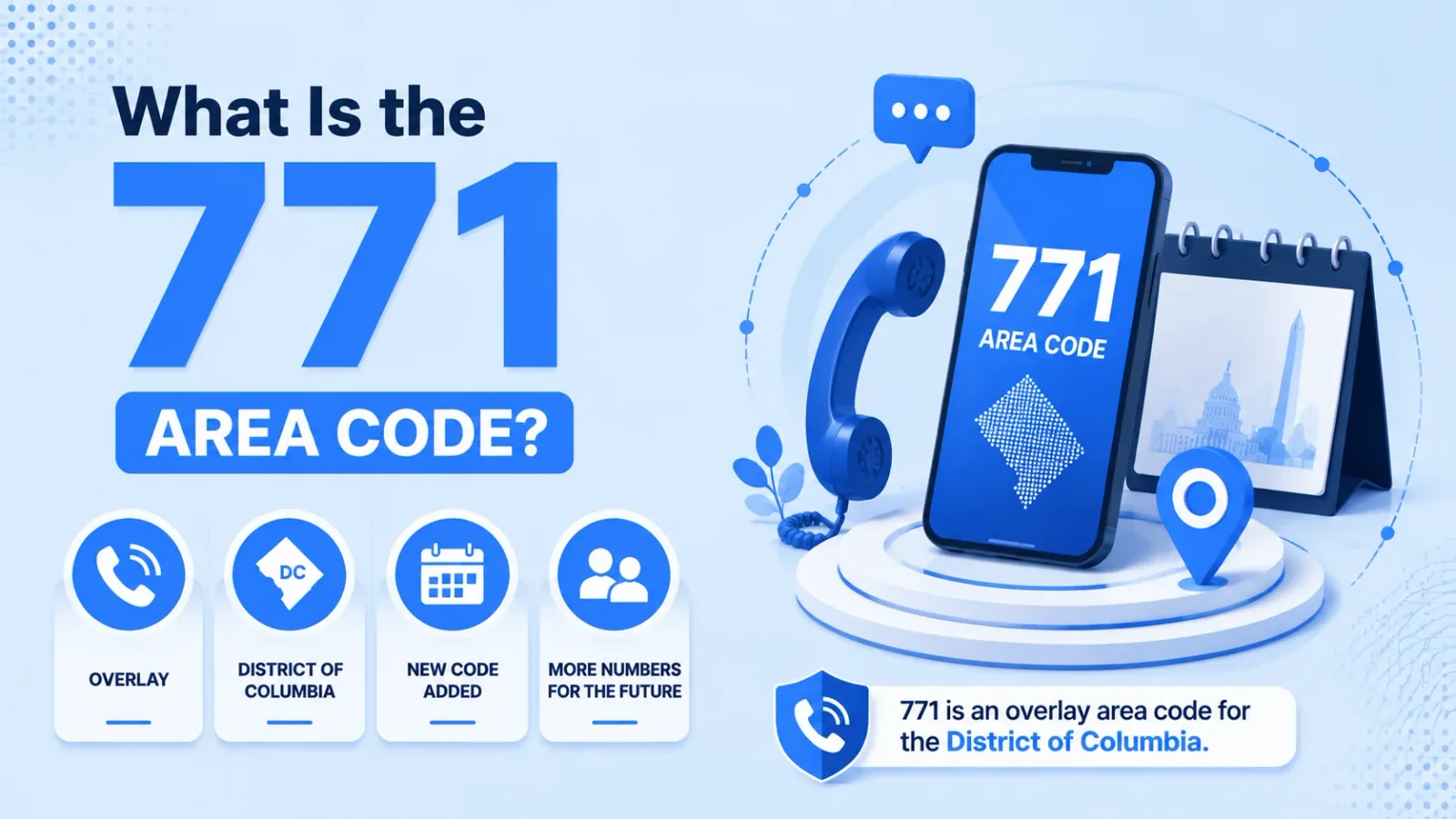
The 771 area code is an overlay for the District of Columbia — it works alongside 202, not instead of it. A rowhouse in Capitol Hill and a federal building on Independence Avenue share one service area, whether the number starts with 202 or 771. NANPA announced the 771 overlay in October 2020, after projections showed 202 would run out of numbers by late 2022, and regulators chose overlay over split — simpler than redrawing boundaries.
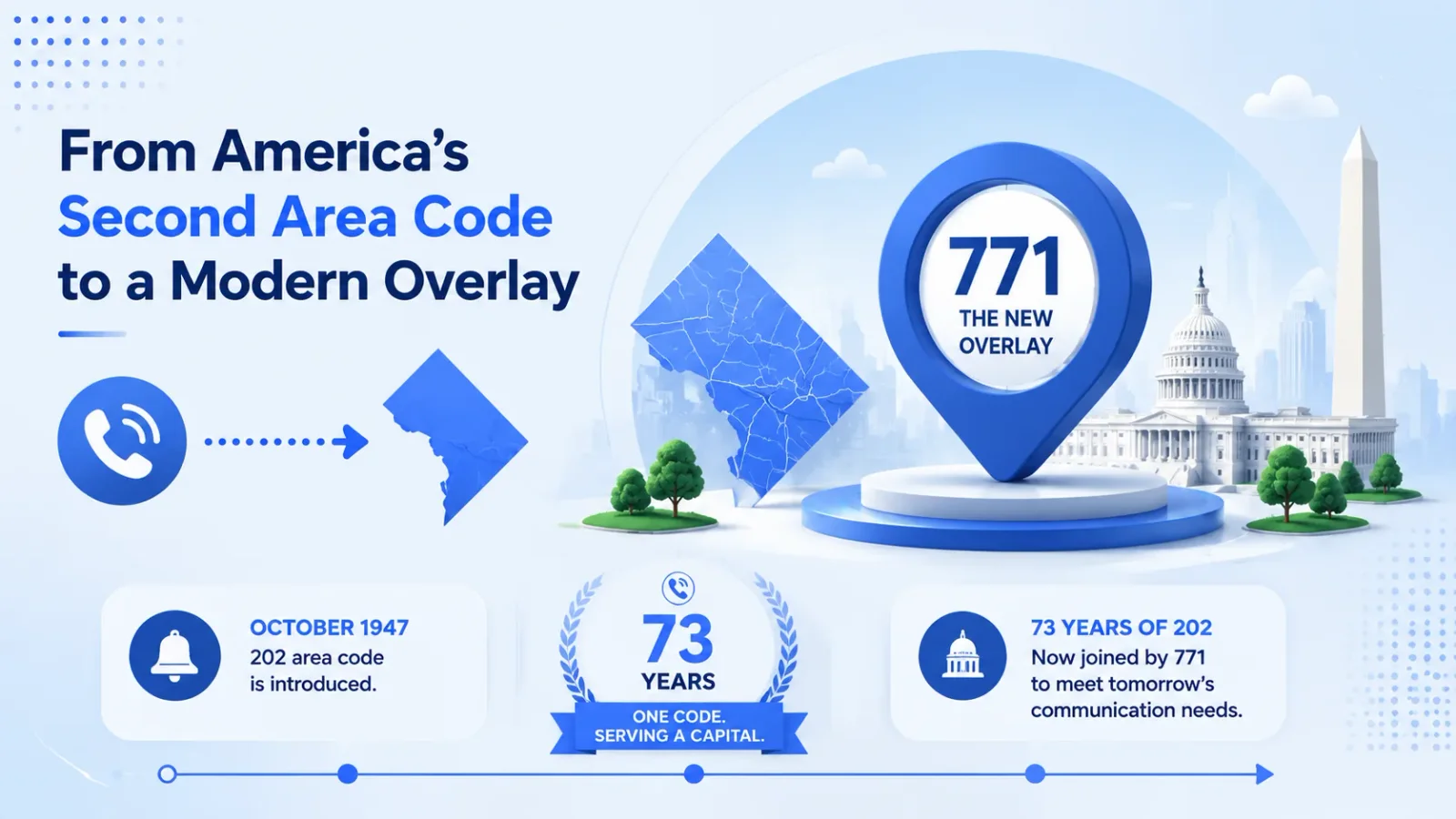
From America's Second Area Code to a Modern Overlay
Washington, D.C.'s phone history starts on day one of the modern area code system. AT&T and the Bell System rolled out the North American Numbering Plan in October 1947 — New Jersey's 201 went first, and 202 followed as the second area code ever activated. For 73 years, 202 was the only area code the District needed, a long run next to fast-growing South Florida or Southern California. Mobile phones, fax lines, VoIP trunks, and machine-to-machine links finally changed that.
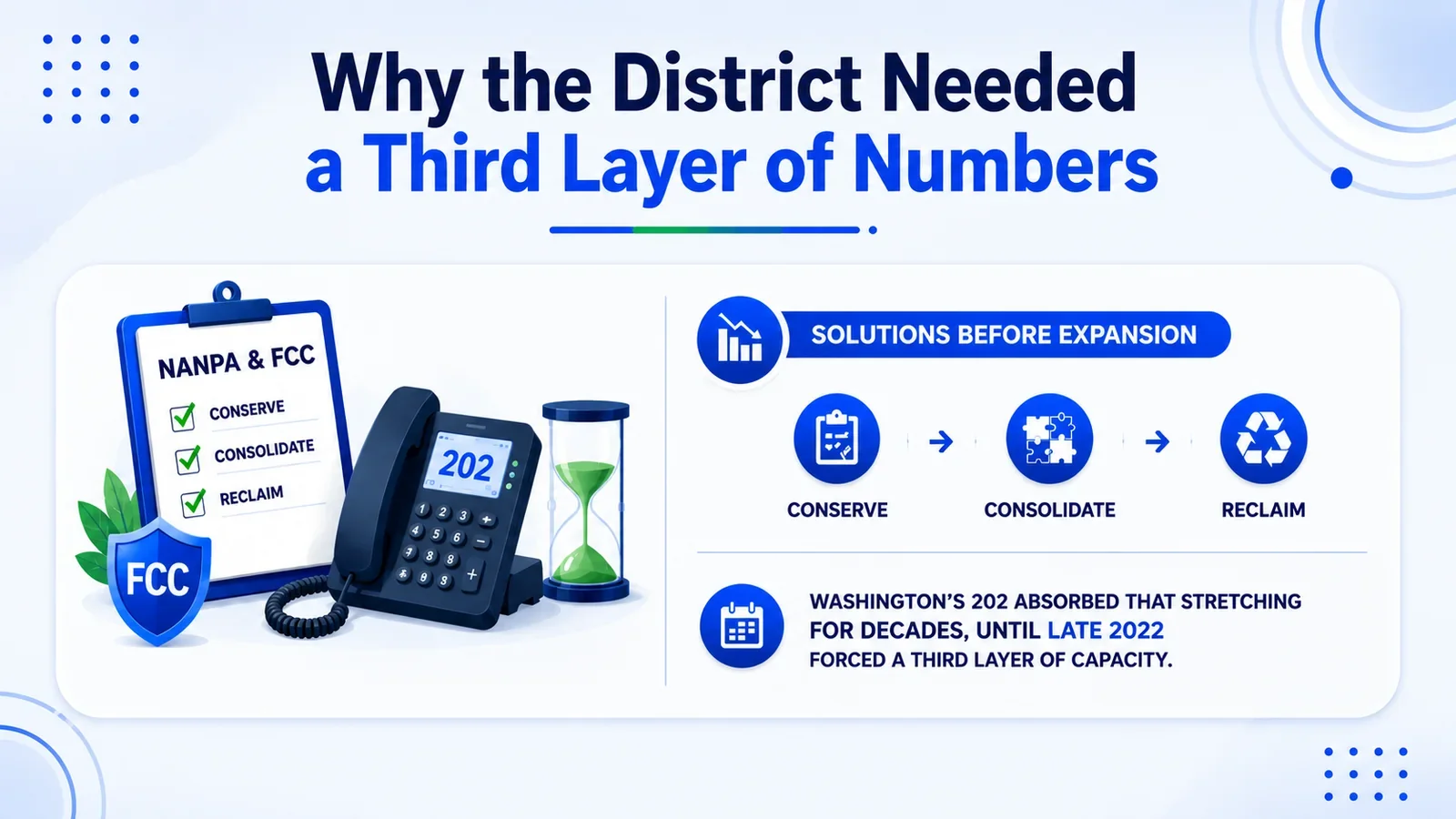
Why the District Needed a Third Layer of Numbers
Regulators don't jump straight from running low on numbers to assigning a new area code. NANPA and the FCC push conservation first — consolidating rate centers, reclaiming inactive ranges. Washington's 202 absorbed that stretching for decades, until its projected exhaustion date of late 2022 forced action. Washington's local calling zone is unusual too: a call from the District reaches Maryland under 301, 240, and 227, and Northern Virginia under 703 and 571 — no long-distance charges. Adding 771 on top of 202 didn't change that.
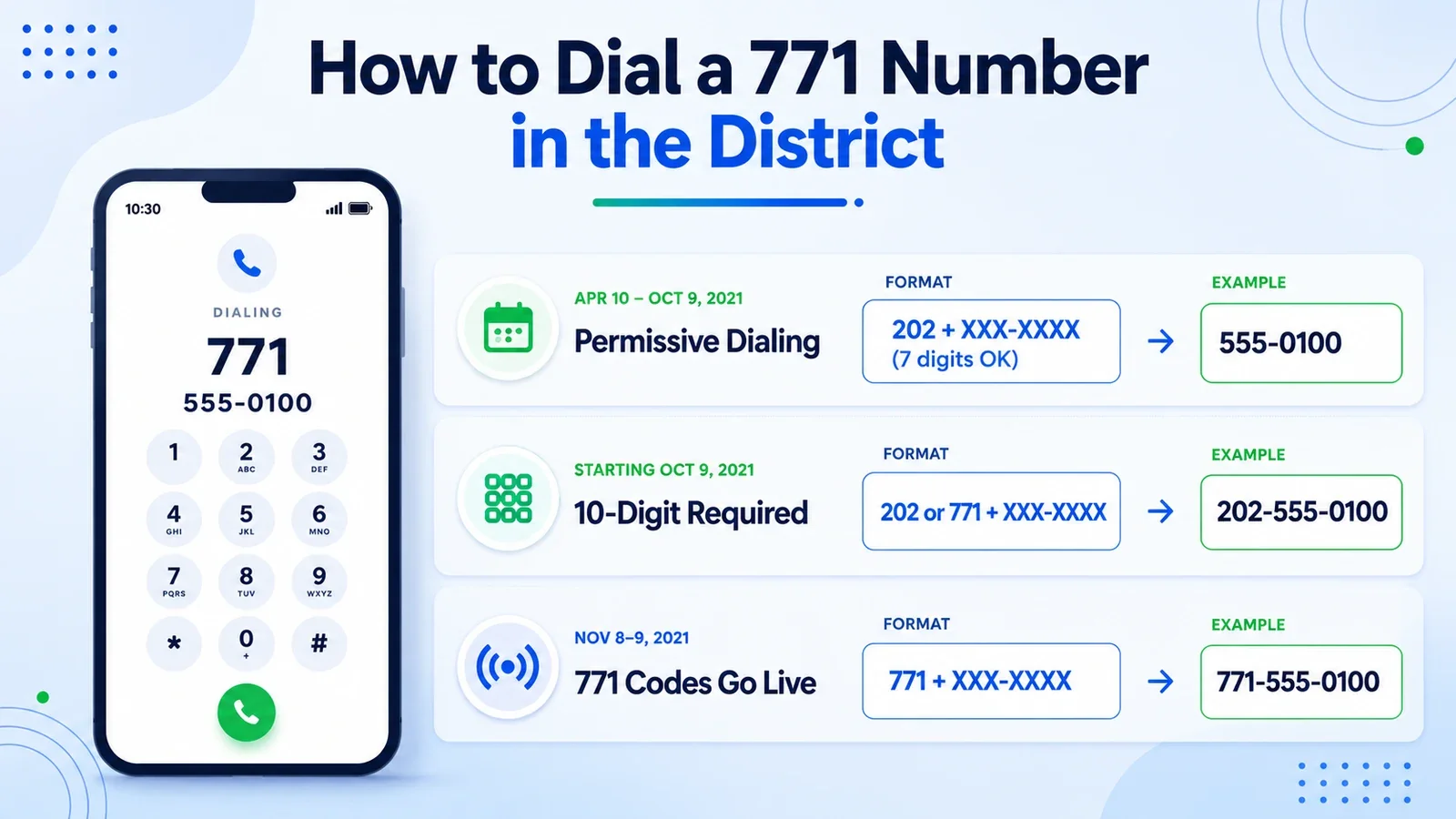
How to Dial a 771 Number in the District
Because 771 shares its footprint with 202, dialing rules were set before the code arrived. A permissive dialing period ran April 10 to October 9, 2021, letting residents dial with just seven digits. After that, 10-digit dialing became mandatory, and the first 771 codes went live November 8—9, 2021.
- Local call: Dial 771 + the seven-digit number (10-digit dialing is mandatory across the entire 202/771 overlay).
- Domestic long-distance: Dial 1 + 771 + the seven-digit number.
- From Canada: Dial 1 + 771 + the seven-digit number (same NANP framework).
- From the UK: Dial 00 + 1 + 771 + the seven-digit number.
- From most other countries: Dial your international access code + 1 + 771 + the seven-digit number.
Getting the sequence right matters more here than most places. A misdialed digit on a call meant for a federal office or embassy switchboard doesn't just fail — it can land inside a building with hundreds of extensions. Double-check all ten digits before dialing, and if you run a PBX or auto-attendant in Washington, confirm 771 is loaded into your dial plan.
Why Federal Offices, Embassies, and Advocacy Groups Want a D.C. Number
Few regions match Washington's institutional density — federal headquarters, a huge concentration of foreign embassies, and some of the biggest advocacy and lobbying firms anywhere. For these organizations, a 202 or 771 number isn't just a phone line. It's a credibility signal that the office sits where policy gets made.
A virtual number makes this achievable without leasing office space in the District, some of the priciest real estate in the country. A policy shop in Chicago or a non-profit in Ohio can hold a 771 DID and route it to whoever's covering Capitol Hill — no District lease required. The same overlay-driven growth shows up far from the Beltway: businesses expanding into New York's Hudson Valley have been claiming numbers in the 329 area code as that region's own overlay matures, echoing the demand that pushed the District from 202 to 771.
Protecting a 771 Number's Reputation and TCPA Compliance
Carriers monitor call patterns on every prefix, and 771 draws extra scrutiny from the District's political and robocall pressure. Call authentication cryptographically signs outbound calls so receiving networks can confirm caller ID hasn't been faked — a line with an unusually high volume of short calls or fast-rising spam reports risks getting throttled. Keep volumes reasonable and stay within TCPA rules.
Register a new 771 number with major caller-ID platforms early — before the first outbound campaign — to build a clean record from day one. For federal offices, embassies, and advocacy groups, that upfront work isn't optional. It's the difference between answered and flagged as spam.
How to Get a 771 Area Code Number
Claiming a 771 number doesn't require a lease on K Street or a trip to the District at all. TKOS provisions Washington numbers the same way it provisions any other market: search, select, and activate from a browser, with the DID live and taking calls the same day. TKOS customers expanding into nearby markets often also set up numbers in the 227 area code, just across the District line in Maryland, to cover both jurisdictions from a single dashboard. Others building out full Mid-Atlantic coverage add a line in the 686 area code for Richmond, Virginia, rounding out the DMV region from one account.
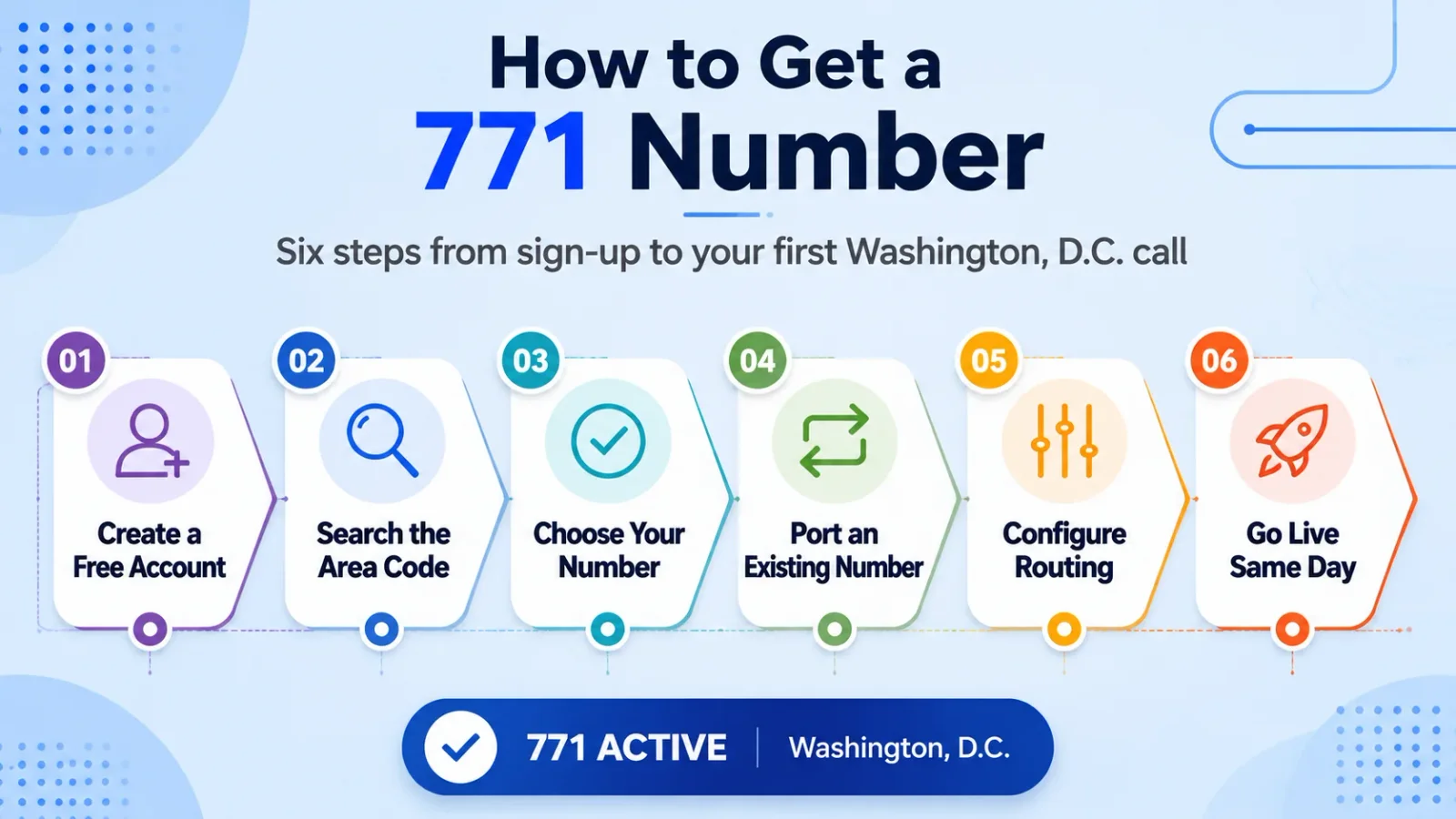
- Create a free TKOS account: Sign up online in a few minutes — no contract or hardware purchase required to start.
- Search the 771 area code: Filter the number picker by area code and browse the available District of Columbia inventory.
- Choose or request a specific number: Pick a memorable DID from the list, or ask support to hunt for a vanity sequence.
- Port an existing number, if switching providers: Submit a port request and keep the number you already use while the transfer completes in the background.
- Configure routing and forwarding: Point the new 771 line to a desk phone, softphone, auto-attendant, or a team ring group.
- Go live: Publish the number, register it with caller-ID platforms, and start taking Washington calls immediately.
Most accounts are fully configured within an afternoon, well ahead of any deadline tied to a press cycle or a filing date. Because the number is virtual, it keeps working even if the physical office changes address within the District.
Conclusion
771 is more than a prefix stacked on an old one — it reflects demand from federal agencies, embassies, and advocacy groups. It's rooted in the same NANP framework that made 202 the second area code in 1947. For residents, that means dialing all ten digits; for offices, a genuine Washington presence with no lease.
Basic phone safety still applies no matter how official a number looks. Never hand over account details or personal information to an unexpected caller, even one showing a trusted 202 or 771 prefix. Send anything suspicious to voicemail and report fraud to your carrier or the FCC.
Popular international calling destinations